Overview
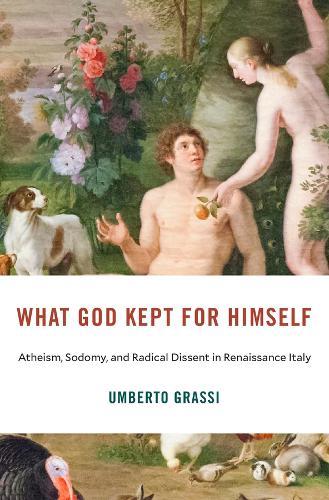
Between the sixteenth and eighteenth centuries, a series of highly controversial Inquisition trials took place throughout the Italian peninsula. The defendants were all accused of the same heresy: claiming that Adam and Eve's original sin had been committing sodomy, a ""celestial"" pleasure reserved for God alone. Such claims were not merely subversive sexual innuendo. Rather, they were the most radical expressions of a much broader critique-one that not only targeted repressive sexual taboos but also denounced the corruption of the Church, questioned the authority of the pope, and suggested that organized religion itself was a hoax designed to maintain elite power. As Umberto Grassi shows, these dissenters' beliefs about sexual freedom came to play a crucial role in the development of skeptical and atheistic positions. Many of the accused argued that, by violating God's exclusive right to engage in sodomy, Adam and Eve dared to make themselves like gods. This view, which led to charges of atheism, radicalized a more widely held belief that the ruling classes banned sodomy to prevent the masses from enjoying it. In turn, such heresies fueled indictments of Christian morality as an all-too-human invention, whose purpose was to reinforce a social order in which the ruling classes controlled both sexuality and religious truth. Tracing a radical tradition of thought on trial, What God Kept for Himself establishes the firm relationship between sexual nonconformity and religious dissent in the early modern Mediterranean world.
Full Product Details
Author: Umberto Grassi
Publisher: Harvard University Press
Imprint: Harvard University Press
Dimensions:
Width: 15.60cm
, Height: 1.50cm
, Length: 23.50cm
Weight: 0.512kg
ISBN: 9780674302860
ISBN 10: 0674302869
Pages: 240
Publication Date: 17 February 2026
Audience:
College/higher education
,
Postgraduate, Research & Scholarly
Format: Hardback
Publisher's Status: Forthcoming
Availability: Awaiting stock

Reviews
This wide-ranging, fascinating, and provocative book explores the early modern history of ‘radical unbelief.’ Considering the views of not only philosophers and theologians but also humble parish priests, laborers, and orphan girls, Grassi traces the belief that Adam and Eve’s original sin was actually sexual intercourse—and according to some, specifically sodomy. In the process, he impressively restores the complexity of a largely hidden past of dissent and irreligiousness. -- Guido Ruggiero, author of <i>Love and Sex in the Time of Plague</i> A groundbreaking examination of early modern religious dissent. In this riveting book, Umberto Grassi delves into the radical belief that Adam and Eve’s disobedience involved an act of sodomy. Drawing on a rich array of sources, he illuminates how this profoundly subversive idea permeated both popular culture and learned libertine circles in early modern Italy and far beyond. A must-read. -- Konrad Eisenbichler, editor of <i>Masculinities and Representation: The Eroticized Male in Early Modern Italy and England</i> For the religious dissenters in this fascinating study, the forbidden fruit in the Garden of Eden was not an apple offered by a snake, but rather the buttocks, offered in an act that God had meant to keep for himself. Grassi traces this irreverent and radical idea among ordinary shopkeepers, learned philosophers, and even nuns, ultimately linking it to broader critiques of social hierarchies and church power.” -- Merry E. Wiesner-Hanks, coeditor of <i>The Cambridge World History of Sexualities</i> This is a work of great erudition and imagination that ranges confidently from classical antiquity to the Enlightenment. Through meticulous research, Umberto Grassi has excavated numerous cases of individuals who held the shocking belief that the fall of Adam and Eve resulted from an act of sodomy committed in the Garden of Eden. Grassi makes a compelling argument that tropes of sexual nonconformity functioned as a form of radical religious dissent, one that ultimately contributed to the rise of early modern skepticism and unbelief. -- Eric R. Dursteler, author of <i>Renegade Women: Gender, Identity, and Boundaries in the Early Modern Mediterranean</i>
This wide-ranging, fascinating, and provocative book explores the early modern history of ‘radical unbelief.’ Considering the views of not only philosophers and theologians but also humble parish priests, laborers, and orphan girls, Grassi traces the belief that Adam and Eve’s original sin was actually sexual intercourse—and according to some, specifically sodomy. In the process, he impressively restores the complexity of a largely hidden past of dissent and irreligiousness. -- Guido Ruggiero, author of <i>Love and Sex in the Time of Plague</i> A ground-breaking examination of early modern religious dissent. In this riveting book, Umberto Grassi delves into the radical belief that Adam and Eve’s disobedience involved an act of sodomy. Drawing on a rich array of sources, he illuminates how this profoundly subversive idea permeated both popular culture and learned libertine circles in early modern Italy and far beyond. A must-read. -- Konrad Eisenbichler, author of <i>Masculinities and Representation: The Eroticized Male in Early Modern Italy and England</i> For the religious dissenters in this fascinating study, the forbidden fruit in the Garden of Eden was not an apple offered by a snake, but rather the buttocks, offered in an act that God had meant to keep for himself. Grassi traces this irreverent and radical idea among ordinary shopkeepers, learned philosophers, and even nuns, ultimately linking it to broader critiques of social hierarchies and church power.” -- Merry E. Wiesner-Hanks, coeditor of <i>The Cambridge World History of Sexualities</i> This is a work of great erudition and imagination that ranges confidently from classical antiquity to the Enlightenment. Through meticulous research, Umberto Grassi has excavated numerous cases of individuals who held the shocking belief that the fall of Adam and Eve resulted from an act of sodomy committed in the Garden of Eden. Grassi makes a compelling argument that tropes of sexual nonconformity functioned as a form of radical religious dissent, one that ultimately contributed to the rise of early modern skepticism and unbelief. -- Eric R. Dursteler, author of <i>Renegade Women: Gender, Identity, and Boundaries in the Early Modern Mediterranean</i>
This is a work of great erudition and imagination that ranges confidently from classical antiquity to the Enlightenment. Through meticulous research, Umberto Grassi has excavated numerous cases of individuals who held the shocking belief that the fall of Adam and Eve resulted from an act of sodomy committed in the Garden of Eden. Grassi makes a compelling argument that tropes of sexual nonconformity functioned as a form of radical religious dissent, one that ultimately contributed to the rise of early modern skepticism and unbelief. -- Eric R. Dursteler, author of <i>Renegade Women: Gender, Identity, and Boundaries in the Early Modern Mediterranean</i> A ground-breaking examination of early modern religious dissent. In this riveting book, Umberto Grassi delves into the radical belief that Adam and Eve’s disobedience involved an act of sodomy. Drawing on a rich array of sources, he illuminates how this profoundly subversive idea permeated both popular culture and learned libertine circles in early modern Italy and far beyond. A must-read. -- Konrad Eisenbichler, author of <i>Masculinities and Representation: The Eroticized Male in Early Modern Italy and England</i>
This is a work of great erudition and imagination that ranges confidently from classical antiquity to the Enlightenment. Through meticulous research, Umberto Grassi has excavated numerous cases of individuals who held the shocking belief that the fall of Adam and Eve resulted from an act of sodomy committed in the Garden of Eden. Grassi makes a compelling argument that tropes of sexual nonconformity functioned as a form of radical religious dissent, one that ultimately contributed to the rise of early modern skepticism and unbelief. -- Eric R. Dursteler, author of <i>Renegade Women: Gender, Identity, and Boundaries in the Early Modern Mediterranean</i>
Author Information
Umberto Grassi is an independent scholar based in Pisa, Italy. He is the author of Bathhouses and Riverbanks: Sodomy in a Renaissance Republic as well as the editor of Cursed Blessings: Sex and Religious Radical Dissent in Early Modern Europe and Mediterranean Crossings: Sexual Transgressions in Islam and Christianity.