Overview
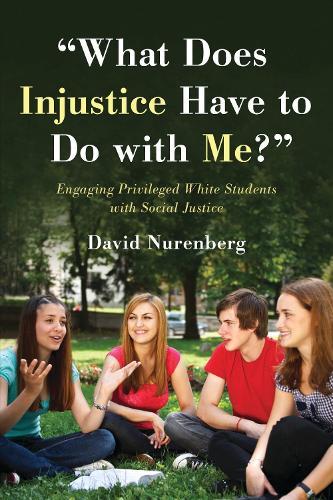
Why should we care about the education of privileged white students? Conversations about education in America focus near-exclusively on underprivileged, majority-minority schools for many important reasons. What Does Injustice Have to Do With Me? , however, argues that such efforts cannot succeed in creating a more just and equitable society without also addressing the students who benefit from America’s educational, economic and racial inequities. These young people grow up to wield disproportionate power and influence, yet emerge undereducated and poorly prepared to navigate, let alone shape, our increasingly diverse country. David Nurenberg weaves together narrative from his twenty years of suburban teaching with relevant research in education and critical race theory to provide practical, hands-on strategies for educators dealing with challenges unique to high-powered suburban, urban and independent schools: affluent myopia, white fragility, the empathy gap, overinvolved parents, overcautious administrators and an “if it isn’t broke, don’t fix it” mentality. Despite high test scores and college acceptances, many schools serving affluent white students are indeed broken. Social justice education for privileged white students is not only critical for our society, but also for helping those students themselves emerge from a culture of anxiety and cynicism to find meaning, purpose and self-confidence as activist allies.
Full Product Details
Author: David Nurenberg
Publisher: Bloomsbury Publishing Plc
Imprint: Rowman & Littlefield
Dimensions:
Width: 16.10cm
, Height: 2.40cm
, Length: 23.30cm
Weight: 0.517kg
ISBN: 9781475853735
ISBN 10: 1475853734
Pages: 234
Publication Date: 15 May 2020
Audience:
Professional and scholarly
,
Professional & Vocational
Format: Hardback
Publisher's Status: Active
Availability: Manufactured on demand

We will order this item for you from a manufactured on demand supplier.
Reviews
...at the present moment, both politically timely and morally important. -- Jonathan Kozol, National Book Award winner and author of ""Savage Inequalities"" and ""Death at an Early Age"" Nurenberg reminds us that White, upper middle class students also have a stake in justice and equity in a society, indeed in a world, that reflects increasing economic, social, educational, and political disparity. More important, What Does Injustice Have to Do with Me? speaks directly to the role of our teachers in ensuring the fundamentals of democracy are taught to and understood by ALL students. -- Gloria Ladson-Billings, President of the National Academy of Education, member of the American Academy of Arts and Sciences, and Professor Emerita in the Department of Curriculum and Instruction at the University of Wisconsin
...at the present moment, both politically timely and morally important.--Jonathan Kozol, National Book Award winner and author of Savage Inequalities and Death at an Early Age With compassion, nuance, and a critical perspective, Nurenberg draws on research and his own experience to help fill a gap in the educational literature--how to educate privileged white students about social justice. He offers extensive, clear, and practical activities and suggestions for how to engage these students (and others). Written in an engaging, personal style, this book is a welcome and needed resource for educators working with white privileged students.--Diane J. Goodman, diversity and social justice training and consulting; author of Promoting Diversity and Social Justice: Educating People from Privileged Groups We need this book! Teaching starts with understanding the learner and that requires caring about the so-called privileged as well as the disadvantaged. Nurenberg got me caring, too.--Deborah Meier, former senior scholar at New York University's Steinhardt School of Education; MacArthur Award-winning founder of the Central Park East Schools in New York and the Mission Hill School in Boston; author of The Power of Their Ideas: Lessons for America from a Small School in Harlem and In Schools we Trust ; co-founder of the Coalition of Essential Schools Nurenberg reminds us that White, upper middle class students also have a stake in justice and equity in a society, indeed in a world, that reflects increasing economic, social, educational, and political disparity. More important, What Does Injustice Have to Do with Me? speaks directly to the role of our teachers in ensuring the fundamentals of democracy are taught to and understood by ALL students.--Gloria Ladson-Billings, President of the National Academy of Education, member of the American Academy of Arts and Sciences, and Professor Emerita in the Department of Curriculum and Instruction at the University of Wisconsin, and author of The Dreamkeepers: Successful Teachers of African American Children and Beyond the Big House: African American Educators on Teacher Education For any educator concerned about how to engage affluent White students in critical conversations about questions of social justice, past and present, look no further than David Nurenberg's very helpful book. Full of creative teaching examples intended to foster critical thinking, it is a valuable resource for an important audience of educators and their students.--Beverly Daniel Tatum, president of Spelman College, and author of Why are All the Black Kids Sitting Together in the Cafeteria? and Other Conversations about Race In the 21st century movement to penetrate the limiting lens of privilege, this resource offers a robust range of fresh ideas and tactics. Through storytelling, sample classroom activities, and pedagogical framing David Nurenberg demonstrates how engaging privileged white students in an exploration of power and privilege is far more than knowledge acquisition; the process itself demands of us the critical inquiry skills and self-awareness that makes us better students, teachers, friends, and citizens.--Debby Irving, author of Waking Up White, and Finding Myself in the Story of Race
...at the present moment, both politically timely and morally important.--Jonathan Kozol, National Book Award winner and author of Savage Inequalities and Death at an Early Age Nurenberg reminds us that White, upper middle class students also have a stake in justice and equity in a society, indeed in a world, that reflects increasing economic, social, educational, and political disparity. More important, What Does Injustice Have to Do with Me? speaks directly to the role of our teachers in ensuring the fundamentals of democracy are taught to and understood by ALL students.--Gloria Ladson-Billings, President of the National Academy of Education, member of the American Academy of Arts and Sciences, and Professor Emerita in the Department of Curriculum and Instruction at the University of Wisconsin
David Nurenberg’s What Does Injustice Have to Do With Me? offers a thoughtful, reasoned, and pragmatic approach to teaching privileged white students about social injustice and communicating to them why it is actually in their best interest to help dismantle their own privilege. . . . By teaching other viewpoints and engaging privileged white students with the teachings of social justice, we are expanding their lenses of understanding the world around them and are developing their critical thinking. The efforts of this book are worthwhile, and it will constitute a helpful part of educators’ social justice “toolkit” for reference and inspiration to do what is right rather than what is easy. * Teachers College Record * ...at the present moment, both politically timely and morally important. -- Jonathan Kozol, National Book Award winner and author of ""Savage Inequalities"" and ""Death at an Early Age"" Nurenberg reminds us that White, upper middle class students also have a stake in justice and equity in a society, indeed in a world, that reflects increasing economic, social, educational, and political disparity. More important, What Does Injustice Have to Do with Me? speaks directly to the role of our teachers in ensuring the fundamentals of democracy are taught to and understood by ALL students. -- Gloria Ladson-Billings, former Kellner Family Distinguished Professor of Urban Education in the Department of Curriculum and Instruction at the University of Wisconsin-Madison With compassion, nuance, and a critical perspective, Nurenberg draws on research and his own experience to help fill a gap in the educational literature—how to educate privileged white students about social justice. He offers extensive, clear, and practical activities and suggestions for how to engage these students (and others). Written in an engaging, personal style, this book is a welcome and needed resource for educators working with white privileged students. -- Diane J. Goodman, diversity and social justice training and consulting; author of ""Promoting Diversity and Social Justice: Educating People from Privileged Groups"" We need this book! Teaching starts with understanding the learner and that requires caring about the so-called privileged as well as the disadvantaged. Nurenberg got me caring, too. -- Deborah Meier, MacArthur Award-winning founder of the Central Park East Schools in New York and the Mission Hill School in Boston For any educator concerned about how to engage affluent White students in critical conversations about questions of social justice, past and present, look no further than David Nurenberg’s very helpful book. Full of creative teaching examples intended to foster critical thinking, it is a valuable resource for an important audience of educators and their students. -- Beverly Daniel Tatum, PhD, president of Spelman College, and author of ""Why are All the Black Kids Sitting Together in the Cafeteria?: And Other Conversations about Race"" In the 21st century movement to penetrate the limiting lens of privilege, this resource offers a robust range of fresh ideas and tactics. Through storytelling, sample classroom activities, and pedagogical framing David Nurenberg demonstrates how engaging privileged white students in an exploration of power and privilege is far more than knowledge acquisition; the process itself demands of us the critical inquiry skills and self-awareness that makes us better students, teachers, friends, and citizens. -- Debby Irving, author of ""Waking Up White, and Finding Myself in the Story of Race""
...at the present moment, both politically timely and morally important.--Jonathan Kozol, National Book Award winner and author of Savage Inequalities and Death at an Early Age Nurenberg reminds us that White, upper middle class students also have a stake in justice and equity in a society, indeed in a world, that reflects increasing economic, social, educational, and political disparity. More important, What Does Injustice Have to Do with Me? speaks directly to the role of our teachers in ensuring the fundamentals of democracy are taught to and understood by ALL students.--Gloria Ladson-Billings, President of the National Academy of Education, member of the American Academy of Arts and Sciences, and Professor Emerita in the Department of Curriculum and Instruction at the University of Wisconsin With compassion, nuance, and a critical perspective, Nurenberg draws on research and his own experience to help fill a gap in the educational literature--how to educate privileged white students about social justice. He offers extensive, clear, and practical activities and suggestions for how to engage these students (and others). Written in an engaging, personal style, this book is a welcome and needed resource for educators working with white privileged students.--Diane J. Goodman, diversity and social justice training and consulting; author of Promoting Diversity and Social Justice: Educating People from Privileged Groups We need this book! Teaching starts with understanding the learner and that requires caring about the so-called privileged as well as the disadvantaged. Nurenberg got me caring, too.--Deborah Meier, former senior scholar at New York University's Steinhardt School of Education; MacArthur Award-winning founder of the Central Park East Schools in New York and the Mission Hill School in Boston; author of The Power of Their Ideas: Lessons for America from a Small School in Harlem and In Schools we Trust ; co-founder of the Coalition of Essential Schools
Author Information
David Nurenberg, Ph.D. is an associate professor, educational consultant, and writer in the Boston area who has taught courses at the high school, undergraduate, and graduate level for over 20 years. His writing has appeared in Education Week, The Harvard Educational Review, NCTE’s English Education, High School Journal, and elsewhere. He is the host of the podcast Ed Infinitium.