Overview
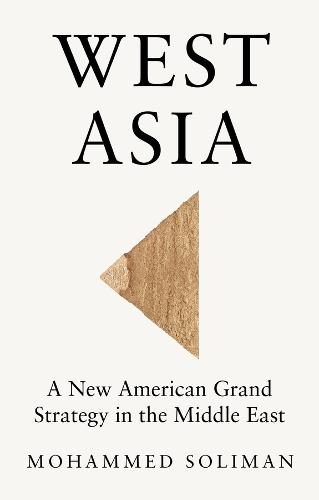
At the end of the twentieth century, the United States birthed a new Middle East order built on realpolitik and a stable balance of power. Three decades later that order has been destroyed. America's disastrous invasion of Iraq along with the failed Arab Spring created a vacuum that has allowed revisionist powers to extend their influence across the region. In West Asia, Mohammed Soliman argues that it is time for the United States to move decisively away from nation-building and get back to the business of order-building. To do so will require zooming out, in both geographical and historical terms, to build a new regional order across 'West Asia' – from the Middle East to South Asia, connecting Europe to the Indo-Pacific via the Mediterranean and Red Seas. Working with India, Italy, Greece, France, Saudi Arabia, Egypt, Japan, the UK and the United Arab Emirates, among others, he shows how the U.S. could lock in a new balance of power in the Eurasian supercontinent to offset China and Russia's efforts to disrupt the status quo and create a rival system. This new strategy rests on three layered coalitions — geostrategic, hard-power, and geo-technological — that together can anchor a stable order stretching from the Mediterranean to the Indian Ocean. But this will require a fundamental shift in U.S. grand strategy, with 'West Asia' at its core. The Middle East is no more. Welcome to West Asia.
Full Product Details
Author: Mohammed Soliman (Middle East Institute, Washington, DC)
Publisher: John Wiley and Sons Ltd
Imprint: Polity Press
Dimensions:
Width: 15.10cm
, Height: 2.30cm
, Length: 22.80cm
Weight: 0.397kg
ISBN: 9781509568383
ISBN 10: 1509568387
Pages: 272
Publication Date: 28 November 2025
Audience:
Professional and scholarly
,
Professional & Vocational
Format: Paperback
Publisher's Status: Active
Availability: Out of stock

The supplier is temporarily out of stock of this item. It will be ordered for you on backorder and shipped when it becomes available.
Reviews
""In West Asia, Mohammed Soliman redraws the map, tracing the connections from South Asia through the Middle East to Southern Europe ... Agree or disagree with his analysis, this is a work to be reckoned with."" Richard Fontaine, CEO, Center for a New American Security ""West Asia provides the road map we need to effectively advance America's national interests."" Geoffrey Ross Pyatt, former assistant secretary of state for energy resources and former ambassador to Greece and Ukraine ""This is the strategic blueprint for the India–Middle East–Europe Corridor, written by the policy thinker who was among the first to see this geoeconomic order emerging and helped shape its intellectual foundation. West Asia offers a powerful vision of how India and the Gulf are reshaping the global map and how U.S. strategy must adapt in response."" Richard Rossow, Chair on India and Emerging Asia Economics at the Center for Strategic and International Studies (CSIS) ""A groundbreaking book examining how the shift in global economic and political gravity from the Euro-Atlantic to the Indo-Pacific basins requires us to rethink our notions of the 'Middle East' and 'South Asia' in favor of a 'West Asia' perspective situated along an emerging Indo-Abrahamic corridor."" Nikolas K. Gvosdev, Director, National Security Program, Foreign Policy Research Institute ""From Delhi to Athens, from London to Riyadh, a new arc of strategic and economic connectivity is reshaping the global order. West Asia is the first book to map this transformation with the clarity it demands. For business leaders, strategists, and anyone interested in how power and markets will flow in the decades ahead, this is essential reading."" Manas Chawla, Founder and CEO, London Politica ""Soliman captures what many policymakers have yet to grasp. The Middle East is no longer a standalone theater; it is the connective tissue of a new geopolitical era stretching from India to the Mediterranean. West Asia reframes the region not as a problem to solve, but as a platform to build upon. A timely, provocative, and necessary intervention."" Firas Maksad, Managing Director, Middle East and North Africa, Eurasia Group ""The most insightful books on geopolitics go beyond borders and categories, revealing the deeper forces that shape our world. Mohammad Soliman does just that, challenging conventional wisdom and uncovering the complex political, social, and economic dynamics that transcend maps and headlines. Through sharp analysis and a global perspective that geo-locates West Asia in a broader world, Soliman offers a compelling framework for understanding power, influence, and interdependence in the twenty-first century."" Afshin Molavi, Johns Hopkins University ""Soliman offers an insightful look at the transformative experience of the region, its blueprints, its various dimensions and successes, and how the U.S. can use it to build future partnerships in West Asia."" Mohammed Baharoon, Director General of the Dubai Public Policy Research Center (b'huth) ""This vital guide calls upon Europe to embrace the Indo-Abrahamic region as a dynamic strategic landscape and not as a perpetual crisis zone. Essential reading for policymakers and global thinkers."" Romana Vlahutin, former EU Special Envoy for Connectivity ""West Asia is a timely book, relevant to policymakers and investors in New Delhi, Washington, and other IMEC capitals as they examine the role of the corridor in reshaping the region's future. It will stand as a tour de force of geopolitical foresight and an investment thesis for the next wave of opportunities in the India–Middle East–Europe Corridor."" Mukesh Aghi, President and CEO, U.S.–India Strategic Partnership Forum (USISPF) ""West Asia offers a compelling vision of a region where Europe's neighborhood becomes central to global power. Essential reading for those who shape policy, from the Mediterranean to the Indo-Pacific."" Francesco Rocchetti, ISPI Secretary General and Curator of the Rome MED Dialogues ""As the global order tilts eastward, the Indo-Abrahamic space has moved from the periphery to the center of strategic thinking. West Asia is an integral part of Asia, and every policy thinker and engaged citizen across Asia should read this book and confront the bold, provocative ideas it presents."" Satoshi Ikeuchi, Professor of Religion and Global Security, University of Tokyo ""This pathbreaking work reflects the Gulf's growing role in shaping the world order rather than reacting to it. It signals how both Indian and U.S. strategy must adapt to a new center of gravity."" Anil Trigunayat, former Indian ambassador to Jordan, Libya, and Malta ""After two years of war and upheaval across the Middle East, this book offers the roadmap for American strategy we've been waiting for. Mohammed Soliman weaves together geopolitics, geoeconomics, technology, and history to chart a bold, clear-eyed strategy for a new regional order. A must-read."" Stuart Jones, former U.S. Ambassador to Iraq and Jordan, and President of the Middle East Institute ""A deeply researched, timely, and persuasive account of major regional change, change that the United States cannot ignore."" Alyssa Ayres, Dean, Elliott School of International Affairs, George Washington University
Author Information
Mohammed Soliman is a Senior Fellow at the Middle East Institute, a Director at McLarty Associates, and a Nonresident Senior Fellow at the Foreign Policy Research Institute. Follow him on X (Twitter) @thisissoliman and on Substack @soliman.