Overview
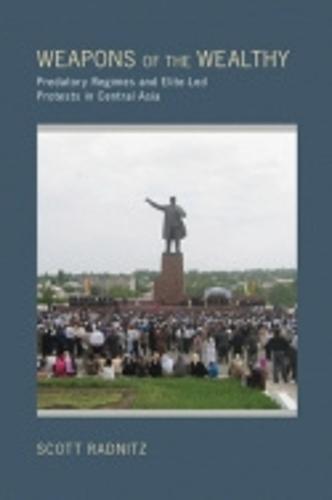
Mass mobilization is among the most dramatic and inspiring forces for political change. When ordinary citizens take to the streets in large numbers, they can undermine and even topple undemocratic governments, as the recent wave of peaceful uprisings in several postcommunist states has shown. However, investigation into how protests are organized can sometimes reveal that the origins and purpose of ""people power"" are not as they appear on the surface. In particular, protest can be used as an instrument of elite actors to advance their own interests rather than those of the masses. Weapons of the Wealthy focuses on the region of post-Soviet Central Asia to investigate the causes of elite-led protest. In nondemocratic states, economic and political opportunities can give rise to elites who are independent of the regime, yet vulnerable to expropriation and harassment from above. In conditions of political uncertainty, elites have an incentive to cultivate support in local communities, which elites can then wield as a ""weapon"" against a predatory regime. Scott Radnitz builds on his in-depth fieldwork and analysis of the spatial distribution of protests to demonstrate how Kyrgyzstan's post-independence development laid the groundwork for elite-led mobilization, whereas Uzbekistan's did not. Elites often have the wherewithal and the motivation to trigger protests, as is borne out by Radnitz's more than one hundred interviews with those who participated in, observed, or avoided protests. Even Kyrgyzstan's 2005 ""Tulip Revolution,"" which brought about the first peaceful change of power in Central Asia since independence, should be understood as a strategic action of elites rather than as an expression of the popular will. This interpretation helps account for the undemocratic nature of the successor government and the 2010 uprising that toppled it. It also serves as a warning for scholars to look critically at bottom-up political change.
Full Product Details
Author: Scott B. Radnitz
Publisher: Cornell University Press
Imprint: Cornell University Press
Dimensions:
Width: 15.50cm
, Height: 2.20cm
, Length: 23.50cm
Weight: 0.907kg
ISBN: 9780801449536
ISBN 10: 0801449537
Pages: 248
Publication Date: 12 November 2010
Audience:
College/higher education
,
Postgraduate, Research & Scholarly
Format: Hardback
Publisher's Status: Active
Availability: In Print

This item will be ordered in for you from one of our suppliers. Upon receipt, we will promptly dispatch it out to you. For in store availability, please contact us.
Reviews
Weapons of the Wealthy is simply one of the best examples of deep, qualitative, theory-driven research that I have seen. This book is a significant step in building a body of theory on how politics really works in hybrid regimes. Henry E. Hale, George Washington University, author of Why Not Parties in Russia? Weapons of the Wealthy is a highly original and comprehensive account of the complicated contortions of political change in Kyrgyzstan. Scott Radnitz makes masterful use of comparative political theory to provide important new insights on why people revolt, even in highly divided societies. Kathryn Stoner-Weiss, Stanford University Many analysts casually comment on the importance of 'informal politics' in Central Asia, but in Weapons of the Wealthy, Scott Radnitz provides an elegant theory of 'subversive clientelism' that explains how vertical and horizontal networks of patronage actually operate. This pioneering book is a major contribution to our understanding of the sources of political mobilization in Central Asia and across other illiberal states where coalition-building and contestation take place outside the formal institutions of the state. Alexander Cooley, Barnard College, Columbia University In this important study, Radnitz examines the processes of political change in post-Soviet Central Asian states. Based on extensive fieldwork in Kyrgyzstan and Uzbekistan, Radnitz sets out to understand the dynamics of mass mobilization in opposition to authoritarian regimes. . . . He argues that these mass protests, rather than being organized by civil society organizations, result from the incentives created by a system . . . in which . . . elite actors are able to provide significant benefits to local communities . . . [allowing them] to mobilize collective action that challenges the state in order to promote their own interests. Choice
<p> Weapons of the Wealthy is a highly original and comprehensive account of the complicated contortions of political change in Kyrgyzstan. Scott Radnitz makes masterful use of comparative political theory to provide important new insights on why people revolt, even in highly divided societies. -Kathryn Stoner-Weiss, Stanford University
Author Information
Scott Radnitz is Associate Professor in the Henry M. Jackson School of International Studies and Director of the Ellison Center for Russian, East European, and Central Asian Studies at the University of Washington.