Overview
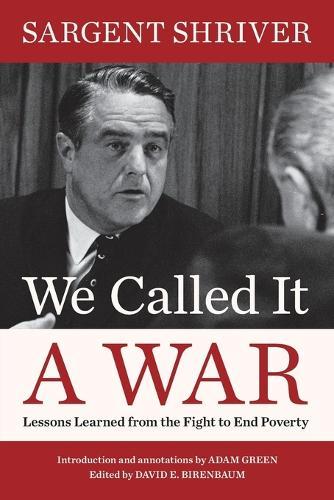
We Called It a War: Lessons Learned from the Fight to End Poverty is a first-hand account of Sargent Shriver's leadership of the War on Poverty, which he undertook under President Lyndon Johnson between 1964 and 1968. The memoir offers a rare inside view of how programs like Head Start, Community Action, Volunteers in Service to America (VISTA, now AmeriCorps VISTA), Job Corps, Legal Services, Neighborhood Health Centers, Foster Grandparents, Upward Bound, and Work-Study were conceived and implemented-and how Shriver's collaborative, community-based approach can be applied to tackling poverty in America today. The book gives the reader intimate insights into the opportunities and challenges of translating President Johnson's audacious pledge to end poverty into a working set of social programs that continue to uplift and empower communities across the United States today. In leading the anti-poverty effort, Shriver was tasked with drafting the requisite legislation, ushering it through a skeptical Congress, creating the Office of Economic Opportunity (OEO), and recruiting the talented anti-poverty warriors who would take the OEO from concept to implementation. Shriver's words reveal a public administrator skilled at creating major social policy; a global citizen driven by his spiritual faith and commitment to social justice; a principled pragmatist who successfully executed grand ideas; a social entrepreneur whose skeptical approach to bureaucracy enabled him to liberate the creative energies of the diverse individuals who collaborated with him; and a politician who earned the trust and respect of his adversaries. Shriver's words remind us that to achieve equal opportunity and justice for all, we must again create an environment that nurtures bold ideas and empowers decisive, community-based action.
Full Product Details
Author: Sargent Shriver
Publisher: Apprentice House
Imprint: Apprentice House
Dimensions:
Width: 15.20cm
, Height: 2.10cm
, Length: 22.90cm
Weight: 0.526kg
ISBN: 9781627206662
ISBN 10: 1627206663
Pages: 394
Publication Date: 20 April 2026
Audience:
General/trade
,
General
Format: Paperback
Publisher's Status: Active
Availability: Not yet available

This item is yet to be released. You can pre-order this item and we will dispatch it to you upon its release.
Author Information
The architect of the Peace Corps and the War on Poverty, Robert Sargent Shriver Jr. was born on November 9, 1915 in Westminster, Maryland. He attended Yale University from 1934 to 1941, earning a Bachelor of Arts and a law degree. He enlisted in the U.S. Navy in 1940, reporting for duty after his graduation from law school. Shriver spent five years in active service in the Pacific during World War II, earning a Purple Heart for wounds he received in the Battle of Guadalcanal.Shriver moved to Chicago in 1946 to manage the Merchandise Mart, which was the world's largest commercial property at the time. Seven years later, he married Eunice Kennedy, sister of John F. Kennedy. In the 1950s, Shriver headed the boards of Chicago Public School Boards and the Catholic Interracial Council, championing numerous educational reforms and spearheading the integration of Catholic high schools and other local institutions. In 1960, Shriver led the civil-rights division of John F. Kennedy's presidential campaign. After Kennedy's election, the president asked Shriver to design and lead the Peace Corps. Shriver served as its Director from 1961-1966.In 1964, President Johnson tapped Shriver to lead ""an unconditional war on poverty in America,"" in addition to managing the Peace Corps. As the architect of the Office of Economic Opportunity, Shriver developed a series of community-centric programs, including Head Start, Community Action, Job Corps, Legal Services, Upward Bound, Neighborhood Health Centers, Foster Grandparents, and Work-Study, that continue to serve people today.Shriver was US Ambassador to France from 1968 to 1970, then joined the law firm of Fried, Frank, Harris, Shriver, & Jacobson. He was very active in the Democratic party during this time. George McGovern chose him as his vice-presidential running mate in the election of 1972, and he himself was a candidate for president in the 1976 Democratic primary. Shriver subsequently worked to ease inter-religious tensions in the Middle East and to de-escalate the nuclear arms race with the Soviet Union, championing America's No First Strike policy.From 1984 to 2003, Shriver joined his wife, Eunice, at Special Olympics, and helped expand the organization into Eastern Europe, North Africa, and the Asia-Pacific, including China.Despite an Alzheimer's diagnosis in 2003, Shriver remained active well into the 2000s, speaking regularly at public events. He died on January 18, 2011 at the age of 95.