Overview
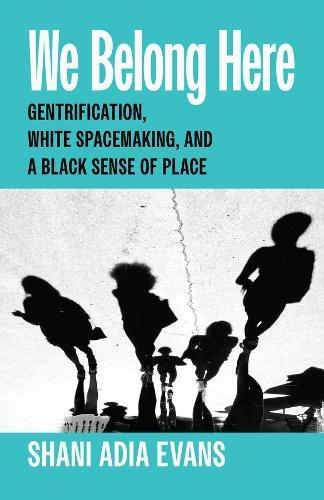
A landmark study that shows how Black residents experience and respond to the rapid transformation of historically Black places. Although Portland, Oregon, is sometimes called ""America's Whitest city,"" Black residents who grew up there made it their own. The neighborhoods of Northeast Portland, also called ""Albina,"" were a haven for and a hub of Black community life. But between 1990 and 2010, Albina changed dramatically—it became majority White. In We Belong Here, sociologist Shani Adia Evans offers an intimate look at gentrification from the inside, documenting the reactions of Albina residents as the racial demographics of their neighborhood shift. As White culture becomes centered in Northeast, Black residents recount their experiences with what Evans refers to as ""White watching,"" the questioning look on the faces of White people they encounter, which conveys an exclusionary message: ""What are you doing here?"" This, Evans shows, is a prime example of what she calls ""White spacemaking"": the establishment of White space—spaces in which Whiteness is assumed to be the norm and non-Whites are treated with suspicion—in formerly non-White neighborhoods. Evans also documents Black residents' efforts to create and maintain places for Black belonging in White-dominated Portland. While gentrification typically describes socioeconomic changes that may have racial implications, White spacemaking allows us to understand racism as a primary mechanism of neighborhood change. We Belong Here illuminates why gentrification and White spacemaking should be examined as intersecting, but not interchangeable, processes of neighborhood change.
Full Product Details
Author: Shani Adia Evans
Publisher: The University of Chicago Press
Imprint: University of Chicago Press
Dimensions:
Width: 15.20cm
, Height: 1.50cm
, Length: 22.90cm
Weight: 0.340kg
ISBN: 9780226837758
ISBN 10: 0226837750
Pages: 240
Publication Date: 07 March 2025
Audience:
Professional and scholarly
,
Professional & Vocational
Format: Paperback
Publisher's Status: Active
Availability: Out of stock

The supplier is temporarily out of stock of this item. It will be ordered for you on backorder and shipped when it becomes available.
Reviews
"""We Belong Here beautifully reclaims the story of Black Portland and offers new frameworks for identifying – and hopefully dismantling – the ways that White spaces are intolerant of and oppressive for Black people."" -- Mary Pattillo, author of 'Black Picket Fences, Second Edition: Privilege and Peril among the Black Middle Class' ""We Belong Here is a fundamental correction to class-based interpretations of Black displacement. Shani Adia Evans develops a very useful conceptual sketch (e.g., “white spacemaking” and “white watching”) to classify the various practices Whites use to push Blacks out of their historical neighborhoods. Unlike other analysts, Evans also includes Blacks’ resistance to this process and documents their continuing efforts to make Black space even in white-dominated Portland. I will definitely assign this book in my classes."" -- Eduardo Bonilla-Silva, co-author of 'White Logic, White Methods: Racism and Methodology'"
""We Belong Here beautifully reclaims the story of Black Portland and offers new frameworks for identifying – and hopefully dismantling – the ways that White spaces are intolerant of and oppressive for Black people."" -- Mary Pattillo, author of 'Black Picket Fences, Second Edition: Privilege and Peril among the Black Middle Class' ""We Belong Here is a fundamental correction to class-based interpretations of Black displacement. Shani Adia Evans develops a very useful conceptual sketch (e.g., “white spacemaking” and “white watching”) to classify the various practices Whites use to push Blacks out of their historical neighborhoods. Unlike other analysts, Evans also includes Blacks’ resistance to this process and documents their continuing efforts to make Black space even in white-dominated Portland. I will definitely assign this book in my classes."" -- Eduardo Bonilla-Silva, co-author of 'White Logic, White Methods: Racism and Methodology' ""We Belong Here is a riveting exploration of how Black space and Black spatial myths are made and mangled in one of our most progressive cities in the nation. Shani Evans writes like a home-grown magician, taking us both around and within how Black folks make lives and attempt to protect space in Portland, Oregon. As a Mississippian, I'm heartened by the work Evans does to really stretch conceptions of why the stability of place, and navigation of spatial instability matter in policy and myth-making."" -- Kiese Laymon, author of 'Heavy: An American Memoir' ""This work contributes helpful insights to the studies of neighborhood change and race relationsin contemporary American urban life. While grounded in modern sociological race theory, the book is also highly accessible to both scholarly and general readers."" * Choice *
"""We Belong Here beautifully reclaims the story of Black Portland and offers new frameworks for identifying – and hopefully dismantling – the ways that White spaces are intolerant of and oppressive for Black people."" -- Mary Pattillo, author of 'Black Picket Fences, Second Edition: Privilege and Peril among the Black Middle Class'"
Author Information
Shani Adia Evans is assistant professor of sociology at Rice University.