Reviews
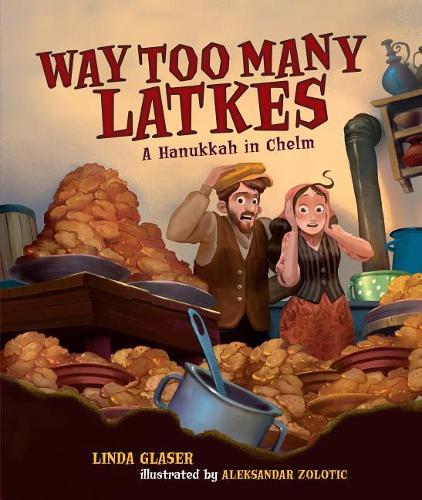
With Chanukah approaching, Faigel suddenly forgets the recipes for latkes. What can she do? Who can she ask? So, her husband, Shmuel, decides to ask the wisest man in the small fictional Eastern European village of Chelm - the rabbi. First, he asks how many potatoes, then how many eggs, then onions. Faigel always made tiny batches of latkes, but following the rabbi's advice, she made a huge batch. Find out what happens to all the latkes - Cleveland Jewish News --Newspaper Glaser (author of Stone Soup with Matzoh Balls, BCCB 3/14) returns for a second visit to Chelm, the village of fools from Jewish folklore; now it's the first night of Hanukkah and Faigel can't remember her latke recipe. She knows she uses potatoes, but how many? Her husband Shmuel runs to ask the rabbi for help, and the rabbi--whose stomach is growling--advises Faigel to use all the potatoes; after all, 'On Hanukkah, that's what potatoes are for.' The same goes for eggs and onions, and before long Faigel and Shmuel have more latkes than they can possibly eat. Luckily, the rabbi once again has wisdom to share: 'There's no such thing as too many latkes, ' he intones. 'Just not enough mouths.' Warmly illustrated in brown and red tones, this tale of Chelm will have viewers giggling as wide-eyed Shmuel runs back and forth between his frazzled wife and the hungry rabbi, offering plenty of opportunities for readaloud performance. The characters and scenes create a world that's an inviting mix of the cartoonish and realistic, and viewers will want to step inside--especially to share the latke feast with the villagers of Chelm at the end. A note at the end provides additional information on Chelm.--Bulletin of the Center for Children's Books --Journal Faigel, the best latke maker in the town of Chelm, has forgotten her recipe on the first night of Hanukkah, so her husband Shmuel goes to ask the wise rabbi for help. The rabbi is so hungry that he tells Shmuel Faigel should use everything--all the potatoes, all the eggs, all the onions--to make her perfect golden latkes. The predictable result is way too many latkes and not enough mouths to eat them, until the whole village is invited 'to bring one mouth each. On Hanukkah, that's what mouths are for.' In spite of a rather thin plot, the use of folkloric phrasing and humorous patter moves the story along, with a few typical Chelmish misunderstandings thrown in for good measure. Digital cartoon illustrations depict an Old World scene with big-eyed expressive characters. VERDICT This story has enough humor and appeal to find a place on most holiday shelves. --School Library Journal --Journal Introduce young readers to Chelm, the traditional village of fools, with Way Too Many Latkes, a Hanukkah in Chelm by Linda Glaser (appetisingly illustrated by Aleksandar Zolotic, KarBen, 6.50). Faigel is making latkes but she cannot remember the recipe. Some careless advice from the rabbi leads her to use every potato, egg and onion she possesses -- resulting in a mountain of latkes and a puzzle about how to eat them all up. The joke in this story is built up by repeated fool's errands, as Faigel sends her husband for advice one ingredient at a time. Children up to age nine will enjoy the escalating latke complications - The Jewish Chronicle --Newspaper Faigel, a woman living in Chelm -- a village where silliness prevails -- has forgotten her beloved latke recipe, in which she makes a latke for each neighbor at Hanukkah. Her husband, Shmuel, asks the wisest man they know -- the rabbi -- how to make the latkes. The rabbi says to use all the potatoes. Faigel is doubtful, but uses them all. Next, she needs to know how many eggs to use, so Shmuel asks the rabbi. 'Use all the eggs you've got, ' he tells him. The process continues with the onions, until... 'Oy! We have too many latkes! If we eat all the latkes, we'll get bellyaches up to our eyeballs, ' says Faigel. It's a fun story with an outlandish theme and a hint of wisdom perfect for a holiday read-aloud. - The Washington Post --Newspaper Chelm stories are supposed to be funny, and this one will inspire giggling in any child, particularly if the reader hams up the character voices. We learn that Faigel makes the best latkes in all of Chelm, but unfortunately for everyone else, she makes only enough for herself and Shmuel, her hapless husband. One year, she inexplicably forgets the recipe and her husband must go to the rabbi ('the wisest man in Chelm') to ask how many potatoes need to be used. The rabbi tells him to 'use them all' without realizing that Shmuel and Faigel's larder is full. The cycle is repeated with the other ingredients (eggs, onions) and silliness ensues. The comic-style illustrations capture the kitchen mayhem, idealized shtetl life and the over-the-top storyline with amusing flair. Of course, the whole town gets to partake in the deliciousness by the story's end. - Jewish Journal --Magazine In the town of Chelm, where foolish ideas often turn out for the best, Faigel can't find her latke recipe. She sends her husband, Shmuel, to ask the rabbi for advice. Too many potatoes? No problem. Use them all! Too many eggs? Ditto. Too many onions? Ditto. At the end of this amusing tale, Faigel has made way too many latkes. What to do? Why, share them with everyone in Chelm, of course--until 'there were just enough mouths and just enough latkes, down to the very last one.' The expressive artwork by Serbian artist, Aleksandar Zolotic, jumps off the page. He describes his art as 'digital painting'. The muted greens, browns, and oranges enhance the atmosphere of an idealized shtetl life. Can we ever have too many Hanukkah and/or Chelm stories? Perhaps not. Here you get two for the price of one. --Association of Jewish Libraries --Other Print Faigel makes the most delicious latkes in her village--but only in tiny batches. Those lucky enough to taste one of them 'dream about it for the rest of the year.' Then Faigel forgets her famous recipe, and because she lives in Chelm, the legendary village of fools, the solution is far from simple--and deeply silly. With nonsensical advice from her rabbi ('Use all the eggs you've got') and acquiescence by her literal-minded husband, Faigel ends up making enough latkes to feed the entire town. Latke makers and their young assistants should easily identify with the muscles and tears involved as Faigel preps mountains of potatoes and onions. Glaser leavens the story with lots of performance-ready, Yiddish-punctuated dialogue ('The rabbi? Faigel gripes. What does he know about making latkes? Bupkes!'), and Zolotic's characters have a vivid presence and energy reminiscent of animated films. --Publishers Weekly --Journal
Glaser (author of Stone Soup with Matzoh Balls, BCCB 3/14) returns for a second visit to Chelm, the village of fools from Jewish folklore; now it's the first night of Hanukkah and Faigel can't remember her latke recipe. She knows she uses potatoes, but how many? Her husband Shmuel runs to ask the rabbi for help, and the rabbi--whose stomach is growling--advises Faigel to use all the potatoes; after all, 'On Hanukkah, that's what potatoes are for.' The same goes for eggs and onions, and before long Faigel and Shmuel have more latkes than they can possibly eat. Luckily, the rabbi once again has wisdom to share: 'There's no such thing as too many latkes, ' he intones. 'Just not enough mouths.' Warmly illustrated in brown and red tones, this tale of Chelm will have viewers giggling as wide-eyed Shmuel runs back and forth between his frazzled wife and the hungry rabbi, offering plenty of opportunities for readaloud performance. The characters and scenes create a world that's an inviting mix of the cartoonish and realistic, and viewers will want to step inside--especially to share the latke feast with the villagers of Chelm at the end. A note at the end provides additional information on Chelm.--Bulletin of the Center for Children's Books --Journal Introduce young readers to Chelm, the traditional village of fools, with Way Too Many Latkes, a Hanukkah in Chelm by Linda Glaser (appetisingly illustrated by Aleksandar Zolotic, KarBen, 6.50). Faigel is making latkes but she cannot remember the recipe. Some careless advice from the rabbi leads her to use every potato, egg and onion she possesses -- resulting in a mountain of latkes and a puzzle about how to eat them all up. The joke in this story is built up by repeated fool's errands, as Faigel sends her husband for advice one ingredient at a time. Children up to age nine will enjoy the escalating latke complications - The Jewish Chronicle --Newspaper With Chanukah approaching, Faigel suddenly forgets the recipes for latkes. What can she do? Who can she ask? So, her husband, Shmuel, decides to ask the wisest man in the small fictional Eastern European village of Chelm - the rabbi. First, he asks how many potatoes, then how many eggs, then onions. Faigel always made tiny batches of latkes, but following the rabbi's advice, she made a huge batch. Find out what happens to all the latkes - Cleveland Jewish News --Newspaper Faigel, a woman living in Chelm -- a village where silliness prevails -- has forgotten her beloved latke recipe, in which she makes a latke for each neighbor at Hanukkah. Her husband, Shmuel, asks the wisest man they know -- the rabbi -- how to make the latkes. The rabbi says to use all the potatoes. Faigel is doubtful, but uses them all. Next, she needs to know how many eggs to use, so Shmuel asks the rabbi. 'Use all the eggs you've got, ' he tells him. The process continues with the onions, until... 'Oy! We have too many latkes! If we eat all the latkes, we'll get bellyaches up to our eyeballs, ' says Faigel. It's a fun story with an outlandish theme and a hint of wisdom perfect for a holiday read-aloud. - The Washington Post --Newspaper Faigel, the best latke maker in the town of Chelm, has forgotten her recipe on the first night of Hanukkah, so her husband Shmuel goes to ask the wise rabbi for help. The rabbi is so hungry that he tells Shmuel Faigel should use everything--all the potatoes, all the eggs, all the onions--to make her perfect golden latkes. The predictable result is way too many latkes and not enough mouths to eat them, until the whole village is invited 'to bring one mouth each. On Hanukkah, that's what mouths are for.' In spite of a rather thin plot, the use of folkloric phrasing and humorous patter moves the story along, with a few typical Chelmish misunderstandings thrown in for good measure. Digital cartoon illustrations depict an Old World scene with big-eyed expressive characters. VERDICT This story has enough humor and appeal to find a place on most holiday shelves. --School Library Journal --Journal Chelm stories are supposed to be funny, and this one will inspire giggling in any child, particularly if the reader hams up the character voices. We learn that Faigel makes the best latkes in all of Chelm, but unfortunately for everyone else, she makes only enough for herself and Shmuel, her hapless husband. One year, she inexplicably forgets the recipe and her husband must go to the rabbi ('the wisest man in Chelm') to ask how many potatoes need to be used. The rabbi tells him to 'use them all' without realizing that Shmuel and Faigel's larder is full. The cycle is repeated with the other ingredients (eggs, onions) and silliness ensues. The comic-style illustrations capture the kitchen mayhem, idealized shtetl life and the over-the-top storyline with amusing flair. Of course, the whole town gets to partake in the deliciousness by the story's end. - Jewish Journal --Magazine In the town of Chelm, where foolish ideas often turn out for the best, Faigel can't find her latke recipe. She sends her husband, Shmuel, to ask the rabbi for advice. Too many potatoes? No problem. Use them all! Too many eggs? Ditto. Too many onions? Ditto. At the end of this amusing tale, Faigel has made way too many latkes. What to do? Why, share them with everyone in Chelm, of course--until 'there were just enough mouths and just enough latkes, down to the very last one.' The expressive artwork by Serbian artist, Aleksandar Zolotic, jumps off the page. He describes his art as 'digital painting'. The muted greens, browns, and oranges enhance the atmosphere of an idealized shtetl life. Can we ever have too many Hanukkah and/or Chelm stories? Perhaps not. Here you get two for the price of one. --Association of Jewish Libraries --Other Print Faigel makes the most delicious latkes in her village--but only in tiny batches. Those lucky enough to taste one of them 'dream about it for the rest of the year.' Then Faigel forgets her famous recipe, and because she lives in Chelm, the legendary village of fools, the solution is far from simple--and deeply silly. With nonsensical advice from her rabbi ('Use all the eggs you've got') and acquiescence by her literal-minded husband, Faigel ends up making enough latkes to feed the entire town. Latke makers and their young assistants should easily identify with the muscles and tears involved as Faigel preps mountains of potatoes and onions. Glaser leavens the story with lots of performance-ready, Yiddish-punctuated dialogue ('The rabbi? Faigel gripes. What does he know about making latkes? Bupkes!'), and Zolotic's characters have a vivid presence and energy reminiscent of animated films. --Publishers Weekly --Journal
Introduce young readers to Chelm, the traditional village of fools, with Way Too Many Latkes, a Hanukkah in Chelm by Linda Glaser (appetisingly illustrated by Aleksandar Zolotic, KarBen, 6.50). Faigel is making latkes but she cannot remember the recipe. Some careless advice from the rabbi leads her to use every potato, egg and onion she possesses -- resulting in a mountain of latkes and a puzzle about how to eat them all up. The joke in this story is built up by repeated fool's errands, as Faigel sends her husband for advice one ingredient at a time. Children up to age nine will enjoy the escalating latke complications - The Jewish Chronicle --Newspaper Glaser (author of Stone Soup with Matzoh Balls, BCCB 3/14) returns for a second visit to Chelm, the village of fools from Jewish folklore; now it's the first night of Hanukkah and Faigel can't remember her latke recipe. She knows she uses potatoes, but how many? Her husband Shmuel runs to ask the rabbi for help, and the rabbi--whose stomach is growling--advises Faigel to use all the potatoes; after all, 'On Hanukkah, that's what potatoes are for.' The same goes for eggs and onions, and before long Faigel and Shmuel have more latkes than they can possibly eat. Luckily, the rabbi once again has wisdom to share: 'There's no such thing as too many latkes, ' he intones. 'Just not enough mouths.' Warmly illustrated in brown and red tones, this tale of Chelm will have viewers giggling as wide-eyed Shmuel runs back and forth between his frazzled wife and the hungry rabbi, offering plenty of opportunities for readaloud performance. The characters and scenes create a world that's an inviting mix of the cartoonish and realistic, and viewers will want to step inside--especially to share the latke feast with the villagers of Chelm at the end. A note at the end provides additional information on Chelm.--Bulletin of the Center for Children's Books --Journal Chelm stories are supposed to be funny, and this one will inspire giggling in any child, particularly if the reader hams up the character voices. We learn that Faigel makes the best latkes in all of Chelm, but unfortunately for everyone else, she makes only enough for herself and Shmuel, her hapless husband. One year, she inexplicably forgets the recipe and her husband must go to the rabbi ('the wisest man in Chelm') to ask how many potatoes need to be used. The rabbi tells him to 'use them all' without realizing that Shmuel and Faigel's larder is full. The cycle is repeated with the other ingredients (eggs, onions) and silliness ensues. The comic-style illustrations capture the kitchen mayhem, idealized shtetl life and the over-the-top storyline with amusing flair. Of course, the whole town gets to partake in the deliciousness by the story's end. - Jewish Journal --Magazine Faigel makes the most delicious latkes in her village--but only in tiny batches. Those lucky enough to taste one of them 'dream about it for the rest of the year.' Then Faigel forgets her famous recipe, and because she lives in Chelm, the legendary village of fools, the solution is far from simple--and deeply silly. With nonsensical advice from her rabbi ('Use all the eggs you've got') and acquiescence by her literal-minded husband, Faigel ends up making enough latkes to feed the entire town. Latke makers and their young assistants should easily identify with the muscles and tears involved as Faigel preps mountains of potatoes and onions. Glaser leavens the story with lots of performance-ready, Yiddish-punctuated dialogue ('The rabbi? Faigel gripes. What does he know about making latkes? Bupkes!'), and Zolotic's characters have a vivid presence and energy reminiscent of animated films. --Publishers Weekly --Journal With Chanukah approaching, Faigel suddenly forgets the recipes for latkes. What can she do? Who can she ask? So, her husband, Shmuel, decides to ask the wisest man in the small fictional Eastern European village of Chelm - the rabbi. First, he asks how many potatoes, then how many eggs, then onions. Faigel always made tiny batches of latkes, but following the rabbi's advice, she made a huge batch. Find out what happens to all the latkes - Cleveland Jewish News --Newspaper Faigel, a woman living in Chelm -- a village where silliness prevails -- has forgotten her beloved latke recipe, in which she makes a latke for each neighbor at Hanukkah. Her husband, Shmuel, asks the wisest man they know -- the rabbi -- how to make the latkes. The rabbi says to use all the potatoes. Faigel is doubtful, but uses them all. Next, she needs to know how many eggs to use, so Shmuel asks the rabbi. 'Use all the eggs you've got, ' he tells him. The process continues with the onions, until... 'Oy! We have too many latkes! If we eat all the latkes, we'll get bellyaches up to our eyeballs, ' says Faigel. It's a fun story with an outlandish theme and a hint of wisdom perfect for a holiday read-aloud. - The Washington Post --Newspaper Faigel, the best latke maker in the town of Chelm, has forgotten her recipe on the first night of Hanukkah, so her husband Shmuel goes to ask the wise rabbi for help. The rabbi is so hungry that he tells Shmuel Faigel should use everything--all the potatoes, all the eggs, all the onions--to make her perfect golden latkes. The predictable result is way too many latkes and not enough mouths to eat them, until the whole village is invited 'to bring one mouth each. On Hanukkah, that's what mouths are for.' In spite of a rather thin plot, the use of folkloric phrasing and humorous patter moves the story along, with a few typical Chelmish misunderstandings thrown in for good measure. Digital cartoon illustrations depict an Old World scene with big-eyed expressive characters. VERDICT This story has enough humor and appeal to find a place on most holiday shelves. --School Library Journal --Journal In the town of Chelm, where foolish ideas often turn out for the best, Faigel can't find her latke recipe. She sends her husband, Shmuel, to ask the rabbi for advice. Too many potatoes? No problem. Use them all! Too many eggs? Ditto. Too many onions? Ditto. At the end of this amusing tale, Faigel has made way too many latkes. What to do? Why, share them with everyone in Chelm, of course--until 'there were just enough mouths and just enough latkes, down to the very last one.' The expressive artwork by Serbian artist, Aleksandar Zolotic, jumps off the page. He describes his art as 'digital painting'. The muted greens, browns, and oranges enhance the atmosphere of an idealized shtetl life. Can we ever have too many Hanukkah and/or Chelm stories? Perhaps not. Here you get two for the price of one. --Association of Jewish Libraries --Other Print
With Chanukah approaching, Faigel suddenly forgets the recipes for latkes. What can she do? Who can she ask? So, her husband, Shmuel, decides to ask the wisest man in the small fictional Eastern European village of Chelm - the rabbi. First, he asks how many potatoes, then how many eggs, then onions. Faigel always made tiny batches of latkes, but following the rabbi's advice, she made a huge batch. Find out what happens to all the latkes - Cleveland Jewish News --Newspaper Faigel, a woman living in Chelm -- a village where silliness prevails -- has forgotten her beloved latke recipe, in which she makes a latke for each neighbor at Hanukkah. Her husband, Shmuel, asks the wisest man they know -- the rabbi -- how to make the latkes. The rabbi says to use all the potatoes. Faigel is doubtful, but uses them all. Next, she needs to know how many eggs to use, so Shmuel asks the rabbi. 'Use all the eggs you've got, ' he tells him. The process continues with the onions, until... 'Oy! We have too many latkes! If we eat all the latkes, we'll get bellyaches up to our eyeballs, ' says Faigel. It's a fun story with an outlandish theme and a hint of wisdom perfect for a holiday read-aloud. - The Washington Post --Newspaper Chelm stories are supposed to be funny, and this one will inspire giggling in any child, particularly if the reader hams up the character voices. We learn that Faigel makes the best latkes in all of Chelm, but unfortunately for everyone else, she makes only enough for herself and Shmuel, her hapless husband. One year, she inexplicably forgets the recipe and her husband must go to the rabbi ('the wisest man in Chelm') to ask how many potatoes need to be used. The rabbi tells him to 'use them all' without realizing that Shmuel and Faigel's larder is full. The cycle is repeated with the other ingredients (eggs, onions) and silliness ensues. The comic-style illustrations capture the kitchen mayhem, idealized shtetl life and the over-the-top storyline with amusing flair. Of course, the whole town gets to partake in the deliciousness by the story's end. - Jewish Journal --Magazine Introduce young readers to Chelm, the traditional village of fools, with Way Too Many Latkes, a Hanukkah in Chelm by Linda Glaser (appetisingly illustrated by Aleksandar Zolotic, KarBen, 6.50). Faigel is making latkes but she cannot remember the recipe. Some careless advice from the rabbi leads her to use every potato, egg and onion she possesses -- resulting in a mountain of latkes and a puzzle about how to eat them all up. The joke in this story is built up by repeated fool's errands, as Faigel sends her husband for advice one ingredient at a time. Children up to age nine will enjoy the escalating latke complications - The Jewish Chronicle --Newspaper Glaser (author of Stone Soup with Matzoh Balls, BCCB 3/14) returns for a second visit to Chelm, the village of fools from Jewish folklore; now it's the first night of Hanukkah and Faigel can't remember her latke recipe. She knows she uses potatoes, but how many? Her husband Shmuel runs to ask the rabbi for help, and the rabbi--whose stomach is growling--advises Faigel to use all the potatoes; after all, 'On Hanukkah, that's what potatoes are for.' The same goes for eggs and onions, and before long Faigel and Shmuel have more latkes than they can possibly eat. Luckily, the rabbi once again has wisdom to share: 'There's no such thing as too many latkes, ' he intones. 'Just not enough mouths.' Warmly illustrated in brown and red tones, this tale of Chelm will have viewers giggling as wide-eyed Shmuel runs back and forth between his frazzled wife and the hungry rabbi, offering plenty of opportunities for readaloud performance. The characters and scenes create a world that's an inviting mix of the cartoonish and realistic, and viewers will want to step inside--especially to share the latke feast with the villagers of Chelm at the end. A note at the end provides additional information on Chelm.--Bulletin of the Center for Children's Books --Journal Faigel, the best latke maker in the town of Chelm, has forgotten her recipe on the first night of Hanukkah, so her husband Shmuel goes to ask the wise rabbi for help. The rabbi is so hungry that he tells Shmuel Faigel should use everything--all the potatoes, all the eggs, all the onions--to make her perfect golden latkes. The predictable result is way too many latkes and not enough mouths to eat them, until the whole village is invited 'to bring one mouth each. On Hanukkah, that's what mouths are for.' In spite of a rather thin plot, the use of folkloric phrasing and humorous patter moves the story along, with a few typical Chelmish misunderstandings thrown in for good measure. Digital cartoon illustrations depict an Old World scene with big-eyed expressive characters. VERDICT This story has enough humor and appeal to find a place on most holiday shelves. --School Library Journal --Journal In the town of Chelm, where foolish ideas often turn out for the best, Faigel can't find her latke recipe. She sends her husband, Shmuel, to ask the rabbi for advice. Too many potatoes? No problem. Use them all! Too many eggs? Ditto. Too many onions? Ditto. At the end of this amusing tale, Faigel has made way too many latkes. What to do? Why, share them with everyone in Chelm, of course--until 'there were just enough mouths and just enough latkes, down to the very last one.' The expressive artwork by Serbian artist, Aleksandar Zolotic, jumps off the page. He describes his art as 'digital painting'. The muted greens, browns, and oranges enhance the atmosphere of an idealized shtetl life. Can we ever have too many Hanukkah and/or Chelm stories? Perhaps not. Here you get two for the price of one. --Association of Jewish Libraries --Other Print Faigel makes the most delicious latkes in her village--but only in tiny batches. Those lucky enough to taste one of them 'dream about it for the rest of the year.' Then Faigel forgets her famous recipe, and because she lives in Chelm, the legendary village of fools, the solution is far from simple--and deeply silly. With nonsensical advice from her rabbi ('Use all the eggs you've got') and acquiescence by her literal-minded husband, Faigel ends up making enough latkes to feed the entire town. Latke makers and their young assistants should easily identify with the muscles and tears involved as Faigel preps mountains of potatoes and onions. Glaser leavens the story with lots of performance-ready, Yiddish-punctuated dialogue ('The rabbi? Faigel gripes. What does he know about making latkes? Bupkes!'), and Zolotic's characters have a vivid presence and energy reminiscent of animated films. --Publishers Weekly --Journal