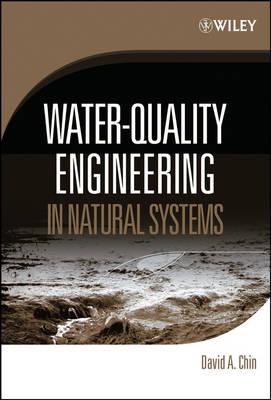
Water-Quality Engineering in Natural Systems

Author:   David A. Chin
Publisher:   John Wiley and Sons Ltd
ISBN:  

9780471718307


Pages:   626
Publication Date:   01 April 2006
Format:   Hardback
Availability:   In Print   Availability explained
Limited stock is available. It will be ordered for you and shipped pending supplier's limited stock.

Our Price $416.99 Quantity:  
Add to Cart

Share |

Water-Quality Engineering in Natural Systems


Overview

FOCUSING ON CONTAMINANT FATE AND TRANSPORT, DESIGN OF ENVIRONMENTAL-CONTROL SYSTEMS, AND REGULATORY CONSTRAINTS This textbook details the fundamental equations that describe the fate and transport of contaminantsin the water environment. The application of these fundamental equations to the design of environmental-control systems and methodologies for assessing the impact of contaminant discharges into rivers, lakes, wetlands, ground water, and oceans are all covered. Readers learn to assess how much waste can be safely assimilatedinto a water body by developing a solid understanding of the relationship between the type of pollutant discharged, the characteristics of the receiving water, and physical, chemical, and biological impacts. In cases of surface runoff from urban and agricultural watersheds, quantitative relationships between the quality of surface runoff and the characteristics of contaminant sources located within the watersheds are presented. Some of the text's distinguishing features include its emphasis on the engineering design of systems that control the fate and transport of contaminants in the water environment, the design of remediation systems, and regulatory constraints. Particular attention is given to use-attainability analyses and the estimation of total maximum daily loads, both of which are essential components of water-quality control in natural systems. Readers are provided with a thorough explanation of the complex set of laws and regulations governing water-quality control in the United States. Proven as an effective textbook in several offerings of the author's class ""Water Quality Control in Natural Systems,"" the flow of the text is carefully structured to facilitate learning. Moreover, a number of practical pedagogical tools are offered: Practical examples used throughout the text illustrate the effects of controlling the quality, quantity, timing, and distribution of contaminant discharges into the environment End-of-chapter problems, and an accompanying solutions manual, help readers assess their grasp of each topic as they progress through the text Several appendices with useful reference material are provided, including current U.S. Water Quality Standards Detailed bibliography guides readers to additional resources to explore particular topics in greater depth With its emphasis on contaminant fate and transport and design of environmental-control systems, this text is ideal for upper-level undergraduates and graduate students in environmental and civil engineering programs.Environmental scientists and practicing environmental/civil engineers will also find the text relevant and useful.

Full Product Details

Author:   David A. Chin
Publisher:   John Wiley and Sons Ltd
Imprint:   John Wiley & Sons Inc
Dimensions:   Width: 18.20cm , Height: 3.50cm , Length: 26.00cm
Weight:   1.246kg
ISBN:  

9780471718307


ISBN 10:   0471718300
Pages:   626
Publication Date:   01 April 2006
Audience:   Professional and scholarly ,  Professional & Vocational
Format:   Hardback
Publisher's Status:   Out of Stock Indefinitely
Availability:   In Print   Availability explained
Limited stock is available. It will be ordered for you and shipped pending supplier's limited stock.

Table of Contents

PREFACE. 1 INTRODUCTION. 1.1 Principles of Water-Quality Control. 1.2 Sources of Water Pollution. 1.2.1 Point Sources. 1.2.2 Nonpoint Sources. 1.3 Laws and Regulations. 1.3.1 Clean Water Act. 1.3.2 Safe Drinking Water Act. 1.4 Strategy for Water-Quality Management. 1.4.1 Use-Attainability Analysis. 1.4.2 Total Maximum Daily Load Process. Summary. Problems. 2 WATER-QUALITY STANDARDS. 2.1 Introduction. 2.2 Measures of Water Quality. 2.2.1 Physical Measures. 2.2.2 Chemical Measures. 2.2.3 Biological Measures. 2.3 U.S. Surface-Water Standards. 2.3.1 Designated Beneficial Uses. 2.3.2 Water-Quality Criteria. 2.3.3 Antidegradation Policy. 2.3.4 General Water-Quality Management Practices. 2.4 U.S. Ground-Water Standards. 2.5 Background Water Quality. 2.6 Computer Codes. Summary. Problems. 3 FATE AND TRANSPORT IN AQUATIC SYSTEMS. 3.1 Mixing of Dissolved Constituents. 3.2 Properties of the Diffusion Equation. 3.2.1 Fundamental Solution in One Dimension. 3.2.2 Principle of Superposition. 3.2.3 Solutions in Higher Dimensions. 3.2.4 Moment Property of the Diffusion Equation. 3.2.5 Nondimensional Form. 3.3 Transport of Suspended Particles. Summary. Problems. 4 RIVERS AND STREAMS. 4.1 Introduction. 4.2 Transport Processes. 4.2.1 Initial Mixing. 4.2.2 Longitudinal Dispersion. 4.3 Spills. 4.3.1 Governing Equation. 4.3.2 Fate of Volatile Organic Compounds in Streams. 4.4 Continuous Discharges. 4.4.1 Oxygen Demand of Wastewater. 4.4.2 Reaeration. 4.4.3 Streeter-Phelps Model. 4.4.4 Other Considerations. 4.5 Restoration and Management. 4.5.1 Nonstructural Techniques. 4.5.2 Structural Techniques. 4.6 Computer Codes. Summary. Problems. 5 LAKES AND RESERVOIRS. 5.1 Introduction. 5.2 Natural Processes. 5.2.1 Flow and Dispersion. 5.2.2 Light Penetration. 5.2.3 Sedimentation. 5.2.4 Eutrophication and Nutrient Recycling. 5.2.5 Thermal Stratification. 5.3 Water-Quality Models. 5.3.1 Zero-Dimensional (Completely Mixed) Model. 5.3.2 One-Dimensional (Vertical) Models. 5.3.3 Two-Dimensional Models. 5.4 Restoration and Management. 5.4.1 Control of Eutrophication. 5.4.2 Control of Dissolved-Oxygen Levels. 5.4.3 Control of Toxic Contaminants. 5.4.4 Control of Acidity. 5.4.5 Control of Aquatic Plants. 5.4.6 Attainability of Lake Uses. 5.5 Computer Codes. Summary. Problems. 6 WETLANDS. 6.1 Introduction. 6.2 Natural Wetlands. 6.2.1 Marshes. 6.2.2 Swamps. 6.2.3 Bogs. 6.2.4 Fens. 6.3 Delineation of Wetlands. 6.3.1 Vegetation. 6.3.2 Soils. 6.3.3 Hydrology. 6.4 Wetland Hydrology. 6.4.1 Net Surface-Water Inflow. 6.4.2 Net Ground-Water Inflow. 6.4.3 Evapotranspiration. 6.5 Case Study: The Everglades and Big Cypress Swamp. 6.6 Constructed Treatment Wetlands. 6.6.1 Surface-Flow Wetlands. 6.6.2 Subsurface-Flow Wetlands. 6.6.3 Wetland Regulations in the United States. 6.6.4 Basic Principles for Wetland Restoration and Creation. 6.6.5 Design of Constructed Treatment Wetlands. 6.6.6 Wetlands for Treating Roadway Runoff. Summary. Problems. 7 GROUND WATER. 7.1 Introduction. 7.2 Natural Ground-Water Quality. 7.3 Contaminant Sources. 7.3.1 Septic Tanks. 7.3.2 Leaking Underground Storage Tanks. 7.3.3 Land Application of Wastewater. 7.3.4 Irrigation and Irrigation Return Flow. 7.3.5 Solid-Waste Disposal Sites. 7.3.6 Waste-Disposal Injection Wells. 7.3.7 Agricultural Operations. 7.4 Fate and Transport Models. 7.4.1 Instantaneous Point Source. 7.4.2 Continuous Point Source. 7.4.3 Continuous Plane Source. 7.5 Transport Processes. 7.6 Fate Processes. 7.6.1 Sorption. 7.6.2 First-Order Decay. 7.6.3 Combined Processes. 7.7 Nonaqueous-Phase Liquids. 7.8 Remediation of Subsurface Contamination. 7.8.1 Remediation Goals. 7.8.2 Site Investigation. 7.8.3 Remediation Strategies. 7.9 Computer Models. Summary. Problems. 8 OCEANS AND ESTUARIES. 8.1 Introduction. 8.2 Ocean-Outfall Discharges. 8.2.1 Near-Field Mixing. 8.2.2 Far-Field Mixing. 8.3 Water-Quality Control in Estuaries. 8.3.1 Classification of Estuaries. 8.3.2 Physical Conditions. 8.3.3 Chemical Conditions. 8.3.4 Biological Conditions. 8.3.5 Use-Attainability Evaluations. 8.4 Computer Models. Summary. Problems. 9 WATERSHEDS. 9.1 Introduction. 9.2 Source-Water Protection. 9.3 Watershed-Generated Pollutant Loads. 9.4 Urban Watersheds. 9.4.1 Sources of Pollution. 9.4.2 Fate and Transport Processes. 9.4.3 Best Management Practices. 9.5 Agricultural Watersheds. 9.5.1 Sources of Pollution. 9.5.2 Fate and Transport Processes. 9.5.3 Best Management Practices. 9.6 Airsheds. 9.6.1 Nitrogen Compounds. 9.6.2 Mercury. 9.6.3 Other Metals. 9.6.4 Pesticides. 9.6.5 Combustion Emissions. 9.7 Computer Models. Summary. Problems. APPENDIX A UNITS AND CONVERSION FACTORS. A.1 Units. A.2 Conversion Factors. APPENDIX B FLUID PROPERTIES. B.1 Water. B.2 Organic Compounds Found in Water. B.3 Air at Standard Atmospheric Pressure. APPENDIX C U.S.WATER-QUALITY STANDARDS. C.1 Water-Quality Criteria for Surface Waters. C.2 Water-Quality Criteria for Drinking Water. C.3 Priority Pollutants. APPENDIX D STATISTICAL TABLES. D.1 Areas Under the Standard Normal Curve. APPENDIX E SPECIAL FUNCTIONS. E.1 Error Function. E.2 Bessel Functions. E.2.1 Definition. E.2.2 Evaluation of Bessel Functions. E.3 Gamma Function. APPENDIX F PIPE SPECIFICATIONS. F.1 PVC Pipe. F.2 Ductile Iron Pipe. F.3 Concrete Pipe. REFERENCES. INDEX.

Reviews

...a useful addition to the libraries of environmental engineers. (Journal of the American Water Resources Association, April 2007) This extremely well-written and well-organized work can be used by senior undergraduates as well as graduate students. It also provides information invaluable to practitioners...highly recommended. (CHOICE, November 2006)


Author Information

DAVID A. CHIN, PhD, PE, is a Professor in the Department of Civil, Architectural, and Environmental Engineering, University of Miami. He is a licensed Professional Engineer, a Fellow of the American Society of Civil Engineers,and a Diplomate of the American Academy of Environmental Engineers.

Tab Content 6

Author Website:  

Countries Available

All regions
Latest Reading Guide

NOV RG 20252


Shopping Cart
Your cart is empty
Shopping cart
Mailing List