Overview
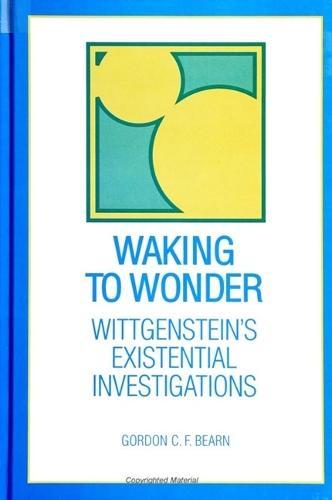
The central claim of this book is that, early and late, Wittgenstein modelled his approach to existential meaning on his account of linguistic meaning. A reading of Nietzsche's The Birth of Tragedy sets up Bearn's reading of the existential point of Wittgenstein's Tractatus. Bearn argues that both books try to resolve our anxiety about the meaning of life by appeal to the deep, unutterable essence of the world. Bearn argues that as Wittgenstein's and Nietzsche's thought matured, they both separately came to believe that the answer to our existential anxiety does not lie beneath the surfaces of our lives, but in our acceptance-Nietzsche's ""Yes""-of the groundless details of those surfaces themselves: the wonder of the ordinary
Full Product Details
Author: Gordon C.F. Bearn
Publisher: State University of New York Press
Imprint: State University of New York Press
Dimensions:
Width: 15.20cm
, Height: 2.50cm
, Length: 22.90cm
Weight: 0.562kg
ISBN: 9780791430293
ISBN 10: 0791430294
Pages: 292
Publication Date: 16 January 1997
Audience:
Professional and scholarly
,
Professional & Vocational
Format: Hardback
Publisher's Status: Active
Availability: Out of stock

The supplier is temporarily out of stock of this item. It will be ordered for you on backorder and shipped when it becomes available.
Reviews
Bearn is impressively well read in both 'analytic' and 'continental' philosophy. The book deals with a fundamental philosophical problem: how is it possible to retain (or regain) a sense of the meaningfulness of life, particularly in the face of the threat of nihilism? It offers an unusual take on Wittgenstein's conception of the task of philosophy and, particularly, of the significance of his later writings. I liked Bearn's remarks on Wittgenstein's conception of the 'sublime' which are wholly original. Waking to Wonder is a well-written and imaginative book. - Michael Williams, Northwestern University Both Nietzsche and Wittgenstein are important philosophers, central to the contemporary philosophical conversation, and Bearn skillfully puts them in conversation with one another. I believe many readers will find Bearn's interpretation of these thinkers to be both plausible and heartening. - James C. Edwards, Furman University
""Bearn is impressively well read in both 'analytic' and 'continental' philosophy. The book deals with a fundamental philosophical problem: how is it possible to retain (or regain) a sense of the meaningfulness of life, particularly in the face of the threat of nihilism? It offers an unusual take on Wittgenstein's conception of the task of philosophy and, particularly, of the significance of his later writings. I liked Bearn's remarks on Wittgenstein's conception of the 'sublime' which are wholly original. Waking to Wonder is a well-written and imaginative book."" - Michael Williams, Northwestern University ""Both Nietzsche and Wittgenstein are important philosophers, central to the contemporary philosophical conversation, and Bearn skillfully puts them in conversation with one another. I believe many readers will find Bearn's interpretation of these thinkers to be both plausible and heartening."" - James C. Edwards, Furman University
Author Information
Gordon C. F. Bearn is Associate Professor and Chair of the Department of Philosophy at Lehigh University.