Overview
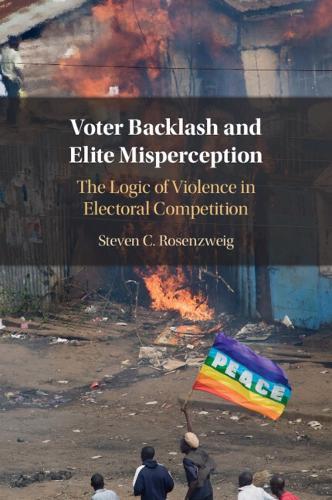
Existing theories of election-related violence often assume that if elites instigate violence, they must benefit electorally from doing so. With a focus on Kenya, this book employs a wide array of data and empirical methods to demonstrate that - contrary to conventional wisdom - violence can be a costly strategy resulting in significant voter backlash. The book argues that politicians often fail to perceive these costs and thus employ violence as an electoral tactic even when its efficacy is doubtful. Election-related violence can therefore be explained not solely by the electoral benefits it provides, but by politicians' misperceptions about its effectiveness as an electoral tactic. The book also shows that violence in founding elections - the first elections held under a new multiparty regime - has long-lasting effects on politicians (mis)perceptions about its usefulness, explaining why some countries' elections suffer from recurrent bouts of violence while others do not.
Full Product Details
Author: Steven C. Rosenzweig (Boston University)
Publisher: Cambridge University Press
Imprint: Cambridge University Press
Dimensions:
Width: 15.20cm
, Height: 1.30cm
, Length: 22.90cm
Weight: 0.367kg
ISBN: 9781009354899
ISBN 10: 1009354892
Pages: 221
Publication Date: 06 February 2025
Audience:
General/trade
,
General
Format: Paperback
Publisher's Status: Active
Availability: Manufactured on demand

We will order this item for you from a manufactured on demand supplier.
Reviews
'Do politicians benefit from using violence against voters? Prevailing theories assume that violence works, but this meticulously executed book suggests otherwise, showing that violence does not help and may even hurt parties and candidates. The book argues that elite misperceptions explain why politicians use violence regardless, and presents sophisticated evidence for voters and politicians in Kenya to support this claim. This interesting twist on the logic of violence in electoral competition will inspire scholarship for years to come.' Ursula Daxecker, University of Amsterdam 'With an extremely important new book on election violence, Rosenzweig documents a disconnect between elite perception and citizen opinion, moving us much closer to understanding how to meaningfully reduce election violence. He finds that strategies used in founding elections play an outsized role in determining what 'works' to win elections such that some countries fall into a more violent pattern, and that politicians do not know the degree to which election violence is highly unpopular. Together, these findings suggest that politicians can be convinced that peaceful elections are in their own best interest at the ballot box. Such persuasion away from violence, driven ultimately by the unpopularity of election violence among voters, has the potential to create a new and more stable peace.' Susan Hyde, University of California, Berkeley 'This highly compelling book is important in both scholarly and substantive terms, as it provides a rigorous demonstration of the cost of electoral violence to perpetrators. This is a message that needs to get out to as many people as possible, to minimize the use of violence as an electoral tool.' Sarah Birch, King's College London 'Rosenzweig's contribution to theory is novel and important … His empirical strategy is rich, detailed, and multifaceted, demonstrating the best of contemporary comparative politics that combines deep case knowledge, microlevel data collection, and careful attention to inference with clearly delimited scope conditions and attention to broader implications. With its careful attention to detailed technical matters while achieving readability and clarity, [the book] is also a masterclass for PhD students wanting to learn how to successfully turn dissertations into first books. I highly recommend this book to students and scholars of contemporary democratic politics.' James D. Long, Perspectives on Politics
Author Information
Steven C. Rosenzweig is Assistant Professor in Political Science at Boston University. His research focuses on electoral violence and democratic accountability.