Awards
- Nominated for Reginald Zelnik Book Prize in History 2010
Overview
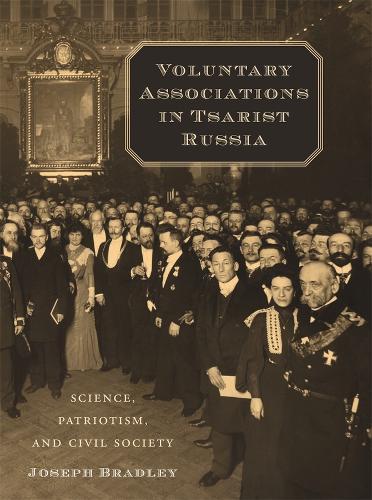
On the eve of World War I, Russia, not known as a nation of joiners, had thousands of voluntary associations. Joseph Bradley examines the crucial role of voluntary associations in the development of civil society in Russia from the late eighteenth to the early twentieth century. Russians populated a growing public sphere with societies based on the model of the European enlightenment. Owing to the mission of such learned associations as the Free Economic Society, the Moscow Agricultural Society, and the Russian Geographical Society, civil society became inextricably linked to patriotism and the dissemination of scientific knowledge. Although civil society and the autocratic state are often described as bitter rivals, cooperation in the project of national prestige and prosperity was more often the rule. However, an increasing public assertiveness challenged autocratic authority, and associations became a focal point of a contradictory political culture: they fostered a state-society partnership but at the same time were a critical element in the effort to emancipate society from autocracy and arbitrary officialdom.
Full Product Details
Author: Joseph Bradley
Publisher: Harvard University Press
Imprint: Harvard University Press
Dimensions:
Width: 15.60cm
, Height: 3.30cm
, Length: 23.50cm
Weight: 0.703kg
ISBN: 9780674032798
ISBN 10: 0674032799
Pages: 384
Publication Date: 01 June 2009
Audience:
Adult education
,
Further / Higher Education
Format: Hardback
Publisher's Status: Active
Availability: Out of stock

The supplier is temporarily out of stock of this item. It will be ordered for you on backorder and shipped when it becomes available.
Reviews
This outstanding book presents an important new perspective on prerevolutionary Russian social and political history through its focus on private nongovernmental associations. While most other scholars have emphasized the paucity of voluntary associations and the overwhelming dominance of the state throughout Russian history, this exemplary study convincingly rebuts those viewpoints and argues that by the end of the 19th century, the burgeoning network of associations and societies had created the institutional basis for civil society in Russia. -- N. M. Brooks Choice 20100501
This splendid book is lucidly written, shrewdly organized, well researched and forcefully argued. Bradley's contention that voluntary organizations played an indispensable role in the formation of Russian civil society is sound. His exploration of the relationship between voluntary associations and Russia's central government is both intelligent and richly suggestive for historians of Russian political culture. This is a first-rate book that will secure wide readership in Russian imperial history and modern European history. -- Gary M. Hamburg, Claremont McKenna College Bradley adds significantly to our understanding of social processes and state-society relations in tsarist Russia. Educated Russians seized opportunities provided by the country's need for science and education and within the constraints maintained by the regime, they created something plausibly described as civil society. A major strength of the book is the consistent comparison with associational activity in Europe. Bradley makes an important contribution in showing that nineteenth-century Russia was not as different from its Western neighbors as many less well-documented accounts suggest. -- Harley Balzer, Georgetown University This outstanding book presents an important new perspective on prerevolutionary Russian social and political history through its focus on private nongovernmental associations. While most other scholars have emphasized the paucity of voluntary associations and the overwhelming dominance of the state throughout Russian history, this exemplary study convincingly rebuts those viewpoints and argues that by the end of the 19th century, the burgeoning network of associations and societies had created the institutional basis for civil society in Russia. -- N. M. Brooks * Choice *
This outstanding book presents an important new perspective on prerevolutionary Russian social and political history through its focus on private nongovernmental associations. While most other scholars have emphasized the paucity of voluntary associations and the overwhelming dominance of the state throughout Russian history, this exemplary study convincingly rebuts those viewpoints and argues that by the end of the 19th century, the burgeoning network of associations and societies had created the institutional basis for civil society in Russia.--N. M. Brooks Choice (05/01/2010)
Author Information
Joseph Bradley is Professor of History at the University of Tulsa.