Overview
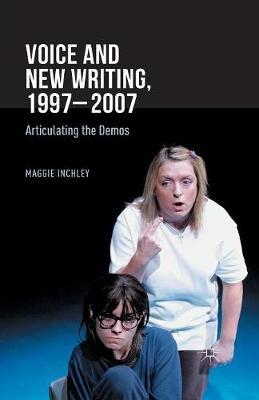
In New Labour's empathetic regime, how did diverse voices scrutinize its etiquettes of articulation and audibility? Using the voice as cultural evidence, Voice and New Writing explores what it means to 'have' a voice in mainstream theatre and for newly included voices to negotiate with the institutions that 'find' and 'represent' their identities.
Full Product Details
Author: M. Inchley
Publisher: Palgrave Macmillan
Imprint: Palgrave Macmillan
Edition: 1st ed. 2015
Weight: 2.776kg
ISBN: 9781349492411
ISBN 10: 1349492418
Pages: 204
Publication Date: 01 January 2015
Audience:
Professional and scholarly
,
Professional & Vocational
Format: Paperback
Publisher's Status: Active
Availability: Manufactured on demand

We will order this item for you from a manufactured on demand supplier.
Reviews
Inchley (Queen Mary, Univ. of London, UK) makes a case for the ability of theater to inspire democratic voices. Exploring voice as 'scripted and trained, performed and perceived,' the author dissects and challenges voice as political authority within a democratic debate. ... Includes photographs and detailed notes. Summing Up: Highly recommended. Graduate students, researchers. (J. Artman, Choice, Vol. 53 (5), January, 2016) 'Maggie Inchley's book is an important and timely contribution to debates about theatre's ability to speak to and for contemporary society. She offers the reader new perspectives and new methods for political theatre and its subjects.' - Kate Dorney, Victoria & Albert Museum, UK 'In an age where terms such as 'empowerment', 'diversity ' and 'plurality' are the meat and mead of the mission statement within any self-respecting theatre that takes itself seriously in promoting new writing, comes another ubiquitous term 'new voices'. Because we so unquestioningly assume an accordance with these goals (who but the churlish could disagree!) makes Maggie Inchley's Voice and New Writing, 1997-2007: Articulating the Demos, such a timely intervention. In her provocative analysis, 'voice' is not only stripped back to its original praxis and value in drama training, but in an extensive and wide ranging analysis she demonstrates how crucibles of new writing culture such as the Royal Court, the Traverse and the National Theatre actually respond to the new or marginalized voice. Inchley's book asks some difficult questions and provides some troubling answers about how, in a supposedly liberal theatre culture, the limits to which new voices are allowed to speak, how these voices are covertly policed and controlled and how all too often the ways in which the unmediated political apparatus of the voice is muzzled into paying lip-service only.' - Graham Saunders, University of Reading, UK
Author Information
Maggie Inchley is a lecturer in Drama, Theatre and Performance at Queen Mary University of London, UK, and has previously lectured at the University of Surrey and Birkbeck College. As a practitioner she has directed and developed work for theatre, radio, and applied fields.