Overview
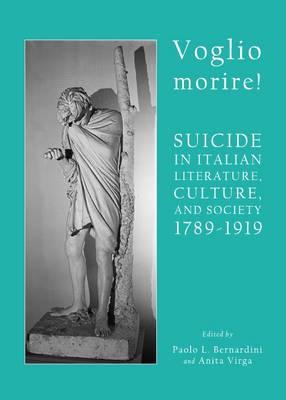
The theme of suicide was of paramount importance in Italy in the long nineteenth century, from the French revolution to the outbreak of World War I. A number of writers, intellectuals, politicians, and artists wrote about suicide, and a very high number of people killed themselves, for several reasons. There were suicides for love and for homeland, suicides for despair, and suicides for ennui. In Italy, once a very traditional, Catholic country, where suicide was very uncommon and rarely treated as a subject of moral theology or literature, it suddenly became extremely widespread. This book provides the first interdisciplinary account of this phenomenon, taken from several angles, including literature, the arts, politics, society, and philosophy, as well as sociology. Its authors rank among the best international specialists on suicide, and the figures dealt with include major intellectuals and writers such as Ugo Foscolo, Emilio Salgari, Giuseppe Pellizza da Volpedo, Giacomo Leopardi and Carlo Michelstaedter.
Full Product Details
Author: Paolo L. Bernardini ,
Anita Virga
Publisher: Cambridge Scholars Publishing
Imprint: Cambridge Scholars Publishing
Edition: Unabridged edition
Dimensions:
Width: 14.80cm
, Height: 2.80cm
, Length: 21.20cm
Weight: 0.540kg
ISBN: 9781443844666
ISBN 10: 1443844667
Pages: 305
Publication Date: 28 March 2013
Audience:
College/higher education
,
Professional and scholarly
,
Postgraduate, Research & Scholarly
,
Professional & Vocational
Format: Hardback
Publisher's Status: Active
Availability: Available To Order

We have confirmation that this item is in stock with the supplier. It will be ordered in for you and dispatched immediately.
Reviews
These exceptionally erudite essays shed new light on the discussion of suicide in the intellectual, moral and legal debate in nineteenth-century Italy. This volume is likely to become one of the standard books on this important subject, the study of which is essential to appreciate the development of Italian culture and society in a critical period of Italian and European history. - Diego Lucci, Associate Professor of History and Philosophy, American University in Bulgaria Beautifully written, meticulously researched, this book suggests a new overview of Italian modern history. - Fabio Finotti, Mariano DiVito Professor of Italian Studies, University of Pennsylvania Suicide is a magnetic subject for historians, sociologists and novelists, perhaps because it offers a challenging perspective on society, via the thoughts and feelings of the most marginal of all minorities: those whom their culture literally cannot accommodate - whom it fails and who are its definitive failures. Few studies do justice to suicide in Catholic countries, and no one has ever before confronted the subject as a theme of Italian history. Voglio Morire, in consequence, is one of the most surprising and revealing books about Italy's nineteenth century. All the essays are insightful and the collection as a whole is a model of interdisciplinarity. - Felipe Fernandez-Armesto, William P. Reynolds Professor of History, University of Notre Dame
These exceptionally erudite essays shed new light on the discussion of suicide in the intellectual, moral and legal debate in nineteenth-century Italy. This volume is likely to become one of the standard books on this important subject, the study of which is essential to appreciate the development of Italian culture and society in a critical period of Italian and European history. - Diego Lucci, Associate Professor of History and Philosophy, American University in Bulgaria Beautifully written, meticulously researched, this book suggests a new overview of Italian modern history. - Fabio Finotti, Mariano DiVito Professor of Italian Studies, University of Pennsylvania Suicide is a magnetic subject for historians, sociologists and novelists, perhaps because it offers a challenging perspective on society, via the thoughts and feelings of the most marginal of all minorities: those whom their culture literally cannot accommodate - whom it fails and who are its definitive failures. Few studies do justice to suicide in Catholic countries, and no one has ever before confronted the subject as a theme of Italian history. Voglio Morire, in consequence, is one of the most surprising and revealing books about Italy's nineteenth century. All the essays are insightful and the collection as a whole is a model of interdisciplinarity. - Felipe Fernandez-Armesto, William P. Reynolds Professor of History, University of Notre Dame
Author Information
Paolo L. Bernardini (1963) teaches Early Modern and Modern European History at the University of Insubria, Como, Italy.Anita Virga (1983) teaches Italian Studies at the University of Witwatersrand, Johannesburg, South Africa.