Overview
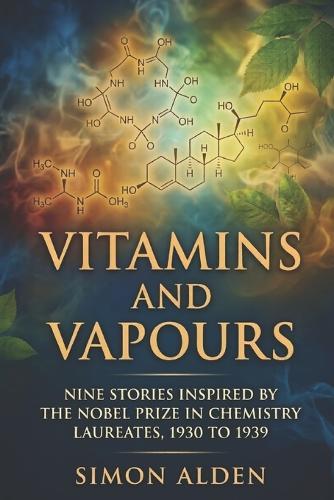
Vitamins and Vapours is the fourth volume in a series of thirteen books, each covering a decade of Nobel Prize winners in Chemistry through a collection of original short stories. Between 1930 and 1939, chemistry shifted from extracting nature to replicating its most intimate architectures. Scientists mapped the chemical constitution of blood and leaves, engineered high-pressure industrial environments, and turned the invisible boundary layers of surface chemistry into a measurable science. They discovered heavy hydrogen, proved that humans could synthesize entirely new radioactive elements, mapped molecular structures using dipole moments, and translated the elusive magic of vitamins and hormones into precise, reproducible organic structures. The laboratory became the place where public health, industrial might, and fundamental physics collided. In this fourth volume, nine prizes become nine works of literary fiction: a counterfeit ring selling fake nutritional extracts that is exposed when a regulator looks past colour to strict structural logic; an engineer who discovers that a high-pressure reactor's mysterious failures are actually subtle, weaponized pressure cycles designed to force a corporate buyout; a corrupt city procurement scheme where inequality is engineered into the skipped surface preparation of an anti-corrosion coating; a fatal factory accident falsely blamed on human error, until heavy hydrogen reveals the unforgiving isotope-sensitive kinetics of the plant; a private medical laboratory that secures its monopoly by manipulating delivery schedules so their competitors' artificial isotopes decay before reaching patients; a smuggling operation that separates polar vapours mid-transit using electric fields, undone by a customs chemist who understands dipole-driven behaviour; a scurvy outbreak in a school caused by a supplier who substitutes a biologically weak structural analogue for true vitamin C; an act of economic warfare waged through the deliberate light-exposure and degradation of fragile carotenoids in a food-storage initiative; and, finally, an act of industrial espionage within a fragrance empire where the stolen property is the architectural secret to building large molecular rings. Every discovery is accurate. Every story is new. Together they make the 1930s not a chapter in a textbook but a living world, full of people for whom these ideas arrived not as settled knowledge but as sudden, disorienting, and irreversible light.
Full Product Details
Author: Simon Alden
Publisher: Independently Published
Imprint: Independently Published
Volume: 4
Dimensions:
Width: 15.20cm
, Height: 1.00cm
, Length: 22.90cm
Weight: 0.263kg
ISBN: 9798259105706
Pages: 190
Publication Date: 06 May 2026
Audience:
General/trade
,
General
Format: Paperback
Publisher's Status: Active
Availability: Available To Order

We have confirmation that this item is in stock with the supplier. It will be ordered in for you and dispatched immediately.