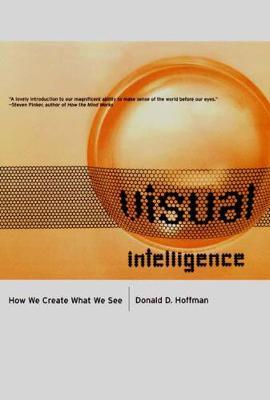
Full Product Details
Author: Donald Hoffman (University of California, Irvine)
Publisher: WW Norton & Co
Imprint: WW Norton & Co
Edition: New edition
Dimensions:
Width: 15.70cm
, Height: 2.30cm
, Length: 23.60cm
Weight: 0.614kg
ISBN: 9780393319675
ISBN 10: 0393319679
Pages: 320
Publication Date: 17 February 2000
Audience:
General/trade
,
General
Format: Paperback
Publisher's Status: Out of Stock Indefinitely
Availability: In Print

Limited stock is available. It will be ordered for you and shipped pending supplier's limited stock.
Reviews
A cognitive scientist synthesizes recent findings of vision researchers to unveil some of the secrets and explore still-unsolved puzzles of how we see. Hoffman (Univ. of Calif., Irvine) argues that children are born with innate rules of universal vision just as Noam Chomsky has argued for innate rules of universal grammar. These inborn rules of vision allow children to acquire, through visual experience, rules of visual processing by which the child constructs, in a multiplicity of stages, visual scenes. The first 20 of these roles, as spelled out here, have to do with seeing shapes. Rule 1, for example, is Always interpret a straight line in an image as a straight line in 3D. Next are eight rules for color and seven rules for motion. These are illustrated with line drawings and photographs - 120 in black-and-white and 30 in color - that draw the reader into participating in his demonstrations. The problem of showing motion is neatly solved by Hoffman: he directs readers to his Web site, where all the motion displays discussed here can be viewed. Like V.S. Ramachandran (Phantoms in the Brain, p. 1096), Hoffman draws on patients with pertinent brain anomalies to explain normal visual intelligence. Also like Ramachandran, he uses phantom limbs to explore briefly the sense of touch, for Hoffman is persuaded that the brain constructs not only what is seen, but also what is felt, heard, smelled, and tasted. He closes with a venture into the world of virtual reality that inspires a series of probing questions into the relationship between what we see relationally (i.e., what we interact with) and what we see phenomenally (i.e., what the visual intelligence constructs). With its many fascinating visual demonstrations, Hoffman's presentation fully engagesthe reader, demanding and rewarding attention. (Kirkus Reviews)
This is a bit of a surprise. Books about cognition are often alarmingly difficult to understand, making one wonder whether cognitive scientists are any good at cognition. But Donald Hoffman is a cognitive scientist who both understands things and explains them. Although this book is really about how the brain works, it is absolutely fascinating just for its discussion and explanation of optical illusions and the tricks the eye plays on the brain. (Kirkus UK)
Author Information
Donald Hoffman is professor of cognitive science at the University of California, Irvine. His writing has appeared in Scientific American and Edge, and his work has been featured in the Atlantic, Wired, and Quanta. He resides in Irvine, California.