Overview
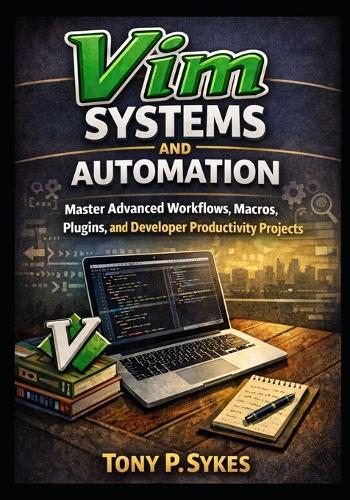
This book presents Vim as a professional development system, not a collection of shortcuts or personal tweaks. It focuses on how to design, build, and operate Vim configurations with the same discipline used for real software systems. The goal is long-term stability, predictable performance, and maintainable automation. Instead of isolated tips, the book explains how different parts of a Vim environment fit together. Configuration, plugins, automation, tooling, and workflows are treated as coordinated components. Readers learn how to avoid common problems such as slow startup, fragile setups, broken updates, and undocumented behavior that accumulates over years of use. The content is written for serious users who rely on Vim daily and need it to scale across projects, machines, and teams. It assumes basic Vim knowledge and focuses on system design, integration, optimization, and maintenance rather than beginner-level usage. WHAT IS INSIDE THE BOOK - System thinking applied to Vim configuration - Productivity architecture and workflow design - Configuration layering and environment isolation - Version control strategies for editor settings - Documentation practices for long-term maintainability - Modular configuration design - Conditional loading and environment detection - Portable and cross-machine Vim setups - Backup and recovery strategies - Startup profiling and performance analysis - Plugin load analysis and lazy loading - Memory management and speed benchmarking - Advanced macro design - Batch editing pipelines and command-line automation - Error handling and automation projects - Mapping strategy and leader key design - Context-aware shortcuts and ergonomic layouts - Fatigue reduction techniques - Plugin evaluation and dependency management - Update policies and security practices - Plugin stack design and governance - Vimscript foundations - Lua integration for modern Vim and Neovim - Event hooks and custom command systems - Full plugin development workflow - Git integration and diff workflows - Merge and conflict resolution - History navigation and repository-aware workflows - LSP configuration - Linters, formatters, and testing integration - Build automation and toolchain orchestration - System blueprints and implementation planning - Integration testing and optimization cycles - Long-term maintenance strategies - Advanced command index appendix WHO THIS BOOK IS FOR - Developers who already use Vim regularly - Software engineers working on large or complex codebases - DevOps and platform engineers - Engineers managing multi-language projects - Technical leads responsible for tooling and standards - Advanced Vim users who want structured, scalable systems - Professionals who value performance and stability WHY THIS BOOK SHOULD BE ON YOUR LIST - Vim setups grow complex and fragile over time - Unstructured configurations lead to slow startup and failures - Plugin collections break without governance - Performance degrades without architectural planning - Most Vim books focus on commands, not systems - Professional teams need reproducible editor platforms - Long-term maintainability is rarely taught - This book provides a system-level framework instead of ad hoc tips
Full Product Details
Author: Tony P Sykes
Publisher: Independently Published
Imprint: Independently Published
Volume: 2
Dimensions:
Width: 17.80cm
, Height: 1.70cm
, Length: 25.40cm
Weight: 0.558kg
ISBN: 9798247429937
Pages: 320
Publication Date: 08 February 2026
Audience:
General/trade
,
General
Format: Paperback
Publisher's Status: Active
Availability: Available To Order

We have confirmation that this item is in stock with the supplier. It will be ordered in for you and dispatched immediately.