Overview
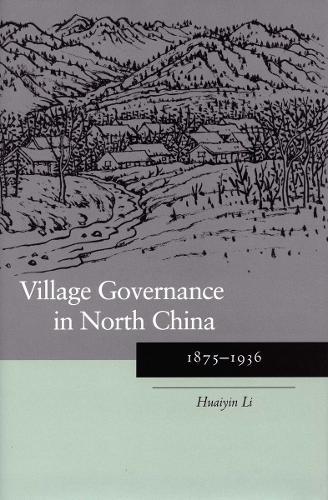
This book is about village governance in China during the late 19th and early 20th centuries. Drawing on government archives from Huailu county, Ilebei province, this book explores the operational realities of local practices as well as institutionally imposed social control, land taxation, and ""self government"" at the village level. Its analysis of peasant behaviors bridges the gap between the rational choice and moral economy models by taking into account both material and symbolic dimensions of power and interest in the peasant community. The author's interpretation of village/state relations before 1900 transcends the state and society dichotomy and accentuates the interplay between formal and informal institutions and practices. His account of ""state making"" after 1900 underscores the continuity of endogenous arrangements in the course of institutional formalization and the interpenetration between official discourse and popular notions in the new process of political legitimization.
Full Product Details
Author: Huaiyin Li
Publisher: Stanford University Press
Imprint: Stanford University Press
Edition: New edition
Dimensions:
Width: 15.20cm
, Height: 2.50cm
, Length: 22.90cm
Weight: 0.590kg
ISBN: 9780804750912
ISBN 10: 0804750912
Pages: 344
Publication Date: 09 March 2005
Audience:
General/trade
,
General
Format: Hardback
Publisher's Status: Active
Availability: In Print

This item will be ordered in for you from one of our suppliers. Upon receipt, we will promptly dispatch it out to you. For in store availability, please contact us.
Reviews
This book is a hugely informative study of the changing relation between villages and the state during the late Qing and early Republican periods ... for anyone hoping to do research in this field it will be essential reading. -- China Review International This is truly a well-written book on China's village governance, a very good example of combining theory, first-hand materials and sophisticated analysis. Even though Li is cautious in extending his arguments into other areas and epochs, this book still helps shed new light to the traditional Chinese local governance. -- Journal of Chinese Political Science
This book is a hugely informative study of the changing relation between villages and the state during the late Qing and early Republican periods ... for anyone hoping to do research in this field it will be essential reading. --China Review International This is truly a well-written book on China's village governance, a very good example of combining theory, first-hand materials and sophisticated analysis. Even though Li is cautious in extending his arguments into other areas and epochs, this book still helps shed new light to the traditional Chinese local governance. --Journal of Chinese Political Science
This book is a hugely informative study of the changing relation between villages and the state during the late Qing and early Republican periods...for anyone hoping to do research in this field it will be essential reading. -China Review International
This book is a hugely informative study of the changing relation between villages and the state during the late Qing and early Republican periods....for anyone hoping to do research in this field it will be essential reading. -- China Review International
“This book is a hugely informative study of the changing relation between villages and the state during the late Qing and early Republican periods....for anyone hoping to do research in this field it will be essential reading.”— China Review International
Author Information
Huaiyin Li teaches modern Chinese history at the University of Texas at Austin.