|
|
|||
|
||||
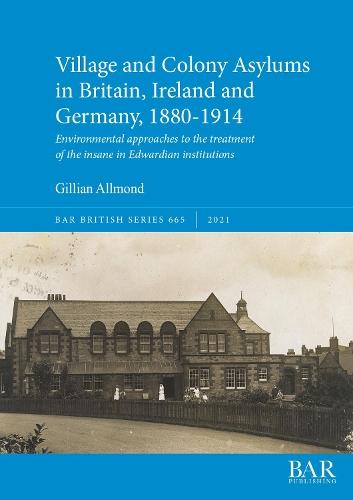
OverviewThis book analyses the buildings, interiors and landscapes of asylums for the insane poor in the early part of the twentieth century, exploring the ways in which environments were seen as therapeutic. An innovative type of asylum layout - the village or colony asylum - is considered in detail. Gillian Allmond offers an original approach to asylum analysis, using field observation, documents and published materials to connect asylum materiality to contemporary discourses of health and poverty. The book shows how the Edwardian understanding of the therapeutic qualities of light and air, together with the promotion of bourgeois domestic ideals, influenced the design of exteriors and interiors in the hope of remaking the minds of the mentally ill. Layout analysis includes the discovery that at least one asylum was based on Ebenezer Howard's 'garden city'. This innovative study is a significant contribution to the growing literature on the historical archaeology of institutions. Full Product DetailsAuthor: Gillian AllmondPublisher: BAR Publishing Imprint: BAR Publishing Weight: 1.296kg ISBN: 9781407357584ISBN 10: 1407357581 Pages: 325 Publication Date: 30 September 2021 Audience: Professional and scholarly , Professional & Vocational Format: Paperback Publisher's Status: Active Availability: Available To Order We have confirmation that this item is in stock with the supplier. It will be ordered in for you and dispatched immediately. Table of ContentsList of Figures List of Tables Abbreviations Glossary of Terms 1. Introduction 1.1. Archaeology of institutions 1.2. Archaeology of the asylum 1.3. Other scholarship relating to asylum environments 1.4. Buildings archaeology and buildings theory 1.5. Approach taken in this study 1.6. Methodology 1.6.1. Material evidence 1.6.2. Textual and other non-material sources 1.7. Discussion and conclusion 2. Historical Background 2.1. Introduction 2.2. England and Wales 2.2.1. Institutional care of the insane prior to public asylums 2.2.2. Establishment of public asylum system 2.2.3. Colony asylums in England 2.3. Ireland 2.3.1. Institutional care of the insane poor prior to public asylums 2.3.2. Establishment of public asylum system 2.3.3. Colony asylums in Ireland 2.4. Scotland 2.4.1. Institutional care of the insane prior to public asylums 2.4.2. Establishment of public asylum system 2.4.3. Village/colony asylums in Scotland 2.5. Germany 2.5.1. Institutional care of the insane prior to public asylums 2.5.2. Establishment of public asylum system 2.5.3. Colony asylums in Germany 2.6. Development of the colony asylum in Europe 2.7. Medical attitudes to insanity at the turn into the twentieth century 3. Study Sites: Scotland 3.1. Aberdeen District Lunatic Asylum (Kingseat) 3.1.1. Introduction 3.1.2. Construction of asylum 3.1.3. Treatments 3.1.4. Escapes, restraint and injuries 3.1.5. Staffing 3.1.6. Site 3.1.7. Layout 3.1.8. Selected buildings 3.1.9. Medical superintendents at Kingseat and their views on insanity 3.2. Edinburgh District Lunatic Asylum (Bangour Village) 3.2.1. Introduction 3.2.2. Construction of asylum 3.2.3. Staffing 3.2.4. Site and layout 3.2.5. Selected buildings 3.2.6. Medical advisors and superintendents at Bangour and their views on insanity 3.3. Renfrew District Asylum (Dykebar) 3.3.1. Introduction 3.3.2. Construction of asylum 3.3.3. Site layout and structures 4. Study Sites: Ireland, England and Germany 4.1. Belfast District Lunatic Asylum (Purdysburn) 4.1.1. Introduction 4.1.2. Site and layout 4.1.3. Selected buildings 4.1.4. Medical superintendent at Purdysburn and his views on insanity 4.2. Sixth Lancashire County Asylum (Whalley) 4.2.1. Introduction 4.2.2. Construction of asylum 4.2.3. Site and layout 4.2.4. Selected buildings 4.3. Alt Scherbitz Provincial Asylum (Die Provinzial Irrenanstalt zu Alt Scherbitz) 4.3.1. Introduction 4.3.2. Construction of asylum 4.3.3. Selected buildings 5. Locations and Layouts 5.1. Factors affecting choice of site 5.1.1. Environment at the turn into the twentieth century 5.1.2. Ventilation 5.1.3. Open-air treatment 5.2. Ireland 5.2.1. Belfast District Lunatic Asylum (Purdysburn) 5.3. Scotland 5.3.1. Edinburgh District Lunatic Asylum (Bangour) 5.3.2. Renfrew District Lunatic Asylum (Dykebar) 5.3.3. Aberdeen District Lunatic Asylum (Kingseat) 5.4. England 5.4.1. Sixth Lancashire County Asylum (Whalley) 5.5. Germany 5.5.1. Alt Scherbitz 5.6. Discussion and conclusion 6. Light and the colony asylum 6.1. Introduction 6.2. Light and its discourses 6.3. Darkness in the Victorian slums 6.4. Natural light provision in Scottish, Irish and English asylums 6.5. Light at Purdysburn 6.6. Interior movement of light 6.7. The winter gardens at Purdysburn 6.8. Discussion and conclusion 7. Domesticity and the colony asylum 7.1. Historical background to domesticity in the asylum 7.2. Contemporary primary evidence relating to domesticity 7.3. External architecture 7.3.1. Alt Scherbitz, Germany 7.3.2. Aberdeen District Asylum (Kingseat) 7.3.3. Edinburgh District Asylum (Bangour Village) 7.3.4. Renfrew District Asylum (Dykebar) 7.3.5. Belfast District Asylum (Purdysburn) 7.3.6. Sixth Lancashire Asylum (Whalley) 7.4. Internal layouts, decoration and furnishings 7.4.1. Alt Scherbitz, Germany 7.4.2. Aberdeen District Asylum (Kingseat) 7.4.3. Edinburgh District Asylum (Bangour Village) 7.4.4. Renfrew District Asylum (Dykebar) 7.4.5. Belfast District Asylum (Purdysburn) 7.4.6. Sixth Lancashire Asylum (Whalley) 7.5. Discussion and conclusion 8. Discussion 8.1. The colony asylum and hygiene 8.2. The colony asylum and rural location 8.3. The colony asylum as 'home-like' 8.4. The colony asylum and bourgeois values 8.5. The colony asylum and spatial segregation 8.6. The colony asylum, liberty and individuality 8.7. Conclusions 9. Conclusion BibliographyReviews{\rtf1\fbidis\ansi\ansicpg1252\deff0\deflang2057{\fonttbl{\f0\fswiss\fprq2\fcharset0 Calibri;}{\f1\fnil\fcharset0 Verdana;}} \viewkind4\uc1\pard\ltrpar\lang1033\f0\fs22\lquote I would recommend the book to all those interested in the history of mental health care, and especially to many students considering a mixed methods approach to postgraduate research into the evolution of mental health services. It is a fascinating, stimulating, highly enriching read.\rquote P. Nolan, British Journal of Mental Health Nursing, 2022\par \lang2057\par \pard\ltrpar\sa160\sl252\slmult1\lquote An excellent study. This will be a much-referenced work, and should be of interest not only in Britain and Ireland, but also in North America and Australasia.\rquote Professor Harold Mytum, University of Liverpool \f1\fs17\par } 'An excellent study. This will be a much-referenced work, and should be of interest not only in Britain and Ireland, but also in North America and Australasia.' Professor Harold Mytum, University of Liverpool {\rtf1\fbidis\ansi\ansicpg1252\deff0\deflang2057{\fonttbl{\f0\fswiss\fprq2\fcharset0 Calibri;}{\f1\fnil\fcharset0 Verdana;}} \viewkind4\uc1\pard\ltrpar\lang1033\f0\fs22\lquote I would recommend the book to all those interested in the history of mental health care, and especially to many students considering a mixed methods approach to postgraduate research into the evolution of mental health services. It is a fascinating, stimulating, highly enriching read.\rquote P. Nolan, British Journal of Mental Health Nursing, 2022\par \lang2057\par \pard\ltrpar\sa160\sl252\slmult1\lquote An excellent study. This will be a much-referenced work, and should be of interest not only in Britain and Ireland, but also in North America and Australasia.\rquote Professor Harold Mytum, University of Liverpool \f1\fs17\par } Author InformationGillian Allmond completed her doctoral study of the archaeology of asylums in 2018. She has been a professional researcher of buildings and landscapes since 2009 and has published widely on topics related to physical and mental health and environments. She is currently a Visiting Scholar in Archaeology and Palaeoecology, Queen's University Belfast. Tab Content 6Author Website:Countries AvailableAll regions |
||||