Overview
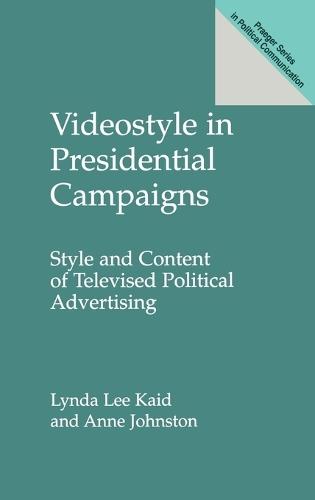
Since 1952, when Eisenhower's media consultants decided they could warm up the General's personality and overcome selective exposure by using short spots on television, advertising has played a major role in American presidential campaigns. By the late 1990s, candidates and their political parties spend hundreds of millions on TV ads. Political spots have become the dominant form of communication between voters and candidates. Kaid and Johnston report the results of a systematic and thorough analysis of virtually all of the political commercials used in general election campaigns from 1952 through the 1996 presidential contest. Important to scholars, students, and other researchers involved with political communications, mass communications, and presidential elections.
Full Product Details
Author: Anne Johnston ,
Lynda Kaid
Publisher: Bloomsbury Publishing Plc
Imprint: Praeger Publishers Inc
Dimensions:
Width: 15.60cm
, Height: 1.40cm
, Length: 23.40cm
Weight: 0.517kg
ISBN: 9780275940713
ISBN 10: 0275940713
Pages: 240
Publication Date: 30 October 2000
Recommended Age: From 7 to 17 years
Audience:
College/higher education
,
Professional and scholarly
,
Undergraduate
,
Postgraduate, Research & Scholarly
Format: Hardback
Publisher's Status: Active
Availability: Manufactured on demand

We will order this item for you from a manufactured on demand supplier.
Reviews
<p>Recommended for general readers, upper-division undergraduates, graduate students, and professionals. - <p>Choice
.,. Kaid and Johnston focus on the personal style candidates develop through television advertising. They claim a candidates's style is revealed initially through a general communication style, a pattern of behavior that is apparent, consistent, and recurring. The writers of the well-researched, easy to read book present extensive data to support their conclusions about one of the more significant aspects of contemporary American political life. -Great Plains Quarterly
Author Information
LYNDA LEE KAID is Professor of Communication and George Lynn Cross Research Professor at the University of Oklahoma where she also serves as the Director of the Political Communication Center and supervises the Political Commercial Archive. She is the author or editor of 14 books, including The Electronic Election, New Perspectives on Political Advertising, Mediated Politics in Two Cultures, Political Advertising in Western Democracies and Political Campaign Communication: A Bibliography and Guide to the Literature. ANNE JOHNSTON is an Associate Professor in the School of Journalism and Mass Communication at the University of North Carolina, Chapel Hill. She has authored and co-authored work on cross-cultural studies of political broadcasting, styles and strategies in political advertising, and women and the media. Her articles have appeared in the Journal of Applied Communication Research, Journalism Quarterly, Journal of Communication, and Political Communication.