Overview
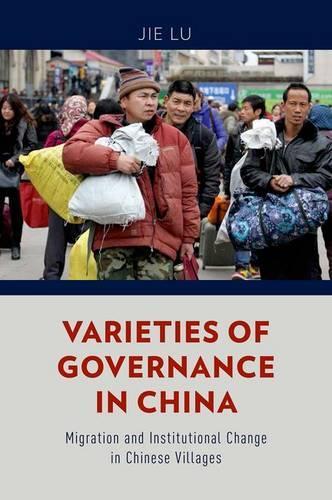
It is well understood that ""good institutions"" are essential for good governance. But even institutions that follow similar designs vary significantly with regard to performance across countries and even across regions within the same country. Following China's abolishment of the Commune system to accommodate market-oriented reforms in the 1980s, decentralized, grassroots democracy was introduced in rural China in order to improve the quality of local governance. In this book, Jie Lu looks at variance among local governance institutions in China to examine under what conditions indigenously cultivated institutions or externally imposed institutions are able to succeed, particularly under pressures of economic modernization. Lu argues that any governance institution can perform effectively as long as it can produce collective action and accountability, but the relative effectiveness of institutions is contingent upon the social environment in which they are embedded. When economic conditions prompt outward migration, social environments are reshaped such that rules-based formal institutions will trump relation-based indigenous forms. In identifying the optimal social conditions for the effective performance of different governance institutions and theorizing the effects of social change on these institutions, Lu deepens understanding of how institutions, particularly in developing countries, change, and under what conditions institutional modernization or engineering may succeed or fail.
Full Product Details
Author: Jie Lu (Assistant Professor of Government, Assistant Professor of Government, American University)
Publisher: Oxford University Press Inc
Imprint: Oxford University Press Inc
Dimensions:
Width: 23.40cm
, Height: 2.00cm
, Length: 16.00cm
Weight: 0.590kg
ISBN: 9780199378746
ISBN 10: 0199378746
Pages: 312
Publication Date: 15 January 2015
Audience:
College/higher education
,
Professional and scholarly
,
Undergraduate
,
Postgraduate, Research & Scholarly
Format: Hardback
Publisher's Status: Active
Availability: To order

Stock availability from the supplier is unknown. We will order it for you and ship this item to you once it is received by us.
Reviews
This is an impressive study that leaves no doubt in the reader's mind that migration will transform both urban and rural China during this century. Varieties of Governance in China is a multidisciplinary triumph for asking challenging questions on the future of Chinese rural governance and demonstrating that the resultant conversation has the potential to bring scholars from anthropology, sociology, religion, history, political science, and economics together. --Journal of International Affairs
Author Information
Jie Lu is Assistant Professor of Government at American University. Lu studies local governance, the political economy of institutional change, public opinion, and political participation. Lu's work has appeared or will appear in Comparative Political Studies, Comparative Politics, Political Psychology, Politics & Society, Political Communication, Journal of Democracy, China Quarterly, and Journal of Contemporary China.