Overview
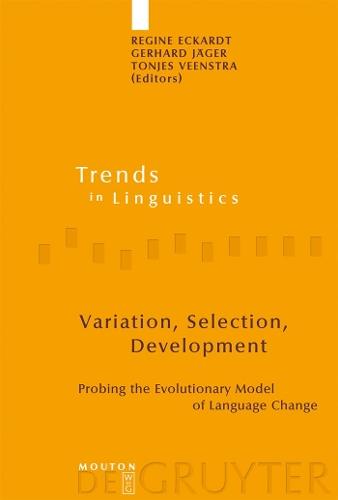
Can language change be modelled as an evolutionary process? Can notions like variation, selection and competition be fruitfully applied to facts of language development? The present volume ties together various strands of linguistic research which can bring us towards an answer to these questions. In one of the youngest and rapidly growing areas of linguistic research, mathematical models and simulations of competition based developments have been applied to instances of language change. By matching the predicted and observed developmental trends, researchers gauge existing models to the needs of linguistic applications and evaluate the fruitfulness of evolutionary models in linguistics. The present volume confronts these studies with more empirically-based studies in creolization and historical language change which bear on key concepts of evolutionary models. What does it mean for a linguistic construction to survive its competitors? How do the interacting factors in phases of creolization differ from those in ordinary language change, and how - consequently - might Creole languages differ structurally from older languages? Some of the authors, finally, also address the question how different aspects of our linguistic competence tie in with our more elementary cognitive capacities. The volume contains contributions by Brady Clark et al., Elly van Gelderen, Alain Kihm, Manfred Krifka, Wouter Kusters, Robert van Rooij, Anette Rosenbach, John McWhorter, Teresa Satterfield, Michael Tomasello and Elizabeth C. Traugott. The book brings together contributions from two areas of research: the study of language evolution by means of methods from artifical intelligence/artificial life (like computer simulations and analytic mathematical methods) on the one hand, and empirically oriented research from historical linguistics and creolisation studies that uses concepts from evolutionary theory as a heuristic tool in a qualitative way. The book is thus interesting for readers from both traditions because it supplies them with information about relevant ongoing research and useful methods and data from the other camp.
Full Product Details
Author: Regine Eckardt ,
Gerhard Jäger ,
Tonjes Veenstra
Publisher: De Gruyter
Imprint: De Gruyter Mouton
Volume: 197
Dimensions:
Width: 15.50cm
, Height: 2.40cm
, Length: 23.00cm
Weight: 0.840kg
ISBN: 9783110198690
ISBN 10: 311019869
Pages: 416
Publication Date: 27 February 2008
Recommended Age: College Graduate Student
Audience:
College/higher education
,
Professional and scholarly
,
Undergraduate
,
Postgraduate, Research & Scholarly
Format: Hardback
Publisher's Status: Active
Availability: Out of stock

The supplier is temporarily out of stock of this item. It will be ordered for you on backorder and shipped when it becomes available.
Author Information
Regine Eckardt, University of Göttingen, Germany; Gerhard Jäger, University of Bielefeld, Germany; Tonjes Veenstra, ZAS Berlin, Germany.