Overview
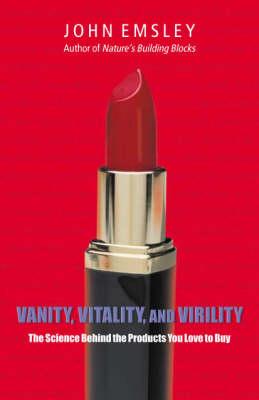
Vanity, Vitality, and Virility is essentially a collection of 'portraits' loosely arranged into 'galleries' that bring together related themes. While it will not advise you what to do if you want to improve your looks, your health, your peace of mind, or your sex life, it does explain the science behind many of the products that claim to be able to do just that. It looks at a range of products and ingredients that impinge on our everyday life and explains in plain language how 30 commonly encountered chemicals work, and how and why we use them. Chapter one, Vanity - no more wrinkles? has an entry on alpha-hydroxy acids. Advertisers call them 'natural fruit acids' but they are products of the chemical industry. They can improve the skin by penetrating the outer layer and stimulating the growth of new skin. But do they really remove wrinkles? Chapter two, Vitality - food for thought, tackles dietary fats: trans fats, essential fatty acids (omega-3 and omega-6 fats), conjugated linoleic acid (CLA), which some say is a necessary preventive against breast cancer despite coming only from animal fats. Chapter three, Virility, Sterility, and Viagra, has a section on 'more and better sex': what natural substances act as aphrodisiacs and can chemists improve upon them? There are substances that can enhance sexual performance and heighten orgasm. How to they work, and are they safe? Chapter four, Germ warfare, contains a section on Hypochlorite: so-called chlorine bleach. It doesn't actually contain chlorine but hypochlorite, and it is this that gives it the power to 'kill all germs stone dead'. But there have been campaigns to ban it because it produces other chemicals when added to water. Chapter five, It's all in the mind, deals with depression and anti-depressants: Prozac, Lithium (used to treat manic depression: the odd thing is that lithium shouldn't work, but does), and Aluminium, once wrongly convicted of causing Alzheimer's Disease. Chapter six, Polymers in unlikely guises, ranges from super-absorbent polymers (SAPs) used in tampons and nappies, to 'whispering asphalt' which modifies bitumen by adding polymers, resulting in road surfaces which are quieter and which produce less spray.
Full Product Details
Author: John Emsley
Publisher: Oxford University Press
Imprint: Oxford University Press
Dimensions:
Width: 15.60cm
, Height: 3.20cm
, Length: 23.40cm
Weight: 0.565kg
ISBN: 9780192805096
ISBN 10: 0192805096
Pages: 272
Publication Date: 01 July 2004
Audience:
General/trade
,
Professional and scholarly
,
General
,
Professional & Vocational
Format: Hardback
Publisher's Status: Active
Availability: To order

Stock availability from the supplier is unknown. We will order it for you and ship this item to you once it is received by us.
Reviews
Emsley knows his everyday chemicals like a farmer knows his sheep.... From depression to cleaning your bathroom, Alzheimer's disease to chewing gum, he discusses the common compounds used in everyday products and remedies and assesses how, why and whether they work. --Financial Times Emsley clearly loves his subject, and writes in a lively style that enhances the fascinating tales he tells, like how castor oil--the object of great disdain in another form--became an essential ingredient in lipstick, or how Viagra's future may include being sold in the form of chewing gum. --Gregory Mott, Washington Post His subjects jump from lipstick and sunscreen to trans-fats and vitamin C, bleach, Prozac, baby diapers and Viagra (hence the third V of the title).... The book can be read cover to cover or used as a reference, but either way, even chemists will find out some surprising facts. --PublishersWeekly Emsley is a champion of the many ways chemicals ease our lives, and in the book's final pages he says he hopes to dispel the 'chemiphobia' of those who think that anything chemical must be bad. --Science News In this engaging work, Emsley succeeds on two major points: he provides the chemistry background that most consumers lack to analyze the advertising and media claims behind everyday products, foods, and medical treatments; and he makes a sound case against the rampant 'chemiphobia' that equates the word chemical with artificial, or worse, toxic. --Library Journal Emsley explores the science that goes into meeting our needs and satisfying our desires. From lipstick to love potions, vitamins to Viagra, he explains facts and explodes myths. Clever chemistry is everywhere: fighting germs in kitchens and bathrooms, sucking up what babies deposit in their diapers, perking people up when they feel down and even giving teenagers something to chew on. Like it or not, we all use the fruits of the chemical industry and, with Emsley's help, we can be better informed about them and know how to respond to the more outlandish scare stories about 'chemicals'. --Peter Budd, New Scientist
Emsley knows his everyday chemicals like a farmer knows his sheep.... From depression to cleaning your bathroom, Alzheimer's disease to chewing gum, he discusses the common compounds used in everyday products and remedies and assesses how, why and whether they work. --Financial Times<br> Emsley clearly loves his subject, and writes in a lively style that enhances the fascinating tales he tells, like how castor oil--the object of great disdain in another form--became an essential ingredient in lipstick, or how Viagra's future may include being sold in the form of chewing gum. --Gregory Mott, Washington Post<br> His subjects jump from lipstick and sunscreen to trans-fats and vitamin C, bleach, Prozac, baby diapers and Viagra (hence the third V of the title).... The book can be read cover to cover or used as a reference, but either way, even chemists will find out some surprising facts. --Publishers Weekly<br> Emsley is a champion of the many ways chemicals ease our lives, and in the book's final pages he says he hopes to dispel the 'chemiphobia' of those who think that anything chemical must be bad. --Science News<br> In this engaging work, Emsley succeeds on two major points: he provides the chemistry background that most consumers lack to analyze the advertising and media claims behind everyday products, foods, and medical treatments; and he makes a sound case against the rampant 'chemiphobia' that equates the word chemical with artificial, or worse, toxic. --Library Journal<br> Emsley explores the science that goes into meeting our needs and satisfying our desires. From lipstick to love potions, vitamins to Viagra, he explains facts and explodes myths. Clever chemistry iseverywhere: fighting germs in kitchens and bathrooms, sucking up what babies deposit in their diapers, perking people up when they feel down and even giving teenagers something to chew on. Like it or not, we all use the fruits of the chemical industry and, with Emsley's help, we can be better informed about them and know how to respond to the more outlandish scare stories about 'chemicals'. --Peter Budd, New Scientist<br>
Emsley knows his everyday chemicals like a farmer knows his sheep.... From depression to cleaning your bathroom, Alzheimer's disease to chewing gum, he discusses the common compounds used in everyday products and remedies and assesses how, why and whether they work. --Financial Times Emsley clearly loves his subject, and writes in a lively style that enhances the fascinating tales he tells, like how castor oil--the object of great disdain in another form--became an essential ingredient in lipstick, or how Viagra's future may include being sold in the form of chewing gum. --Gregory Mott, Washington Post His subjects jump from lipstick and sunscreen to trans-fats and vitamin C, bleach, Prozac, baby diapers and Viagra (hence the third V of the title).... The book can be read cover to cover or used as a reference, but either way, even chemists will find out some surprising facts. --Publishers Weekly Emsley is a champion of the many ways chemicals ease our lives, and in the
Author Information
John Emsley is Science Writer in Residence in the Chemistry Department at the University of Cambridge. He wrote a Molecule of the Month column for the Independent for many years, received a Glaxo award for science writing and the Chemical Industries Association's President's Award for science communication. His books include Molecules in an Exhibition and Nature's Building Blocks.