Overview
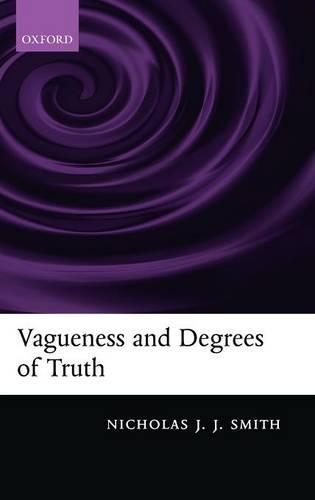
In Vagueness and Degrees of Truth, Nicholas Smith develops a new theory of vagueness: fuzzy plurivaluationism. A predicate is said to be vague if there is no sharply defined boundary between the things to which it applies and the things to which it does not apply. For example, 'heavy' is vague in a way that 'weighs over 20 kilograms' is not. A great many predicates - both in everyday talk, and in a wide array of theoretical vocabularies, from law to psychology to engineering - are vague. Smith argues, on the basis of a detailed account of the defining features of vagueness, that an accurate theory of vagueness must involve the idea that truth comes in degrees. The core idea of degrees of truth is that while some sentences are true and some are false, others possess intermediate truth values: they are truer than the false sentences, but not as true as the true ones. Degree-theoretic treatments of vagueness have been proposed in the past, but all have encountered significant objections. In light of these, Smith develops a new type of degree theory. Its innovations include a definition of logical consequence that allows the derivation of a classical consequence relation from the degree-theoretic semantics, a unified account of degrees of truth and subjective probabilities, and the incorporation of semantic indeterminacy - the view that vague statements need not have unique meanings - into the degree-theoretic framework. As well as being essential reading for those working on vagueness, Smith's book provides an excellent entry-point for newcomers to the era - both from elsewhere in philosophy, and from computer science, logic and engineering. It contains a thorough introduction to existing theories of vagueness and to the requisite logical background.
Full Product Details
Author: Nicholas J. J. Smith (The University of Sydney)
Publisher: Oxford University Press
Imprint: Oxford University Press
Dimensions:
Width: 16.20cm
, Height: 2.40cm
, Length: 24.10cm
Weight: 0.677kg
ISBN: 9780199233007
ISBN 10: 0199233004
Pages: 350
Publication Date: 06 November 2008
Audience:
College/higher education
,
Undergraduate
,
Postgraduate, Research & Scholarly
Format: Hardback
Publisher's Status: Active
Availability: Manufactured on demand

We will order this item for you from a manufactured on demand supplier.
Reviews
It is an excellent book: clearly written and packed full of interesting ideas and arguments. Researchers in the area must read itshould become a cornerstone of the literature... The technical material is self-contained and well presented, and the book would suit a graduate or an advanced undergraduate class not afraid of the odd bit of elementary mathematical formalism. J. R. G. Williams, Mind Both a sharply written introduction to the philosophical logic of vagueness and a persuasive defence of Smith's favoured theory David Ripley, Analysis one of the most important contributions on vagueness in the last ten years, and for years to come ... profound and original ... succeeds in promoting a new and inspiring conception of vagueness Paul Egre, Australasian Journal of Philosophy a very significant and important contribution to the debate. Dominic Hyde, Bulletin of Symbolic Logicy The book is clear, focussed, technically deft, and has impressive vision ... a must-read for anyone interested in vagueness. Graham Priest, History and Philosophy of Logic brimming with philosophical insight and formal niceties. It deserves to, and surely will, generate much discussion John Collins, Philosophical Quarterly required reading for anyone working on the logic and semantics of vagueness. Roy Cook, Theoria
required reading for anyone working on the logic and semantics of vagueness. * Roy Cook, Theoria * brimming with philosophical insight and formal niceties. It deserves to, and surely will, generate much discussion * John Collins, Philosophical Quarterly * The book is clear, focussed, technically deft, and has impressive vision . . . a must-read for anyone interested in vagueness. * Graham Priest, History and Philosophy of Logic * a very significant and important contribution to the debate. * Dominic Hyde, Bulletin of Symbolic Logicy * one of the most important contributions on vagueness in the last ten years, and for years to come . . . profound and original . . . succeeds in promoting a new and inspiring conception of vagueness * Paul Egre, Australasian Journal of Philosophy * Both a sharply written introduction to the philosophical logic of vagueness and a persuasive defence of Smith's favoured theory * David Ripley, Analysis * It is an excellent book: clearly written and packed full of interesting ideas and arguments. Researchers in the area must read itshould become a cornerstone of the literature. . . . The technical material is self-contained and well presented, and the book would suit a graduate or an advanced undergraduate class not afraid of the odd bit of elementary mathematical formalism. * J. R. G. Williams, Mind *
Author Information
Nicholas Smith is a Senior Lecturer in Philosophy at The University of Sydney.