Overview
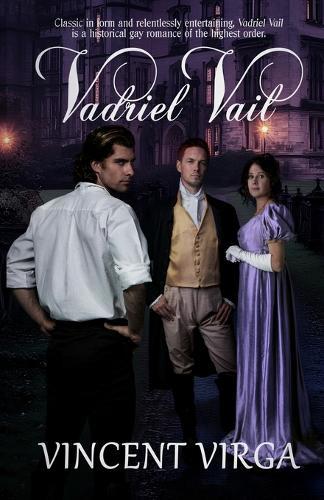
Set in the milieu of New York's Gilded Age aristocracy, Vadriel Vail vividly explores excesses and arrogance from the heights of glittering society to the depths of poverty in unimaginably horrific immigrant slums. Romance, secrets, and high stakes action, exceptional women and extraordinary men are swept into a whirlwind of love and forbidden desire. Armand de Guise, dangerous scion of a New York financial empire, is both handsome and loathsome. Wrought with guilt over an egregious encounter, he turns his lust, then love, toward young, brilliant, and ethereally handsome Vadriel Vail, Newport, RI's lavender-eyed golden boy of wealth and privilege. But Vadriel is soon in the arms of Placidia Van Leer, a perfect social match. As Vadriel crucifies himself on duty and doubt, appetite and anxiety, Armand looms, menacing and melodramatic. Placidia, her prized Vadriel in her bed, grows terrified that someone, something else will steal him away. Can redemption and true love become one? With hyperbolic exuberance, classic in form and relentlessly entertaining, Vadriel Vail is an historical gay romance of the highest order, a stunning follow-up to Gaywyck. ""Vincent Virga understands that the Gothic is always about the secret, vexed attraction of virtue for vice and vice for virtue, the first unsure of whether it wants to ennoble or be degraded, the second of whether it wants to degrade or be ennobled. That engine pulses through this wild, magnificently excessive novel, which teems with the social and sexual life of queer Gilded-Age New York."" - Peter Trachtenberg, The Twilight of Bohemia: Westbeth and the Last Artists in New York ""As melodramatic, mysterious and menacing a gay gothic romance as one might desire on the heels of the classic Gaywyck."" - Layla McCay, The Queer Bookshelf: a reader's guide ""Luminous and beguiling, a profound mosaic of allusion and desire, Virga's novel returns to the literary scene just in time: we need and deserve transformative love - this epic torch that is Vadriel Vail lights the way."" - Tom Cardamone, Momentary Aberrations
Full Product Details
Author: Vincent Virga ,
P a Skantze
Publisher: Requeered Tales
Imprint: Requeered Tales
Volume: 2
Dimensions:
Width: 14.00cm
, Height: 2.30cm
, Length: 21.60cm
Weight: 0.472kg
ISBN: 9781959902331
ISBN 10: 1959902334
Pages: 410
Publication Date: 04 March 2026
Audience:
General/trade
,
General
Format: Paperback
Publisher's Status: Active
Availability: Available To Order

We have confirmation that this item is in stock with the supplier. It will be ordered in for you and dispatched immediately.
Author Information
Vincent Virga, born in Greenwich Village in 1942, was raised in a family of seven on Long Island. Vincent was obsessed with movies, and books, and pop music, and dancing, and had been Macy's Most Beautiful Child - the foundation for a life somewhere over the rainbow.In 1964, he went to Yale's Graduate School of Drama where he met James McCourt. In 1965, he ""came out"" in Paris in the shadow of Notre Dame and made an exclusive commitment to McCourt; they celebrated their 60th anniversary in 2025.Vincent Virga has been called ""America's foremost picture editor."" He has researched, edited, and designed picture sections for more than 150 books, including Eyes of the Nation: A Visual History of the United States and Cartographia: Mapping Civilizations. He also spent over two decades working with the curators at the Library of Congress on 29 books.His most celebrated novel, Gaywyck, sparked a revolution as the first gay gothic romance. ReQueered Tales is reissuing it, the sequel Vadriel Vail, and two follow-up novels, completing a Quartet of indescribable delight. A Comfortable Corner, his second published fiction, was also recently reissued. P. A. Skantze is a theatre director, writer and composer based in Italy and working internationally staging work by the poets Anne Carson and Matthew Fink, inventing forms of staged textual interventions for the opera Falstaff at the National Theatre of Croatia and currently planning a production of her musical. Her publications include: Stillness in Motion in the Seventeenth-Century Theatre (Routledge 2003) and Itinerant Spectator/Itinerant Spectacle (Punctum 2013). She has been teaching across the disciplines of theatre history, theatre practice, writing and performance since her postgraduate study at Columbia University. Her method has always been one of engaged translation between practice, practitioners and theorists, theorists in the most joyous sense of that word, working with thinkers such as Blake [Eubie and William] and Billie Holiday, Fred Moten and Isaac Hayes.