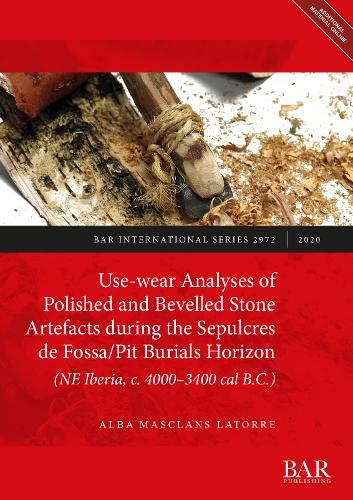
Use-wear Analyses of Polished and Bevelled Stone Artefacts during the Sepulcres de Fossa/ Pit Burials Horizon (NE Iberia, c. 4000-3400 cal B.C.)

Author:   Alba Masclans Latorre
Publisher:   BAR Publishing
ISBN:  

9781407317007


Pages:   222
Publication Date:   31 March 2020
Format:   Mixed media product
Availability:   Available To Order   Availability explained
We have confirmation that this item is in stock with the supplier. It will be ordered in for you and dispatched immediately.

Our Price $155.25 Quantity:  
Add to Cart

Share |

Use-wear Analyses of Polished and Bevelled Stone Artefacts during the Sepulcres de Fossa/ Pit Burials Horizon (NE Iberia, c. 4000-3400 cal B.C.)


Overview

{\rtf1\ansi\ansicpg1252\deff0\deflang2057{\fonttbl{\f0\fswiss\fprq2\fcharset0 Calibri;}{\f1\fnil\fcharset0 Verdana;}} \viewkind4\uc1\pard\sa160\sl252\slmult1\f0\fs22 This work broadens the current interpretative framework about communities living in the North- East of the Iberian Peninsula around the turn of the fifth and fourth millennia BC. The empirical foundation of this research is the analysis of polished and bevelled stone artefacts, found both in funerary and domestic contexts. The new data provides fresh insight into the technical choices and the productive processes in which the tools were employed by the Neolithic groups. The results of this enquiry, together with the data concerning the age and sexual determination of the buried individuals as well as the artefact distribution across the graves, constitutes an unprecedented opportunity to understand and explain the archaeological record variability in terms of gender and other social hierarchies.\par \pard\f1\fs17\par }

Full Product Details

Author:   Alba Masclans Latorre
Publisher:   BAR Publishing
Imprint:   BAR Publishing
Weight:   0.901kg
ISBN:  

9781407317007


ISBN 10:   1407317008
Pages:   222
Publication Date:   31 March 2020
Audience:   Professional and scholarly ,  Professional & Vocational
Format:   Mixed media product
Publisher's Status:   Active
Availability:   Available To Order   Availability explained
We have confirmation that this item is in stock with the supplier. It will be ordered in for you and dispatched immediately.

Table of Contents

{\rtf1\fbidis\ansi\ansicpg1252\deff0\deflang2057{\fonttbl{\f0\fswiss\fprq2\fcharset0 Calibri;}{\f1\fnil\fcharset0 Verdana;}} \viewkind4\uc1\pard\ltrpar\b\f0\fs22 List of Figures\par List of Tables\par 1. Introduction\par \b0 1.1. Objectives, methods and sampling \par 1.2. Theoretical framework\par 1.3. A critical revision of the social hypothesis: a state of the art\par 1.4. PBAs and the generation of new explanatory hypotheses\par \b 2. Towards a PBA use-wear characterisation method\par \b0 2.1. Theoretical and methodological framework\par 2.1.1. Archaeological questions and experimental goals\par 2.1.1.1. The formulation of a well-founded hypothesis related to the possible PBA uses\par 2.1.1.2. The formulation of hypothesis concerning which could be the diagnostic dependent variables or attributes that characterise the PBA use-wear traces\par 2.1.1.3. The formulation of a methodological framework that allows linking the independent variables and the attributes using the data generated in the first two points\par 2.1.1.4. The continuation of the process of corroborating/refuting the hypotheses suggested in the first point through the archaeological material analysis by means of the methodological framework created in the third point\par 2.1.2. Analogy as Heuristics\par 2.2. Hypothesis formulation concerning the possible PBA uses \par 2.2.1. PBA uses through Ethnography, (pre)historical references and experimental benchmark\par 2.2.2. Objects of work: production and maintenance processes\par 2.2.2.1. Stone blade production\par 2.2.2.2. Hafting production\par 2.2.2.3. Summary\par 2.2.3. Symbolic tools\par 2.2.3.1. PBA used in non-mortuary ideological activities\par 2.2.3.2. Figurative representations\par 2.2.3.3. PBA used in mortuary rites\par 2.2.3.3. Summary\par 2.2.4. Objects of exchange\par 2.2.5. Working tools\par 2.2.5.1. Wood-working tools\par 2.2.5.2. Hideprocessing\par 2.2.5.3. Butchering\par 2.2.5.4. Hoeing/tilling\par 2.2.5.5. Polyfunctionality\par 2.2.5.6. Summary\par 2.2.6. Interpersonal violence\par 2.2.6.1. Preliminary archaeological review\par 2.2.6.2. Ethnographic references\par 2.2.6.3. Archaeological references\par 2.2.6.4. Experimental referents\par 2.2.6.5. Summary\par 2.2.7. Independent variables definition\par 2.2.7.1. Introduction\par 2.2.7.2. Variables regarding the experimental tools\par 2.2.7.3. Variables regarding the experimental activities\par 2.2.7.4. Variables regarding the worked material characteristics\par 2.3. Dependent variables\par 2.3.1. Introduction\par 2.3.1.1. Theoretical and methodological framework\par 2.3.2. Dependent variables\par 2.4. The experimental programme\par 2.4.1. Introduction\par 2.4.2. Making the experimental artefacts\par 2.4.3. Using the experimental artifacts in woodworking activities\par 2.4.4. The animal-related experiments\par 2.4.4.1. Butchering activities\par 2.4.4.2. Hide-processing activities\par 2.4.5. Hoeing activities\par 2.5. Results\par 2.5.1. Introduction\par 2.5.2. Methods and observation procedures\par 2.5.2.1. Residue cleaning and acetate casting\par 2.5.2.2. Used equipment\par 2.5.3. Microscopic variables\par 2.5.3.1. Matrix micro-polish\par 2.5.3.2. Crystal wear\par 2.5.3.3. Micro-chipping\par 2.5.3.4. Rounding\par 2.5.3.5. Lineal traces\par 2.5.4. Macroscopic variables\par 2.5.4.1. Linear Traces\par 2.5.4.2. Micro-chipping\par 2.5.5. Technological wear characterization\par 2.5.6. Butchering wear\par 2.5.7. Hoeing wear\par 2.5.8. Woodworking wear\par 2.5.9. Hide processing wear\par 2.5.10. Quantitative comparison between technological, woodworking and hide-processing use-wear on hornfelds tools\par 2.5.10.1. Introduction\par 2.5.10.2. Macroscopic observation\par 2.5.10.3. Microscopic observation\par 2.5.11. Use-wear traces summary\par \b 3. B\'f2bila Madurell-Can Gamb\'fas 1-2\par \b0 3.1. General information about the site\par 3.1.1. Chronological characterization of the site\par 3.1.2. The funerary pattern characterisation\par 3.1.3. Anthropological data\par 3.1.4. Domestic structures\par 3.1.5. The artefact characterisation\par 3.1.5.1. Bone tools\par 3.1.5.2. The flacked stone assemblage\par 3.1.5.3. Ceramic assemblage\par 3.1.5.4. Ornaments and grinding tools\par 3.1.6. Subsistence and economy\par 3.2. Polished-bevelled artefacts analysis\par 3.2.1. Sample context and inventory\par 3.2.1.1. Introduction\par 3.2.1.2. Polished-bevelled artefacts from grave goods assemblages\par 3.2.1.3. Polished-bevelled artefacts from the filling of structures containing human remains\par 3.2.1.4. Polished-beveled artefacts from domestic contexts\par 3.2.2. Polished-bevelled artefact integrity and conservation\par 3.2.2.1. PBA integrity\par 3.2.2.2. Polished-bevelled artefact raw materials\par 3.2.2.3. Polished-bevelled artefact production\par 3.2.3. Results of the use-wear analysis\par 3.2.3.1. General results\par 3.2.3.2. The woodworking tools\par 3.2.3.3. Animal work: butchering and hide-processing tools\par 3.2.3.4. The non-used or scarcely used tools\par 3.2.3.5. The artefact technological traces\par 3.2.3.6. The artefact repairing, re-sharpening and discarding\par 3.2.4. Exploring the functional variability\par 3.3. Conclusions\par 3.3.1. Contribution to the economic characterization of activities on the site\par 3.3.2. Contribution to the technical aspects of the PBA production, repairing and sharpening\par 3.3.3. Contribution to the funerary pattern characterisation\par 3.3.4. Contribution to the investigation into the sexual division of labour\par 3.3.5. Contribution to the characterisation of the imported raw materials management\par 3.3.6. Contribution to the general understanding of possible dissymmetrical social relations\par \b 4. Mas d\rquote en Boixos and the Pened\'e8s area occupation\par \b0 4.1. General information about the site\par 4.1.1. Funerary pattern characterisation\par 4.1.2. The non-funerary record\par 4.1.3. Characterisation of the artefacts and the subsistence patterns\par 4.1.4. The other sampled sites: Cam\'ed de Santa Maria dels Horts, Cal Pere Pastor, els Pujols, La Serreta, Mas Puj\'f3 and Pujolet de Moja\par 4.1.4.1. Cam\'ed de Santa Maria dels Horts\par 4.1.4.2. Cal Pere Pastor\par 4.1.4.3. Els Pujols\par 4.1.4.4. La Serreta and Serreta Nord\par 4.1.4.5. Mas Puj\'f3\par 4.1.4.6. Pujolet de Moja\par 4.1.5. Conclusions\par 4.2. Analysis of polished-bevelled artefacts\par 4.2.1. Sample context and inventory\par 4.2.2. PBA integrity and preservation\par 4.2.3. PBA raw materials\par 4.2.4. PBA production\par 4.2.4.1. Production\par 4.2.4.2. Technical evidence\par 4.2.5. Use-wear analysis results\par 4.2.6. Data interpretation\par 4.3. Conclusions\par \b 5. The prehistoric mines of Gav\'e0\par \b0 5.1. General information about the site\par 5.1.1. Chronological characterisation of the site\par 5.1.2. Characterisation of the funerary pattern\par 5.1.3. The mines\par 5.1.4. Characterisation of the artefacts and the subsistence patterns\par 5.2. PBA analysis\par 5.2.1. Sample context and inventory\par 5.2.2. PBA integrity and raw material\par 5.2.2.1. Technical evidence\par 5.2.2.2. Shape\par 5.2.2.3. Measure and size characteristics\par 5.2.3. Use-wear analysis results\par 5.2.3.1. Technological traces\par 5.2.4. Interpretation of the use-wear analysis results\par 5.3. Conclusions\par \b 6. Vall\'e8s-Barcelon\'e8s and Pened\'e8s areas: a comprehensive approach\par \b0 6.1. Introduction\par 6.2. The main productive activities\par 6.2.1. The raw materials\par 6.2.2. PBAs as objects of work\par 6.2.2.1. Preforms and local raw materials procurement\par 6.2.2.2. Production of the PBAs\par 6.2.3. PBAs as working tools\par 6.2.3.1. The maintenance of the PBAs\par 6.2.3.2. The productive processes in which PBAs were used as working tools\par 6.2.4. PBAs form, function and raw materials\par 6.3. PBAs, funerary pattern and social inequalities\par 6.3.1. PBAs representativeness in Pit Burial funerary contexts\par 6.3.2. The role of PBAs in the funerary pattern and its interpretations\par 6.3.3. The presence of inequalities or social differences\par 6.3.3.1. PBAs distribution\par 6.3.3.2. PBAs raw materials distribution\par 6.3.3.3. The PBAs function and morpho-technological distribution\par 6.4. Differences between the PBAs used by the Vall\'e8s-Barcelon\'e8s and Pened\'e8s communities\par 6.4.1. PBAs distribution and productive activities\par 6.4.2. Raw materials and their participation in exchange networks\par 6.4.3. Technological processes\par \b 7. Conclusions\par \b0 7.1. The main productive activities\par 7.2. The funerary pattern\par 7.3. The differences between the communities\par 7.4. The presence of asymmetries or social differences\par \b Bibliography\par \b0 A digital download of the Annexes is available as an accompanying download\f1\fs17\par }

Reviews

{\rtf1\ansi\ansicpg1252\deff0\deflang2057{\fonttbl{\f0\fswiss\fprq2\fcharset0 Calibri;}{\f1\fnil\fcharset0 Verdana;}} \viewkind4\uc1\pard\f0\fs22\lquote\lang1034 La contribuci\'f3n es importante y significativa.\rquote Dr Javier Mangado Llach, Universitat de Barcelona\lang2057\par \f1\fs17\par }


Author Information

{\rtf1\ansi\ansicpg1252\deff0\deflang2057{\fonttbl{\f0\fswiss\fprq2\fcharset0 Calibri;}{\f1\fnil\fcharset0 Verdana;}} \viewkind4\uc1\pard\f0\fs22 Alba Masclans Latorre was awarded a PhD in 2017, specialising in stone tools use-wear analysis. Her postdoctoral research is focused on funerary practices and gender studies of Central European Early farming communities and western Mediterranean Neolithic groups.\f1\fs17\par }

Tab Content 6

Author Website:  

Countries Available

All regions
Latest Reading Guide

April RG 26_2


Shopping Cart
Your cart is empty
Shopping cart
Mailing List