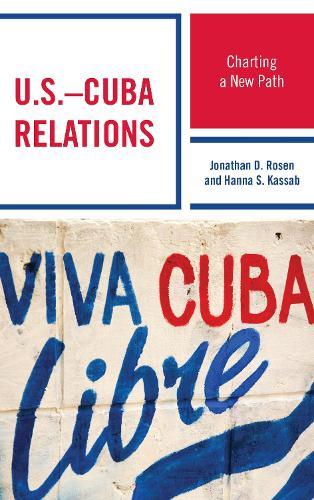
Full Product Details
Author: Jonathan D. Rosen ,
Hanna Samir Kassab
Publisher: Bloomsbury Publishing Plc
Imprint: Lexington Books
Dimensions:
Width: 15.20cm
, Height: 1.50cm
, Length: 22.30cm
Weight: 0.281kg
ISBN: 9781498537759
ISBN 10: 1498537758
Pages: 184
Publication Date: 15 November 2018
Audience:
Professional and scholarly
,
Professional & Vocational
Format: Paperback
Publisher's Status: Active
Availability: Manufactured on demand

We will order this item for you from a manufactured on demand supplier.
Reviews
Rosen (Florida State) and Kassab (Northern Michigan) present a well-articulated case for redefining US-Cuban relations and building on Obama’s shift in policy. This book succinctly details Cuba’s history, including US-Cuba relations. The authors focus on Obama’s efforts to restore diplomatic ties with Raúl Castro before reviewing the obstacles confronting this shift: vested interest groups, public opinion, and ideological views held by politicians. This book raises critical questions about the practicality and rationale for maintaining a failed foreign policy. At the time of this publication, the presidential elections were still ongoing. The Trump administration has not been clear regarding its policy toward Cuba, aside from stipulating that ""we should have made a better deal."" In January 2017, a Cuban trade delegation arrived in the US to visit four states and six ports. If Obama’s efforts are reversed, Rosen and Kassab contend that nothing will change in Cuba, but if the US embraces this shift, we have far more to gain than lose, particularly with our Latin American neighbors. This book is strongly recommended to all readers interested in learning from the past to develop a stronger US-Cuba policy in the 21st century. Summing Up: Highly recommended. Upper-division undergraduates through faculty. * Choice Reviews * It is rare to find books containing such concise analyses and lucid prose as this one. The authors have done a remarkable job at providing historical accuracy and strategic insight into U.S.-Cuba relations. With masterful clarity, attention to details, and a hopeful tone, this book is truly a rare gem for scholars and anyone who aims to grasp the complex history and evolving relationship between the United States and Cuba. -- Richard Cores, United Nations Department of Economic and Social Affairs
Rosen (Florida State) and Kassab (Northern Michigan) present a well-articulated case for redefining US-Cuban relations and building on Obama's shift in policy. This book succinctly details Cuba's history, including US-Cuba relations. The authors focus on Obama's efforts to restore diplomatic ties with Raul Castro before reviewing the obstacles confronting this shift: vested interest groups, public opinion, and ideological views held by politicians. This book raises critical questions about the practicality and rationale for maintaining a failed foreign policy. At the time of this publication, the presidential elections were still ongoing. The Trump administration has not been clear regarding its policy toward Cuba, aside from stipulating that we should have made a better deal. In January 2017, a Cuban trade delegation arrived in the US to visit four states and six ports. If Obama's efforts are reversed, Rosen and Kassab contend that nothing will change in Cuba, but if the US embraces this shift, we have far more to gain than lose, particularly with our Latin American neighbors. This book is strongly recommended to all readers interested in learning from the past to develop a stronger US-Cuba policy in the 21st century. Summing Up: Highly recommended. Upper-division undergraduates through faculty. * CHOICE * It is rare to find books containing such concise analyses and lucid prose as this one. The authors have done a remarkable job at providing historical accuracy and strategic insight into U.S.-Cuba relations. With masterful clarity, attention to details, and a hopeful tone, this book is truly a rare gem for scholars and anyone who aims to grasp the complex history and evolving relationship between the United States and Cuba. -- Richard Cores, United Nations Department of Economic and Social Affairs
Author Information
Jonathan D. Rosen is a research scientist at Florida International University’s Jack D. Gordon Institute for Public Policy. Hanna S. Kassab is a visiting professor at Northern Michigan University.