Overview
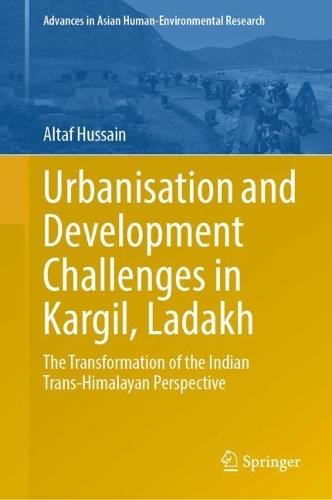
Urbanisation has been one of the significant drivers of socio-economic and environmental change in the Trans-Himalaya. Recently, the remote and less accessible areas of Ladakh have undergone rapid urbanisation due to road construction, mountain tourism, geopolitical factors, administrative changes, and external interventions. These driving factors are responsible for the drastic transformation and development in Ladakh's newly formed Union Territory (UT). The region has experienced rapid urban growth and unplanned urbanisation, particularly in the capital towns of Leh and Kargil. After Leh, the capital, Kargil town is the second-largest urban centre in the region. The town has witnessed significant changes in its urban landscape, driven by historical developments, urban population growth, rural-to-urban migration, spatial expansion, and the growing tourism sector. These factors have collectively contributed to the emergence, growth, and transformation of this mountain town in Ladakh. Based on a multi-temporal approach using high-resolution satellite images combined with a mixed methods approach and field surveys, urbanisation and its landscape dynamics have been analysed since the 1960s
Full Product Details
Author: Altaf Hussain
Publisher: Springer Nature Switzerland AG
Imprint: Springer Nature Switzerland AG
ISBN: 9783032056665
ISBN 10: 3032056667
Pages: 187
Publication Date: 16 November 2025
Audience:
Professional and scholarly
,
Professional & Vocational
Format: Hardback
Publisher's Status: Active
Availability: Not yet available

This item is yet to be released. You can pre-order this item and we will dispatch it to you upon its release.
Author Information
Altaf Hussain holds a Ph.D. from the Department of Geography at the South Asia Institute (SAI), Heidelberg University, Germany. His academic journey is marked by diverse and specialised studies. He received his master’s degree in planning with a specialization in Regional Planning from School of Planning and Architecture (SPA), New Delhi, India. Additionally, he earned his master’s and bachelor’s degree in Geography from the Department of Geography, Jamia Millia Islamia (JMI), New Delhi, India. He is also the associate member of the Institute of Town Planners, India (ITPI), reflecting his commitment and recognised expertise in the field of urban and regional planning. His professional and academic pursuits are deeply rooted in the study of human-environment relationships, human geography, urban and regional planning, disaster management, and sustainable development. His research focuses on the mountainous regions of the Himalaya and Hindu Kush Himalaya, with a particular emphasis on the Trans-Himalayan region of Ladakh, India. In these regions, he explores the intricate dynamics between humans and their environment, investigating how these relationships are shaped by and contribute to the distinct geographical and environmental conditions of mountainous landscapes, with a special focus on Ladakh and the broader Himalayan region.