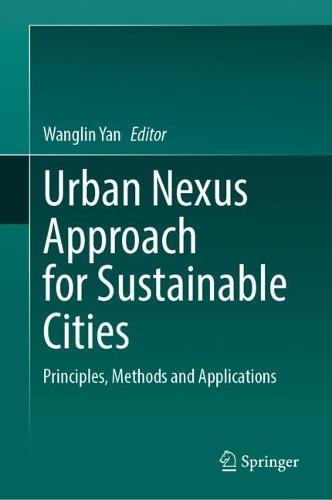
Full Product Details
Author: Wanglin Yan
Publisher: Springer Verlag, Singapore
Imprint: Springer Verlag, Singapore
ISBN: 9789819561551
ISBN 10: 9819561558
Pages: 300
Publication Date: 10 February 2026
Audience:
College/higher education
,
Postgraduate, Research & Scholarly
Format: Hardback
Publisher's Status: Active
Availability: In Print

This item will be ordered in for you from one of our suppliers. Upon receipt, we will promptly dispatch it out to you. For in store availability, please contact us.
Author Information
Dr. Wanglin Yan is a Professor in the Faculty of Environment and Information Studies and Head of the Program for Environmental Design and Governance at the Graduate School of Media and Governance, Keio University, Shonan Fujisawa Campus, Japan. He received his Bachelor of Engineering from Wuhan Technical University of Surveying and Mapping in 1982, followed by Master’s and Doctoral degrees in Civil Engineering from the University of Tokyo. Over the past three decades, Dr. Yan has become an influential figure in the fields of environmental science, geoinformation technology, and sustainable urban and regional planning. Dr. Yan was formerly President of the Geographic Information Systems Association (Japan) and received the Gijuku Award of Keio University in 2024. At Keio University, Dr. Yan has pioneered the development of education and research that integrate environmental design, spatial information science, and governance innovation. His academic leadership has shaped a new interdisciplinary paradigm bridging geography, engineering, urban planning, and social policy. As Head of the Program for Environmental Design and Governance, he has trained numerous doctoral and master’s students, encouraging them to combine scientific analysis with creative design and evidence-based policy formulation to address complex environmental challenges. Dr. Yan’s research and practice have increasingly centered on what he defines as the Policy Design-Led Nexus Approach—a framework that integrates nexus thinking with design methodologies and policy innovation. This approach views cities as dynamic socio-ecological systems in which the interdependencies of food, energy, and water can be understood, visualized, and governed through co-creation among scientists, designers, citizens, and policymakers. By linking conceptual frameworks with tangible spatial and policy design outcomes, the Policy Design-Led Nexus Approach bridges the long-standing gap between scientific knowledge and urban practice. Internationally, Dr. Yan leads the Sub-Regional Node for the Asia-Pacific Adaptation Network (APAN) under the United Nations Environment Programme (UNEP), where he contributes to advancing climate change adaptation and disaster risk reduction across Japan and Northeast Asia. His expertise encompasses spatial analysis, resilience planning, and post-disaster reconstruction design, with a focus on climate-responsive urban transformation and regional sustainability. From 2018 to 2022, Dr. Yan directed the Moveable Nexus Project (M-NEX) under the Sustainable Urbanisation Global Initiative (SUGI)/Food–Water–Energy Nexus, a joint program of the Belmont Forum and the Joint Programming Initiative Urban Europe. This multinational collaboration—with partners in Amsterdam, Belfast, Detroit, Doha, Sydney, and Tokyo—demonstrated how design-led nexus thinking can inform policy innovation at multiple spatial scales, from households and neighborhoods to metropolitan regions. Dr. Yan has authored and edited numerous academic books and journal papers addressing resilience, sustainability, and the transformation of cities under climatic and social change. His recent book, Resilient and Adaptive Tokyo: Towards Sustainable Urbanisation in the Perspective of the Food–Energy–Water Nexus (Springer Singapore, 2024), synthesizes the results of the M-NEX project and establishes a foundation for the ongoing development of the Policy Design-Led Nexus Approach. Through his interdisciplinary vision, international collaboration, and commitment to bridging science, design, and governance, Dr. Yan continues to advance the frontiers of sustainable urbanisation. His work exemplifies how nexus thinking can evolve into a practical framework for co-creating resilient, low-carbon, and inclusive cities.