Overview
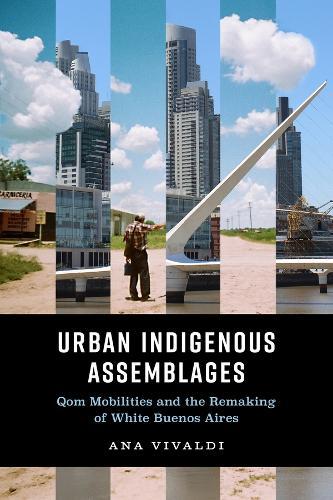
Over the past two decades, Latin American politicians and activists have reckoned with their nations’ histories of racism, forced displacement of native peoples, and inequality by acknowledging Indigenous communities as peoples preexisting the modern states. In Argentina—a nation long fixated on presenting itself as “white” and “European”—this shift has been dramatic. After decades of erasure and racism toward Indigenous peoples, Argentinian civil society is identifying Indigenous groups as not just an element from the past, but as nations central to the country’s culturally plural and multiracial identity. In Urban Indigenous Assemblages, Ana Vivaldi considers how Argentina’s urban Indigenous population fits into this recent political and social movement. To do this, she focuses on how the Qom Indigenous people—whose traditional territories are in northern Argentina—have moved to Buenos Aires, made homes in shantytowns alongside other migrants, and remade urban space by building Indigenous lives in the city. Starting from a Qom barrio in Greater Buenos Aires, Vivaldi traces how Qom peoples’ travels to rural communities and movement across the city create complex networks and produce an urban life always in connection to other places. She argues that urban racialized indigeneities represent sites of contradictory relations visible and invisible to state actors and hypervisible to development agencies, as the Qom are expected to prove their authenticity and remove themselves from important relationships with nonwhite neighbors to access rights and recognition. Based on eighteen months of fieldwork, this book analyzes the historical process that created the barrio: the constant remaking of this Indigenous space in interaction with state institutions and NGOs, the links between the barrio and northern Argentina through travels “far out” to rural communities in the Chaco, and the expansion of “Indigenous territories” beyond bounded location.
Full Product Details
Author: Ana Vivaldi
Publisher: Vanderbilt University Press
Imprint: Vanderbilt University Press
Dimensions:
Width: 15.20cm
, Height: 2.00cm
, Length: 22.90cm
Weight: 0.340kg
ISBN: 9780826508355
ISBN 10: 0826508359
Pages: 212
Publication Date: 30 January 2026
Audience:
Professional and scholarly
,
Professional & Vocational
Format: Paperback
Publisher's Status: Active
Availability: In Print

This item will be ordered in for you from one of our suppliers. Upon receipt, we will promptly dispatch it out to you. For in store availability, please contact us.
Reviews
""This book offers a compelling ethnographic study of an Indigenous people in movement and in a distinctly urban space, contributing to the growing literature on urban Indigeneity, rural-to-urban migration, and the (re-)formation of ethnic identity through collective institutions."" —Carwil Bjork-James, author of The Sovereign Street: Making Revolution in Urban Bolivia
""This book offers a compelling ethnographic study of an Indigenous people in movement and in a distinctly urban space, contributing to the growing literature on urban Indigeneity, rural-to-urban migration, and the (re-)formation of ethnic identity through collective institutions."" --Carwil Bjork-James, author of The Sovereign Street: Making Revolution in Urban Bolivia
Author Information
Ana Vivaldi is an instructor in the Departments of Sociology and Anthropology at the University of British Columbia, an honorary researcher at the University of Manchester, and a research manager at Firelight.