Full Product Details
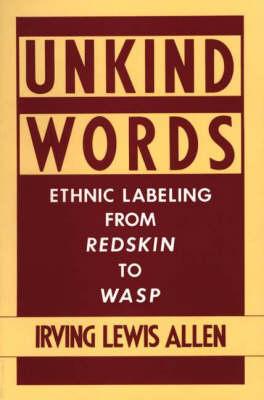
Author: Irving Lewis Allen
Publisher: Bloomsbury Publishing Plc
Imprint: Praeger Publishers Inc
Dimensions:
Width: 13.90cm
, Height: 1.20cm
, Length: 23.00cm
Weight: 0.209kg
ISBN: 9780897892209
ISBN 10: 0897892208
Pages: 152
Publication Date: 27 August 1990
Recommended Age: From 7 to 17 years
Audience:
College/higher education
,
Undergraduate
,
Postgraduate, Research & Scholarly
Format: Paperback
Publisher's Status: Out of Print
Availability: Awaiting stock

Reviews
One of the most fascinating branches of etymology is ethnic labeling. Did you know, for example, that WASP originally stood for White Appalachian Southern Protestant? The first half of the book surveys slurs the author considers familiar. Readers encountering them for the first time will be pleasantly surprised with their own lack of bigotry. Do you know what a guappo is? A Mexican breakfast? A dee-donk? A Mister John? The second part of the book brings out the sociologist in its author, who examines current, euphemistics slurs: the capitalization of Black (but not white); the use of ethnic to exclude blacks, Jews, Irish, and become a code word for city-dwellers who oppose residential integration; the evolution of the word poor to needy to culturally deprived to under-privileged to disadvantages to underclass. Eminently readable fare for language buffs and sociologists. -Booklist ?One of the most fascinating branches of etymology is ethnic labeling. Did you know, for example, that WASP originally stood for White Appalachian Southern Protestant? The first half of the book surveys slurs the author considers familiar. Readers encountering them for the first time will be pleasantly surprised with their own lack of bigotry. Do you know what a guappo is? A Mexican breakfast? A dee-donk? A Mister John? The second part of the book brings out the sociologist in its author, who examines current, euphemistics slurs: the capitalization of Black (but not white); the use of ethnic to exclude blacks, Jews, Irish, and become a code word for city-dwellers who oppose residential integration; the evolution of the word poor to needy to culturally deprived to under-privileged to disadvantages to underclass. Eminently readable fare for language buffs and sociologists.?-Booklist
?One of the most fascinating branches of etymology is ethnic labeling. Did you know, for example, that WASP originally stood for White Appalachian Southern Protestant? The first half of the book surveys slurs the author considers familiar. Readers encountering them for the first time will be pleasantly surprised with their own lack of bigotry. Do you know what a guappo is? A Mexican breakfast? A dee-donk? A Mister John? The second part of the book brings out the sociologist in its author, who examines current, euphemistics slurs: the capitalization of Black (but not white); the use of ethnic to exclude blacks, Jews, Irish, and become a code word for city-dwellers who oppose residential integration; the evolution of the word poor to needy to culturally deprived to under-privileged to disadvantages to underclass. Eminently readable fare for language buffs and sociologists.?-Booklist One of the most fascinating branches of etymology is ethnic labeling. Did you know, for example, that WASP originally stood for White Appalachian Southern Protestant? The first half of the book surveys slurs the author considers familiar. Readers encountering them for the first time will be pleasantly surprised with their own lack of bigotry. Do you know what a guappo is? A Mexican breakfast? A dee-donk? A Mister John? The second part of the book brings out the sociologist in its author, who examines current, euphemistics slurs: the capitalization of Black (but not white); the use of ethnic to exclude blacks, Jews, Irish, and become a code word for city-dwellers who oppose residential integration; the evolution of the word poor to needy to culturally deprived to under-privileged to disadvantages to underclass. Eminently readable fare for language buffs and sociologists. -Booklist
?One of the most fascinating branches of etymology is ethnic labeling. Did you know, for example, that WASP originally stood for White Appalachian Southern Protestant? The first half of the book surveys slurs the author considers familiar. Readers encountering them for the first time will be pleasantly surprised with their own lack of bigotry. Do you know what a guappo is? A Mexican breakfast? A dee-donk? A Mister John? The second part of the book brings out the sociologist in its author, who examines current, euphemistics slurs: the capitalization of Black (but not white); the use of ethnic to exclude blacks, Jews, Irish, and become a code word for city-dwellers who oppose residential integration; the evolution of the word poor to needy to culturally deprived to under-privileged to disadvantages to underclass. Eminently readable fare for language buffs and sociologists.?-Booklist
Author Information
IRVING LEWIS ALLEN is Professor of Sociology at the University of Connecticut. He is the author of some forty articles including The Sociology of Slang in The Encyclopedia of Language and Linguistics.