Overview
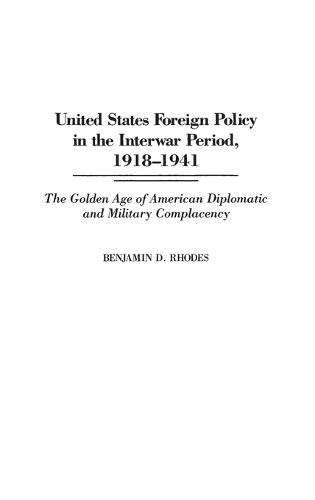
This study presents an in-depth survey of the principal policies and personalities of American diplomacy of the era, together with a discussion of recent historiography in the field. For two decades between the two world wars, America pursued a foreign policy course that was, according to Rhodes, shortsighted and self-centered. Believing World War I had been an aberration, Americans na^Dively signed disarmament treaties and a pact renouncing war, while eschewing such inconveniences as enforcement machinery or participation in international organizations. Smug moral superiority, a penurious desire to save money, and naíveté ultimately led to the neglect of America's armed forces even as potential rivals were arming themselves to the teeth. In contrast to the dynamic drive of the New Deal in domestic policy, foreign policy under Franklin D. Roosevelt was often characterized by a lack of clarity and, reflecting Roosevelt's fear of isolationists and pacifists, by presidential explanations that were frequently evasive, incomplete, or deliberately misleading. One of the period's few successes was the bipartisan Good Neighbor policy, which proved far-sighted commercially and strategically. Rhodes praises Cordell Hull as the outstanding secretary of state of the time, whose judgment was often more on target than others in the State Department and the executive branch.
Full Product Details
Author: Benjamin Rhodes
Publisher: Bloomsbury Publishing Plc
Imprint: Praeger Publishers Inc
Dimensions:
Width: 15.60cm
, Height: 1.90cm
, Length: 23.50cm
Weight: 0.482kg
ISBN: 9780275948252
ISBN 10: 0275948250
Pages: 238
Publication Date: 30 July 2001
Recommended Age: From 7 to 17 years
Audience:
College/higher education
,
Professional and scholarly
,
Tertiary & Higher Education
,
Professional & Vocational
Format: Hardback
Publisher's Status: Active
Availability: Manufactured on demand

We will order this item for you from a manufactured on demand supplier.
Reviews
"?[t]his survey sets the standard for this period. All levels and collections.?-Choice ""Ýt¨his survey sets the standard for this period. All levels and collections.""-Choice ""[t]his survey sets the standard for this period. All levels and collections.""-Choice"
?[t]his survey sets the standard for this period. All levels and collections.?-Choice
?[t]his survey sets the standard for this period. All levels and collections.?-Choice Ythis survey sets the standard for this period. All levels and collections. -Choice [t]his survey sets the standard for this period. All levels and collections. -Choice
[t]his survey sets the standard for this period. All levels and collections. -Choice t his survey sets the standard for this period. All levels and collections. -Choice ?[t]his survey sets the standard for this period. All levels and collections.?-Choice
Author Information
BENJAMIN D. RHODES is Professor of History at the University of Wisconsin-Whitewater. Rhodes is the author of The Anglo-American Winter War with Russia, 1918-1919: A Diplomatic and Military Tragicomedy (1988), and James P. Goodrich, Indiana's Governor Strangelove: A Republican's Infatuation with Soviet Russia (1996). Author of numerous articles, he has also been a Fulbright lecturer in Finland and the People's Republic of China.