Overview
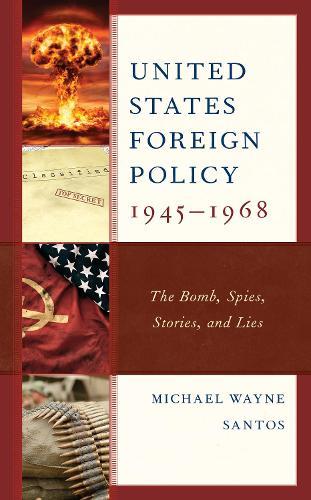
Between 1945 and 1968, the possibility of Mutual Assured Destruction led to a host of odd realities, including the creation of an affable cartoon turtle named Bert who taught millions of school children that nuclear war was survivable if they simply learned how to “duck and cover.” Meanwhile, fear of Communism played out against the backdrop of potential Armageddon to provide justification for a variety of covert operations involving regime change, political assassination, and sometimes bizarre plot twists. United States Foreign Policy 1945-1968: The Bomb, Spies, Stories, and Lies takes a fresh look at this complex, often confusing, and frequently farcical period in American and world history.
Full Product Details
Author: Michael Wayne Santos
Publisher: Bloomsbury Publishing Plc
Imprint: Lexington Books
Dimensions:
Width: 16.00cm
, Height: 3.10cm
, Length: 22.90cm
Weight: 0.721kg
ISBN: 9781793602176
ISBN 10: 1793602174
Pages: 358
Publication Date: 17 January 2020
Audience:
Professional and scholarly
,
Professional & Vocational
Format: Hardback
Publisher's Status: Active
Availability: Manufactured on demand

We will order this item for you from a manufactured on demand supplier.
Reviews
United States Foreign Policy 1945-1968 is a lucid, comprehensive account of this critical period in the history of the world. The author takes an even-handed approach to the volatile issues that unfolded during the Cold War, with the extensive bibliography reflects the wide-ranging primary and secondary sources on which the author relies. --William R. Keylor, Boston University The Cold War was as much a set of stories as it was a 'scientific outcome' of structures and great power politics. Historian Michael Santos has written a beautifully textured analysis of the most important stories that shaped international relations in the second half of the 20th century. This is a book brimming with fresh insight about how people, decisions, beliefs, and convictions about the nature of experience came together in a mix that continues to frame the stories we tell about world politics today. --Steven Weber, University of California at Berkeley
This historical narrative expertly brings together a plethora of sources to explicate the complexities of decision-making during the most turbulent 23 years of the Cold War (1945–68). Though Santos (Univ. of Lynchburg) asserts no theoretical construct, “seeking more to describe,” he posits ""satisficing"" as the centralizing theme of the period, whereby decisions were made “in light of short-term realities.” As he details, the fallibility of decision-makers, seeming unwillingness to negotiate with enemies, imperfect intelligence, bureaucratic politics, unequal levels of rationality among the international actors, domestic sociocultural turmoil, and a rapidly changing dynamic of disparate nation-states exposed the limits of what was acceptable from regimes antithetical to an American agenda. Ultimately, these two decades of short-term satisficing ""were motivated by a consistent theme—keep communism ... out of the regions at all costs,” a constraining rather than liberating framework for decision-making. Throughout this well-written text, Santos reveals similar overarching constraints to long-term thinking, referencing Dean Acheson's observation that “the significance of events [is] shrouded in ambiguity” as they are occurring. The lessons to be learned from this period continuously reveal themselves in America’s pursuit to export democracy today. Summing Up: Recommended. All readership levels. * Choice Reviews * “United States Foreign Policy 1945-1968 is a lucid, comprehensive account of this critical period in the history of the world. Michael Wayne Santos takes an even-handed approach to the volatile issues that unfolded during the Cold War, with an extensive bibliography that reflects the wide-ranging primary and secondary sources on which the author relies.” -- William R. Keylor, Boston University “The Cold War was as much a set of stories as it was a ‘scientific outcome' of structures and great power politics. Historian Michael Wayne Santos has written a beautifully textured analysis of the most important stories that shaped international relations in the second half of the twentieth century. This is a book brimming with fresh insight about how people, decisions, beliefs, and convictions about the nature of experience came together in a mix that continues to frame the stories we tell about world politics today.” -- Steven Weber, University of California at Berkeley
“United States Foreign Policy 1945-1968 is a lucid, comprehensive account of this critical period in the history of the world. The author takes an even-handed approach to the volatile issues that unfolded during the Cold War, with the extensive bibliography reflects the wide-ranging primary and secondary sources on which the author relies.” -- William R. Keylor, Boston University “The Cold War was as much a set of stories as it was a ‘scientific outcome' of structures and great power politics. Historian Michael Santos has written a beautifully textured analysis of the most important stories that shaped international relations in the second half of the 20th century. This is a book brimming with fresh insight about how people, decisions, beliefs, and convictions about the nature of experience came together in a mix that continues to frame the stories we tell about world politics today.” -- Steven Weber, University of California at Berkeley
United States Foreign Policy 1945-1968 is a lucid, comprehensive account of this critical period in the history of the world. Michael Wayne Santos takes an even-handed approach to the volatile issues that unfolded during the Cold War, with an extensive bibliography that reflects the wide-ranging primary and secondary sources on which the author relies. --William R. Keylor, Boston University The Cold War was as much a set of stories as it was a 'scientific outcome' of structures and great power politics. Historian Michael Wayne Santos has written a beautifully textured analysis of the most important stories that shaped international relations in the second half of the twentieth century. This is a book brimming with fresh insight about how people, decisions, beliefs, and convictions about the nature of experience came together in a mix that continues to frame the stories we tell about world politics today. --Steven Weber, University of California at Berkeley
Author Information
Michael Wayne Santos is professor of history at the University of Lynchburg.