Overview
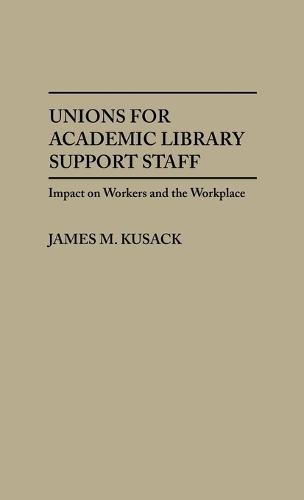
In this first book-length study of collective bargaining by library support staff employees, Professor Kusack addresses issues that will help to determine the future of the nation's academic libraries. He begins by discussing current trends and the history of collective bargaining in university libraries. The collective bargaining literature dealing with white collar and clerical employees is reviewed, and implications for libraries--especially possible changes in compensation levels and shifts in productivity--are considered. The results of a comparative study of more than 200 university libraries with and without staff unions are presented in detail. The analysis provides information on how unionization affects compensation patterns, selected employment policies and practices, and personnel and budget characteristics; and it examines the relationships between environment variables, including the type of institutional control and the level of unionization in the state and region. Finally, the author summarizes the results and possible implications of this and other research and suggests techniques and areas for study that might prove productive.
Full Product Details
Author: James Kusack
Publisher: Bloomsbury Publishing Plc
Imprint: Praeger Publishers Inc
Volume: No. 10
Dimensions:
Width: 14.00cm
, Height: 0.90cm
, Length: 21.60cm
Weight: 0.296kg
ISBN: 9780313249914
ISBN 10: 0313249911
Pages: 121
Publication Date: 21 October 1986
Recommended Age: From 7 to 17 years
Audience:
Professional and scholarly
,
General/trade
,
College/higher education
,
Professional & Vocational
,
General
Format: Hardback
Publisher's Status: Active
Availability: Manufactured on demand

We will order this item for you from a manufactured on demand supplier.
Reviews
?[This] text, which is one of the few examinations of the impact of unions on workers and the workplace in academic libraries, does offer, initially, a sound methodological approach. Kusack starts with a brief, but reasonably thorough, history of library unions. He next reviews the literature on the effects of collective bargaining with an emphasis on its impact in academic institutions and academic libraries in particular. He then reports on the results of a specific study of support staff in unionized and non-unionized academic libraries in mid-1983. That study compared compensation and selected employment policies and practices as well as personnel and budget characteristics in the two settings. As one of the first statistical examinations of academic library union issues, Kusack's effort provides some useful information. His primary conclusion is that the data show no statistical evidence of differences in the characteristics studied in unionized or non-unionized academic libraries.?-Wilson Library Bulletin
[This] text, which is one of the few examinations of the impact of unions on workers and the workplace in academic libraries, does offer, initially, a sound methodological approach. Kusack starts with a brief, but reasonably thorough, history of library unions. He next reviews the literature on the effects of collective bargaining with an emphasis on its impact in academic institutions and academic libraries in particular. He then reports on the results of a specific study of support staff in unionized and non-unionized academic libraries in mid-1983. That study compared compensation and selected employment policies and practices as well as personnel and budget characteristics in the two settings. As one of the first statistical examinations of academic library union issues, Kusack's effort provides some useful information. His primary conclusion is that the data show no statistical evidence of differences in the characteristics studied in unionized or non-unionized academic libraries. -Wilson Library Bulletin This compact, information-packed book covers a subject that is of increasing importance to library professionals. . . . it is an excellent introduction to the coming trends. All those engaged in library work can profit by reading it. . . . Good and timely reading. -National Librarian �This� text, which is one of the few examinations of the impact of unions on workers and the workplace in academic libraries, does offer, initially, a sound methodological approach. Kusack starts with a brief, but reasonably thorough, history of library unions. He next reviews the literature on the effects of collective bargaining with an emphasis on its impact in academic institutions and academic libraries in particular. He then reports on the results of a specific study of support staff in unionized and non-unionized academic libraries in mid-1983. That study compared compensation and selected employment policies and practices as well as personnel and budget characteristics in the two settings. As one of the first statistical examinations of academic library union issues, Kusack's effort provides some useful information. His primary conclusion is that the data show no statistical evidence of differences in the characteristics studied in unionized or non-unionized academic libraries. -Wilson Library Bulletin ?This compact, information-packed book covers a subject that is of increasing importance to library professionals. . . . it is an excellent introduction to the coming trends. All those engaged in library work can profit by reading it. . . . Good and timely reading.?-National Librarian ?[This] text, which is one of the few examinations of the impact of unions on workers and the workplace in academic libraries, does offer, initially, a sound methodological approach. Kusack starts with a brief, but reasonably thorough, history of library unions. He next reviews the literature on the effects of collective bargaining with an emphasis on its impact in academic institutions and academic libraries in particular. He then reports on the results of a specific study of support staff in unionized and non-unionized academic libraries in mid-1983. That study compared compensation and selected employment policies and practices as well as personnel and budget characteristics in the two settings. As one of the first statistical examinations of academic library union issues, Kusack's effort provides some useful information. His primary conclusion is that the data show no statistical evidence of differences in the characteristics studied in unionized or non-unionized academic libraries.?-Wilson Library Bulletin