Overview
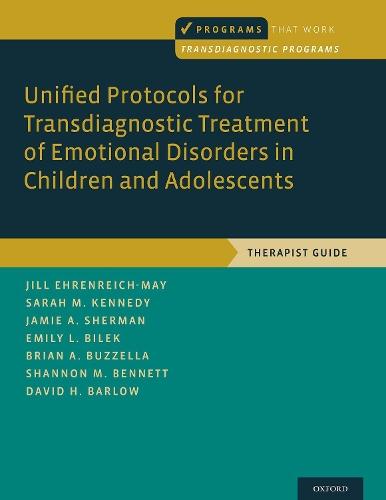
The Unified Protocols for Transdiagnostic Treatment of Emotional Disorders in Children and Adolescents, based in groundbreaking research from Jill Ehrenreich-May, David H. Barlow, and colleagues, suggest that there may be a simpler and more efficient method of utilizing effective strategies, such as those commonly included in CBT and third-wave behavior therapies, in a manner that addresses the broad array of emotional disorder symptoms in children and adolescents. The Unified Protocols for children and adolescents include a Therapist Guide with two full courses of therapy described (a modular, individual therapy for adolescents; and, a more structured, group therapy for children, complete with a full parent-directed component), as well as two Workbooks, one for children along with their parents or caregivers, and one for adolescents.The child and adolescent Unified Protocols frame effective strategies in the general language of strong or intense emotions and promote change through a common lens that applies across emotional disorders, including anxiety, depression, obsessive compulsive disorders and others. Specifically, the child and adolescent Unified Protocols help youth by allowing them to focus on a straightforward goal across emotional disorders: reducing intense negative emotion states by extinguishing the distress and anxiety these emotions produce through emotion-focused education, awareness techniques, cognitive strategies, problem-solving and an array of behavioral strategies, including a full-range of exposure and activation techniques.
Full Product Details
Author: Jill Ehrenreich-May (Associate Professor, Associate Professor, Child Division of the Department of Psychology, University of Miami) ,
Sarah M. Kennedy (postdoctoral fellow, postdoctoral fellow, Children's Hospital Colorado) ,
Jamie A. Sherman (doctoral candidate, doctoral candidate, Child clinical psychology program, University of Miami) ,
Emily L. Bilek (Clinical Assistant Professor, Clinical Assistant Professor, Department of Psychiatry, University of Michigan)
Publisher: Oxford University Press Inc
Imprint: Oxford University Press Inc
Dimensions:
Width: 27.20cm
, Height: 2.50cm
, Length: 21.60cm
Weight: 1.021kg
ISBN: 9780199340989
ISBN 10: 0199340986
Pages: 448
Publication Date: 22 February 2018
Audience:
Professional and scholarly
,
Professional & Vocational
Format: Paperback
Publisher's Status: Active
Availability: To order

Stock availability from the supplier is unknown. We will order it for you and ship this item to you once it is received by us.
Author Information
Jill Ehrenreich-May, PhD, is Associate Professor and Director of the Child and Adolescent Mood and Anxiety Treatment (CAMAT) program in the Child Division of the Department of Psychology at the University of Miami. Sarah M. Kennedy, PhD, is a postdoctoral fellow at Children's Hospital Colorado, where she provides clinical services and conducts research on transdiagnostic approaches to assessment and treatment of emotional disorders in youth. Jamie A. Sherman, MS, is a doctoral candidate in the child clinical psychology program at the University of Miami. Emily L. Bilek, PhD, is a Clinical Assistant Professor at the University of Michigan in the Department of Psychiatry. Brian A. Buzzella, PhD, ABPP, is currently Director of the VA San Diego's Family Mental Health Program and H. S. Clinical Assistant Professor of Psychiatry at the University of California San Diego. Shannon M. Bennett, PhD, is an Assistant Professor of Psychology in Clinical Psychiatry at Weill Cornell Medicine, and is the Director of Psychology for the Division of Child and Adolescent Psychiatry. David H. Barlow, PhD, ABPP, is Professor of Psychiatry and Psychology Emeritus at Boston University and the Founder and Director of the Center for Anxiety and Related Disorders, Emeritus.