|
|
|||
|
||||
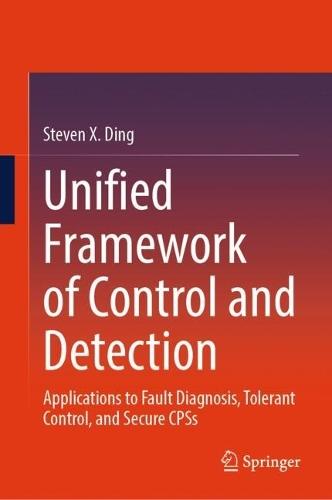
OverviewThis book introduces a unified framework for control and detection that brings together concepts from the unified design of control and detection systems and extends them into a comprehensive methodology for analysing and synthesising control, fault diagnosis, and fault-tolerant control systems. A one-to-one mapping from process input–output signals to residual and latent variables forms the foundation of this framework, enabling consistent analysis of control and detection behaviour across a wide spectrum of dynamic systems and supporting the uniform and optimal design of advanced control and diagnosis schemes. This signal subspace based formulation provides an effective means of addressing uncertainties and faults within the residual subspace while simultaneously creating a common platform that integrates traditionally independent research paradigms: model-based, data-driven, and machine learning-aided methods for control and diagnosis. By bridging these domains, the framework fosters new possibilities for innovative and cohesive design methodologies. A particularly impactful application is in secure cyber-physical systems (CPSs), where the effects of cyber-attacks and technical faults are modelled in distinct subspaces, thereby enabling simultaneous fault and attack detection as well as unified strategies for fault-tolerant and resilient control. Full Product DetailsAuthor: Steven X. DingPublisher: Springer-Verlag Berlin and Heidelberg GmbH & Co. KG Imprint: Springer-Verlag Berlin and Heidelberg GmbH & Co. K ISBN: 9783662724163ISBN 10: 3662724162 Pages: 654 Publication Date: 19 April 2026 Audience: Professional and scholarly , Professional & Vocational Format: Hardback Publisher's Status: Forthcoming Availability: Not yet available This item is yet to be released. You can pre-order this item and we will dispatch it to you upon its release. Table of ContentsReviewsAuthor InformationTab Content 6Author Website:Countries AvailableAll regions |
||||