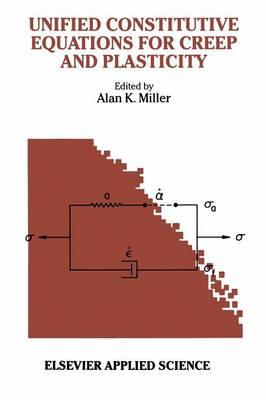
Unified Constitutive Equations for Creep and Plasticity

Author:   A.K. Miller
Publisher:   Springer
Edition:   Softcover reprint of the original 1st ed. 1987
ISBN:  

9789401080392


Pages:   342
Publication Date:   27 September 2011
Format:   Paperback
Availability:   Manufactured on demand   Availability explained
We will order this item for you from a manufactured on demand supplier.

Our Price $290.37 Quantity:  
Add to Cart

Share |

Unified Constitutive Equations for Creep and Plasticity


Overview

Constitutive equations refer to 'the equations that constitute the material response' at any point within an object. They are one of the ingredients necessary to predict the deformation and fracture response of solid bodies (among other ingredients such as the equations of equilibrium and compatibility and mathematical descriptions of the configuration and loading history). These ingredients are generally combined together in complicated computer programs, such as finite­ element analyses, which serve to both codify the pertinent knowledge and to provide convenient tools for making predictions of peak stresses, plastic strain ranges, crack growth rates, and other quantities of interest. Such predictions fall largely into two classes: structural analysis and manufacturing analysis. In the first category, the usual purpose is life prediction, for assessment of safety, reliability, durability, and/or operational strategies. Some high-technology systems limited by mechanical behavior, and therefore requiring accurate life assess­ ments, include rocket engines (the space-shuttle main engine being a prominent example), piping and pressure vessels in nuclear and non-nuclear power plants (for example, heat exchanger tubes in solar central receivers and reformer tubes in high-temperature gas-cooled reactors used for process heat applications), and the ubiquitous example of the jet engine turbine blade. In structural analysis, one is sometimes concerned with predicting distortion per se, but more often, one is concerned with predicting fracture; in these cases the informa­ tion about deformation is an intermediate result en route to the final goal of a life prediction.

Full Product Details

Author:   A.K. Miller
Publisher:   Springer
Imprint:   Springer
Edition:   Softcover reprint of the original 1st ed. 1987
Dimensions:   Width: 15.20cm , Height: 1.90cm , Length: 22.90cm
Weight:   0.527kg
ISBN:  

9789401080392


ISBN 10:   9401080399
Pages:   342
Publication Date:   27 September 2011
Audience:   Professional and scholarly ,  Professional & Vocational
Format:   Paperback
Publisher's Status:   Active
Availability:   Manufactured on demand   Availability explained
We will order this item for you from a manufactured on demand supplier.

Table of Contents

1 Constitutive Behavior Based on Crystal Plasticity.- 1 Introduction.- 2 Some Important Realities.- 3 Flow Kinetics.- 4 Polycrystal Plasticity.- 5 Evolution.- 6 Internal Stresses.- 7 Application.- 8 Summary and Recommendations.- 2 State Variable Theories Based on Hart’s Formulation.- 1 Introduction.- 2 The Physical and Phenomenological Bases.- 3 A State Variable Description.- 4 The Type of Data Utilized in Determining the Material Parameters.- 5 Materials Tested.- 6 Simulative and Predictive Powers of the State Variable Approach.- 7 Discussion.- 3 The MATMOD Equations.- 1 Introduction.- 2 Development of the Equations.- 3 Simulations and Predictions.- 4 Numerical Integration Methods.- 5 Calculation of the Material Constants.- 6 Summary.- 4 The Mechanical Equation of State.- 1 Yield Criteria.- 2 Mechanical Equation of State for Dislocation Creep under Multiaxial Stresses.- 5 A Physically Based Internal Variable Model for Rate Dependent Plasticity.- 1 Introduction.- 2 The General Problem.- 3 Proposed New Model.- 4 Behavior of the Model.- 6 Review of Unified Elastic—Viscoplastic Theory.- 1 Introduction.- 2 Constitutive Equations.- 3 Interpretation and Evaluation of Material Constants.- 4 Modeling of Metals.- 5 Applications.- 7 Summary and Critique.- 1 Introduction.- 2 Model by Krieg, Swearengen and Jones.- 3 Model by Miller.- 4 Model by Bodner.- 5 Model by Korhonen, Hannula and Li.- 6 Model by Gittus.- 7 Numerical Difficulties with the Models.- 8 Conclusion.

Reviews

Author Information

Tab Content 6

Author Website:  

Countries Available

All regions
Latest Reading Guide

NOV RG 20252


Shopping Cart
Your cart is empty
Shopping cart
Mailing List