Overview
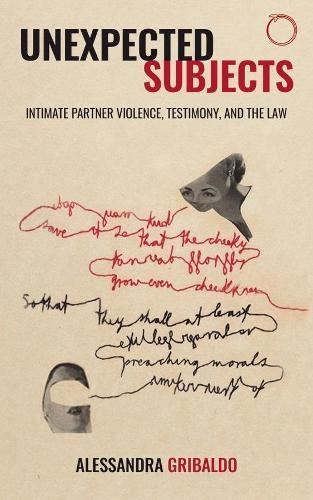
Unexpected Subjects is an ethnography of the encounter between women's words and the demands of the law in the context of adjudications on intimate partner violence. A study of institutional devices, it focuses on women’s practices of resistance and the elicitation of intelligible subjectivities. Using Italy as an illustrative case, Alessandra Gribaldo explores the problematic encounter between the need to speak, the entanglement of violence and intimacy, and the way the law approaches domestic violence. On this basis it advances theoretical reflections on questions of evidence, persuasion, and testimony, and their implications for ethnographic theory. Gribaldo analyzes the dynamics that produce the subjectivity of the victim, shedding light on how the Italian legal system reproduces broader conditions of violence against women. Perfect for graduate and advanced undergraduate teaching, this book will appeal to anthropologists and scholars of law, society, and gender.
Full Product Details
Author: Alessandra Gribaldo
Publisher: HAU Society Of Ethnographic Theory
Imprint: HAU Books
Dimensions:
Width: 12.90cm
, Height: 1.20cm
, Length: 20.70cm
Weight: 0.186kg
ISBN: 9781912808304
ISBN 10: 1912808307
Pages: 80
Publication Date: 01 September 2020
Audience:
Professional and scholarly
,
Professional & Vocational
Format: Paperback
Publisher's Status: Active
Availability: Out of stock

The supplier is temporarily out of stock of this item. It will be ordered for you on backorder and shipped when it becomes available.
Reviews
Exploring the translation of violent experiences into words, Gribaldo reflects on the social logic of imprecision, ambivalence, and embellishment in establishing credibility. She makes important claims on the role of the speech act in the wake of domestic violence, and shows us just how complicated that act is when it is framed by the court as a medium of verification. --Kelly Gillespie, University of the Western Cape Gribaldo's vividly enlightening study of language in domestic violence hearings reveals an unresolved gap between women's words and the law; between a victim's speech and the law's expectations. This is a central issue in current debates on trauma, violence, and testimony, and Gribaldo helps the reader to think on women's hesitations not just as an expression of reticence but as another form of imagination, different from that required by law and the racial-patriarchal order of things. Also especially captivating is Gribaldo's analysis of the difficulties the social sciences meet in inquiring into this area of ambivalence, fear, and violence that is stubbornly reproduced in our democracies. --Roberto Beneduce, author of Archeologie del trauma: Un'antropologia del sottosuolo This is a fascinating study of the narratives of domestic violence constructed in Italian courts. Engaging ethnographically with socially unnerving contradictions, it shows how the law both offers recognition to those who make recourse to it and yet at the same time subjects them to distorting categorizations. Gribaldo also offers important insights into relations between anthropology and feminism. --Julia Hornberger, author of Policing and Human Rights: The Meaning of Violence and Justice in the Everyday Policing of Johannesburg
With her book, Gribaldo makes her mark in advocating for women to be heard and for institutions and the public to listen closely. It asks us to rethink the expectations of the socio-legal system and to incorporate the unexpected in the narrative reconstruction of cases of intimate partner violence. Above all, she provides a much-needed challenge to the standard for intelligible subjectivities and shows how the process of elicitation in the way law enforcement, social services, as well as courts handle cases of intimate partner violence, distorts realities and produces contradictory subjectivities which harm the solidity of the case. * Anthropos * Gribaldo's vividly enlightening study of language in domestic violence hearings reveals an unresolved gap between women's words and the law; between a victim's speech and the law's expectations. This is a central issue in current debates on trauma, violence, and testimony, and Gribaldo helps the reader to think on women's hesitations not just as an expression of reticence but as another form of imagination, different from that required by law and the racial-patriarchal order of things. Also especially captivating is Gribaldo's analysis of the difficulties the social sciences meet in inquiring into this area of ambivalence, fear, and violence that is stubbornly reproduced in our democracies. -- Roberto Beneduce, author of Archeologie del trauma: Un'antropologia del sottosuolo Exploring the translation of violent experiences into words, Gribaldo reflects on the social logic of imprecision, ambivalence, and embellishment in establishing credibility. She makes important claims on the role of the speech act in the wake of domestic violence, and shows us just how complicated that act is when it is framed by the court as a medium of verification. -- Kelly Gillespie, University of the Western Cape This is a fascinating study of the narratives of domestic violence constructed in Italian courts. Engaging ethnographically with socially unnerving contradictions, it shows how the law both offers recognition to those who make recourse to it and yet at the same time subjects them to distorting categorizations. Gribaldo also offers important insights into relations between anthropology and feminism. -- Julia Hornberger, author of Policing and Human Rights: The Meaning of Violence and Justice in the Everyday Policing of Johannesburg
Author Information
Alessandra Gribaldo is associate professor of cultural anthropology at Roma Tre University in Rome.