Overview
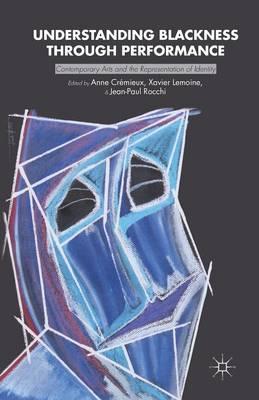
How does the performance of blackness reframe issues of race, class, gender, and sexuality? Here, the contributors look into representational practices in film, literature, fashion, and theatre and explore how they have fleshed out political struggles, while recognizing that they have sometimes maintained the mechanisms of violence against blacks.
Full Product Details
Author: Anne Cremieux ,
X. Lemoine ,
J. Rocchi ,
A Cremieux
Publisher: Palgrave Macmillan
Imprint: Palgrave Macmillan
Edition: 1st ed. 2013
Dimensions:
Width: 14.00cm
, Height: 1.50cm
, Length: 21.60cm
Weight: 3.697kg
ISBN: 9781349459155
ISBN 10: 1349459151
Pages: 282
Publication Date: 31 October 2013
Audience:
Professional and scholarly
,
Professional & Vocational
Format: Paperback
Publisher's Status: Active
Availability: Manufactured on demand

We will order this item for you from a manufactured on demand supplier.
Reviews
I applaud the authors for theorizing black performance and embodiment away from the centrality of the written texts, specifically traditional literary texts. It is highly significant in that it moves the discipline forward in both its approach and structure. - Myron M. Beasley, PhD, Associate Professor, American Cultural Studies and African American Studies, Bates College, USA This provocative collection brings together a creative community of scholars, artists, artist-scholars, and more to probe, reconfigure, and challenge the underlying presuppositions of blackness premised on fixedness and the erasure of agency. Always critical and reflective, it offers theoretical considerations, matched by ample historical and contemporary evidence, of the implications of what is involved in performing an identity, especially in cases where one is already enmeshed, whether socially or corporeally, in it. Art, in this case, goes beyond the world of fetish and voyeur into the realm of interrelatedness. A must-read not only for those of us interested in African Diasporic studies and the formation of identity but also for anyone interested in the relationship of performance to the poetics of what it means 'to be' as a form of 'not to be', paradoxically, through the zone of nonbeing. - Lewis R. Gordon, University of Connecticut, USA; Europhilosophy Visiting Professor, Toulouse University, France; and Nelson Mandela Professor, Rhodes University, South Africa Understanding Blackness through Performance illuminates the field of black performance scholarship by focusing an international lens on ethnic cultural phenonmena. Anita Gonzales, Theatre Study
I applaud the authors for theorizing black performance and embodiment away from the centrality of the written texts, specifically traditional literary texts. It is highly significant in that it moves the discipline forward in both its approach and structure. - Myron M. Beasley, PhD, Associate Professor, American Cultural Studies and African American Studies, Bates College, USA This provocative collection brings together a creative community of scholars, artists, artist-scholars, and more to probe, reconfigure, and challenge the underlying presuppositions of blackness premised on fixedness and the erasure of agency. Always critical and reflective, it offers theoretical considerations, matched by ample historical and contemporary evidence, of the implications of what is involved in performing an identity, especially in cases where one is already enmeshed, whether socially or corporeally, in it. Art, in this case, goes beyond the world of fetish and voyeur into the realm of interrelatedness. A must-read not only for those of us interested in African Diasporic studies and the formation of identity but also for anyone interested in the relationship of performance to the poetics of what it means 'to be' as a form of 'not to be', paradoxically, through the zone of nonbeing. - Lewis R. Gordon, University of Connecticut, USA; Europhilosophy Visiting Professor, Toulouse University, France; and Nelson Mandela Professor, Rhodes University, South Africa Understanding Blackness through Performance illuminates the field of black performance scholarship by focusing an international lens on ethnic cultural phenonmena. Anita Gonzales, Theatre Study
I applaud the authors for theorizing black performance and embodiment away from the centrality of the written texts, specifically traditional literary texts. It is highly significant in that it moves the discipline forward in both its approach and structure. - Myron M. Beasley, PhD, Associate Professor, American Cultural Studies and African American Studies, Bates College, USA This provocative collection brings together a creative community of scholars, artists, artist-scholars, and more to probe, reconfigure, and challenge the underlying presuppositions of blackness premised on fixedness and the erasure of agency. Always critical and reflective, it offers theoretical considerations, matched by ample historical and contemporary evidence, of the implications of what is involved in performing an identity, especially in cases where one is already enmeshed, whether socially or corporeally, in it. Art, in this case, goes beyond the world of fetish and voyeur into the realm of interrelatedness. A must-read not only for those of us interested in African Diasporic studies and the formation of identity but also for anyone interested in the relationship of performance to the poetics of what it means 'to be' as a form of 'not to be', paradoxically, through the zone of nonbeing. - Lewis R. Gordon, University of Connecticut, USA; Europhilosophy Visiting Professor, Toulouse University, France; and Nelson Mandela Professor, Rhodes University, South Africa Understanding Blackness through Performance illuminates the field of black performance scholarship by focusing an international lens on ethnic cultural phenonmena. Anita Gonzales, Theatre Study
Author Information
Zakiya R. Adair, University of Missouri, USA Gayle Baldwin, University of North Dakota, USA Myron M. Beasley, Bates College, USA Simon Dickel, Ruhr-University Bochum, Germany Vanina Géré, University Sorbonne Nouvelle-Paris 3, France Mae G. Henderson, University of North Carolina at Chapel Hill, USA Kristin Leigh Moriah, The Graduate Center, City University of New York, USA James Smalls, University of Maryland, USA Stephany Spaulding, University of Colorado at Colorado Springs, USA Toniesha L. Taylor, Prairie View A & M University, USA Rinaldo Walcott, University of Toronto, Canada