Overview
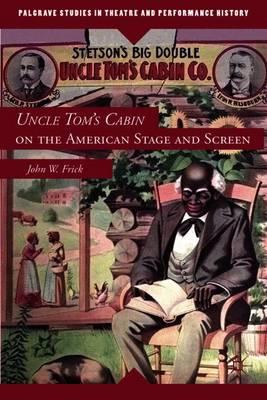
No play in the history of the American stage has been as ubiquitous and as widely viewed as Uncle Tom's Cabin. This book traces the major dramatizations of Stowe's classic from its inception in 1852 through modern versions on film. Frick introduces the reader to the artists who created the plays and productions that created theatre history.
Full Product Details
Author: J. Frick
Publisher: Palgrave Macmillan
Imprint: Palgrave Macmillan
Dimensions:
Width: 14.00cm
, Height: 1.90cm
, Length: 21.60cm
Weight: 0.540kg
ISBN: 9780230114074
ISBN 10: 0230114075
Pages: 308
Publication Date: 31 October 2012
Audience:
Professional and scholarly
,
Professional & Vocational
Format: Hardback
Publisher's Status: Active
Availability: In Print

This item will be ordered in for you from one of our suppliers. Upon receipt, we will promptly dispatch it out to you. For in store availability, please contact us.
Reviews
John Frick's comprehensive study of the myriad theatrical and movie interpretations of Uncle Tom's Cabin should be required reading for all scholars of American culture and theatre. - Journal of Dramatic Theory and Criticism Frick not only illuminates nineteenth century stage practices (for example, the odious custom of white actors performing in blackface) and the play itself, but he also provides a panoramic view of the titanic social issues inherent in the play and that the work directly influenced, in regard to slavery . . . Frick's eye for engaging details and his astute and thorough scholarship provide a treasure trove for theatre and cultural historians . . . Frick's study makes clear that the play's ongoing dialogue with its culture, for better or worse, is as enduringly American as that proverbial apple pie. - Broadside
<p> John W. Frick has given a great gift to American theatre scholarship: a full-length, expansively-conceived, meticulously researched study of Uncle Tom's Cabin. This lively, erudite book zooms in to feel the texture of individual shows and to envision the performances of specific actors, and then zooms out to locate Uncle Tom's Cabin in the greater contexts of theatre history and large-scale social forces that Uncle Tom both reflected and influenced. This is a magisterial, exciting, and necessary book. - Robin Bernstein, associate professor of African and African American Studies and of Studies of Women, Gender, and Sexuality, Harvard University As John W. Frick points out, between the mid-1850s and the 1930s, anybody who was anybody appeared in a production of Uncle Tom's Cabin, whether on stage or on screen. Frick's study sheds new light on the complex history of America's best-known and perhaps most controversial and far-reaching play. Mapping its transition from page to stage to screen, he examines how the seemingly infinite adaptations of Uncle Tom's Cabin challenged or affirmed audience prejudices. More importantly, he explains why, 160 years after its debut on the American stage, Uncle Tom's Cabin remains a work that illuminates not only the history of American theatre and film, but the trajectory of our national discussions on race. - Heather S. Nathans, professor of Theatre, School of Theatre, Dance, and Performance Studies, University of Maryland
<p> Frick not only illuminates nineteenth century stage practices (for example, the odious custom of white actors performing in blackface) and the play itself, but he also provides a panoramic view of the titanic social issues inherent in the play and that the work directly influenced, in regard to slavery . . . Frick's eye for engaging details and his astute and thorough scholarship provide a treasure trove for theatre and cultural historians . . . Frick's study makes clear that the play's ongoing dialogue with its culture, for better or worse, is as enduringly American as that proverbial apple pie. - Broadside
Author Information
John Frick is Professor Emeritus of Theatre at the University of Virginia, USA. He is the author of Theatre, Culture and Temperance Reform in Nineteenth-Century America and New York's First Theatrical Center: The Rialto at Union Square as well as co-editor of The Directory of Historic American Theatre and Theatrical Directors: A Biographical Dictionary . He is a past editor of Theatre Symposium , a former Stanley J. Kahrl Fellow at Harvard University, past president of the American Theatre and Drama Society, and the 2010 recipient of the Betty Jean Jones Award for Outstanding Teacher of American Theatre and Drama. While in New York, he worked Off-Off Broadway as a dramaturg and as a stage manager with theatre and dance companies.