Overview
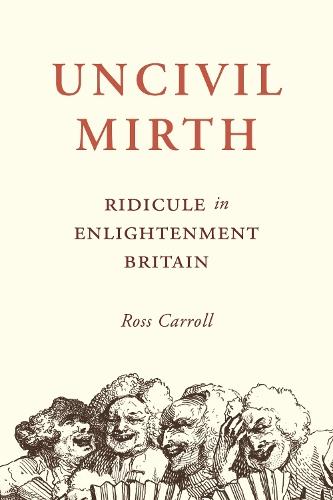
How the philosophers and polemicists of eighteenth-century Britain used ridicule in the service of religious toleration, abolition, and political justice. The relaxing of censorship in Britain at the turn of the eighteenth century led to an explosion of satires, caricatures, and comic hoaxes. This new vogue for ridicule unleashed moral panic and prompted warnings that it would corrupt public debate. But ridicule also had vocal defenders who saw it as a means to expose hypocrisy, unsettle the arrogant, and deflate the powerful. Uncivil Mirth examines how leading thinkers of the period searched for a humane form of ridicule, one that served the causes of religious toleration, the abolition of the slave trade, and the dismantling of patriarchal power. Ross Carroll brings to life a tumultuous age in which the place of ridicule in public life was subjected to unparalleled scrutiny. He shows how the Third Earl of Shaftesbury, far from accepting ridicule as an unfortunate byproduct of free public debate, refashioned it into a check on pretension and authority. Drawing on philosophical treatises, political pamphlets, and conduct manuals of the time, Carroll examines how David Hume, Mary Wollstonecraft, and others who came after Shaftesbury debated the value of ridicule in the fight against intolerance, fanaticism, and hubris. Casting Enlightenment Britain in an entirely new light, Uncivil Mirth demonstrates how the Age of Reason was also an Age of Ridicule, and speaks to our current anxieties about the lack of civility in public debate. 'Illuminating and persuasive. Carroll sheds new light on eighteenth-century British moral and political thought.' - James A. Harris, University of St. Andrews 'Uncivil Mirth is an outstanding book that examines eighteenth-century political thought from a refreshing new angle.' - William Selinger, author of Parliamentarism: From Burke to Weber 'A stimulating and timely study of eighteenth-century ridicule and satire. Uncivil Mirth has much to say to our troubled consciences and the problematic valences of humour in unpropitious times.' - B. W. Young, author of The Victorian Eighteenth Century: An Intellectual History
Full Product Details
Author: Ross Carroll
Publisher: Princeton University Press
Imprint: Princeton University Press
ISBN: 9780691241777
ISBN 10: 0691241775
Pages: 280
Publication Date: 09 August 2022
Audience:
College/higher education
,
Professional and scholarly
,
General/trade
,
Tertiary & Higher Education
,
Professional & Vocational
Format: Paperback
Publisher's Status: Active
Availability: Manufactured on demand

We will order this item for you from a manufactured on demand supplier.
Reviews
For those curious to know the role of ridicule in eighteenth-century Britain, Ross Carroll's Uncivil Mirth is the place to start. In it, readers will find a reliable survey of the main lines of argument about ridicule's function in enlightened public debate. ---Mark G. Spencer, LSE Review of Books Witty and insightful. . . . this study could hardly be more timely. ---Jan Machielsen, Times Literary Supplement
Winner of the Morris D. Forkosch Book Prize, Journal for the History of Ideas For those curious to know the role of ridicule in eighteenth-century Britain, Ross Carroll's Uncivil Mirth is the place to start. In it, readers will find a reliable survey of the main lines of argument about ridicule's function in enlightened public debate. ---Mark G. Spencer, LSE Review of Books Witty and insightful. . . . this study could hardly be more timely. ---Jan Machielsen, Times Literary Supplement
Author Information
Ross Carroll is senior lecturer in political theory and a member of the Centre for Political Thought at the University of Exeter. Twitter @rossecarroll