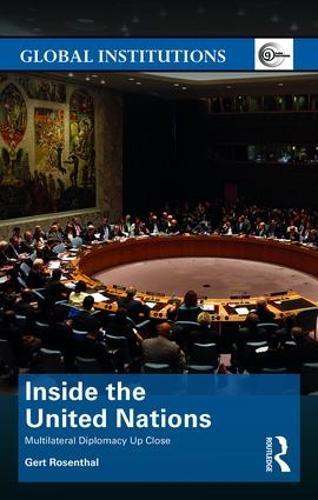
Full Product Details
Author: Gert Rosenthal
Publisher: Taylor & Francis Ltd
Imprint: Routledge
Weight: 0.470kg
ISBN: 9781138236684
ISBN 10: 1138236683
Pages: 168
Publication Date: 27 March 2017
Audience:
College/higher education
,
Tertiary & Higher Education
,
Undergraduate
Format: Hardback
Publisher's Status: Active
Availability: In Print

This item will be ordered in for you from one of our suppliers. Upon receipt, we will promptly dispatch it out to you. For in store availability, please contact us.
Reviews
<strong> I highly recommend this volume to anyone who wants to know how the United Nations really works. Nowhere else could one find so much wisdom about the world body packed into so few pages. From his unparalleled experience representing Guatemala in the Security Council, General Assembly, and ECOSOC, Ambassador Rosenthal draws invaluable lessons for diplomats, policymakers, scholars, and representatives of civil society. Among them is that size is not the only thing that counts at the United Nations. He shows that, with skill and dedication, representatives of small countries can--at times--make a real difference in global diplomacy. </strong> - <i>Edward C. Luck, Arnold A. Saltzman Professor of Professional Practice, School of International and Public Affairs, Columbia University and former Special Adviser and Assistant Secretary-General, the United Nations</p></i> <b> This admirably slim, deeply wise volume from one of Latin America s leading social scientists assesses unsentimentally and in-depth a set of important negotiations in which he was involved at the United Nations, generally in a leading role, over nearly two decades. Helpfully presented as minutely dissected case studies, Rosenthal makes clear that the stakes in such UN negotiations are above all political, with transparency (at least among insiders) and a sense of ownership prized more that the saliency or relevance of outcomes. Nevertheless, whether in the Security Council or one of the UN s economic or internal management processes, the sovereign equality of member states is regularly upended by the UN s powerful members, whose diplomatic reach to capitals, short-circuiting those in New York, is impressive. The narrative achieves a deep dive into intra-UN dynamics. The UN remains a unique and valuable asset for international relations, but one that serves too often as the theatre for essentially esoteric struggles among those involved with limited impact on the world beyond. </b><i>- David Malone, Rector of the United Nations University and Under-Secretary-General of the United Nations</i></p><b> There are always at least two United Nations: the UN of the Secretary General and its operational arms, from peace-keeping to humanitarian aid, and the UN made up of each of its 193 member countries. The first is highly visible and often blamed when things go wrong around the world; the work of the second, with the exception perhaps of the Security Council, is much less well understood. Gert Rosenthal has written a fascinating and important book about the politics and practicalities of diplomacy between countries at the UN, and how these countries interact with the UN secretariat. Very few people can have seen this hidden landscape from as many different perches as Ambassador Rosenthal, who has facilitated resolutions on sensitive issues in the General Assembly, served as President of the Economic and Social Council, as Chair of the Fifth Committee which deals with the UN's budget, and as member of the Security Council during the early years of the Syria conflict. This text will be an indispensable primer for diplomats and policy makers at the UN as much as for students and scholars of multilateral diplomacy. </b> - <i>Sarah F. Cliffe Director Center on International Cooperation (CIC), New York University </p></i>
"‘I highly recommend this volume to anyone who wants to know how the United Nations really works. Nowhere else could one find so much wisdom about the world body packed into so few pages. From his unparalleled experience representing Guatemala in the Security Council, General Assembly, and ECOSOC, Ambassador Rosenthal draws invaluable lessons for diplomats, policymakers, scholars, and representatives of civil society. Among them is that size is not the only thing that counts at the United Nations. He shows that, with skill and dedication, representatives of small countries can--at times--make a real difference in global diplomacy.’ - Edward C. Luck, Arnold A. Saltzman Professor of Professional Practice, School of International and Public Affairs, Columbia University and former Special Adviser and Assistant Secretary-General, the United Nations ‘This admirably slim, deeply wise volume from one of Latin America’s leading social scientists assesses unsentimentally and in-depth a set of important negotiations in which he was involved at the United Nations, generally in a leading role, over nearly two decades. Helpfully presented as minutely dissected case studies, Rosenthal makes clear that the stakes in such UN negotiations are above all political, with transparency (at least among insiders) and a ""sense of ownership"" prized more that the saliency or relevance of outcomes. Nevertheless, whether in the Security Council or one of the UN’s economic or internal management processes, the ""sovereign equality"" of member states is regularly upended by the UN’s powerful members, whose diplomatic reach to capitals, short-circuiting those in New York, is impressive. The narrative achieves a deep dive into intra-UN dynamics. The UN remains a unique and valuable asset for international relations, but one that serves too often as the theatre for essentially esoteric struggles among those involved with limited impact on the world beyond.’ - David Malone, Rector of the United Nations University and Under-Secretary-General of the United Nations ‘There are always at least two United Nations: the UN of the Secretary General and its operational arms, from peace-keeping to humanitarian aid, and the UN made up of each of its 193 member countries. The first is highly visible and often blamed when things go wrong around the world; the work of the second, with the exception perhaps of the Security Council, is much less well understood. Gert Rosenthal has written a fascinating and important book about the politics and practicalities of diplomacy between countries at the UN, and how these countries interact with the UN secretariat. Very few people can have seen this hidden landscape from as many different perches as Ambassador Rosenthal, who has facilitated resolutions on sensitive issues in the General Assembly, served as President of the Economic and Social Council, as Chair of the Fifth Committee which deals with the UN's budget, and as member of the Security Council during the early years of the Syria conflict. This text will be an indispensable primer for diplomats and policy makers at the UN as much as for students and scholars of multilateral diplomacy.’ - Sarah F. Cliffe Director Center on International Cooperation (CIC), New York University"
'I highly recommend this volume to anyone who wants to know how the United Nations really works. Nowhere else could one find so much wisdom about the world body packed into so few pages. From his unparalleled experience representing Guatemala in the Security Council, General Assembly, and ECOSOC, Ambassador Rosenthal draws invaluable lessons for diplomats, policymakers, scholars, and representatives of civil society. Among them is that size is not the only thing that counts at the United Nations. He shows that, with skill and dedication, representatives of small countries can--at times--make a real difference in global diplomacy.' - Edward C. Luck, Arnold A. Saltzman Professor of Professional Practice, School of International and Public Affairs, Columbia University and former Special Adviser and Assistant Secretary-General, the United Nations 'This admirably slim, deeply wise volume from one of Latin America's leading social scientists assesses unsentimentally and in-depth a set of important negotiations in which he was involved at the United Nations, generally in a leading role, over nearly two decades. Helpfully presented as minutely dissected case studies, Rosenthal makes clear that the stakes in such UN negotiations are above all political, with transparency (at least among insiders) and a sense of ownership prized more that the saliency or relevance of outcomes. Nevertheless, whether in the Security Council or one of the UN's economic or internal management processes, the sovereign equality of member states is regularly upended by the UN's powerful members, whose diplomatic reach to capitals, short-circuiting those in New York, is impressive. The narrative achieves a deep dive into intra-UN dynamics. The UN remains a unique and valuable asset for international relations, but one that serves too often as the theatre for essentially esoteric struggles among those involved with limited impact on the world beyond.' - David Malone, Rector of the United Nations University and Under-Secretary-General of the United Nations 'There are always at least two United Nations: the UN of the Secretary General and its operational arms, from peace-keeping to humanitarian aid, and the UN made up of each of its 193 member countries. The first is highly visible and often blamed when things go wrong around the world; the work of the second, with the exception perhaps of the Security Council, is much less well understood. Gert Rosenthal has written a fascinating and important book about the politics and practicalities of diplomacy between countries at the UN, and how these countries interact with the UN secretariat. Very few people can have seen this hidden landscape from as many different perches as Ambassador Rosenthal, who has facilitated resolutions on sensitive issues in the General Assembly, served as President of the Economic and Social Council, as Chair of the Fifth Committee which deals with the UN's budget, and as member of the Security Council during the early years of the Syria conflict. This text will be an indispensable primer for diplomats and policy makers at the UN as much as for students and scholars of multilateral diplomacy.' - Sarah F. Cliffe Director Center on International Cooperation (CIC), New York University
Author Information
Gert Rosenthal is a Guatemalan economist. He did both his undergraduate and graduate studies at the University of California at Berkeley. He alternated his career between public service in Guatemala and in international organizations. On the former, he was, among other posts Secretary-General of the National Planning and Budgetary Secretariat. On the latter, he worked for the Secretariat of the Central American Common Market before joining the United Nations Economic Commission for Latin America and the Caribbean (ECLAC) where he served as its Executive Secretary from 1988 to 1997. After retiring from the UN secretariat he rejoined his government and served, first, as Permanent Representative of Guatemala to the United Nations, then as Foreign Minister of Guatemala, followed by a second tour of duty to the UN to lead the Guatemalan delegation to the Security Council. His last activity with the United Nations was as Chair of the Advisory Group of Experts for the 2015 review of the organization’s peacebuilding architecture.