Overview
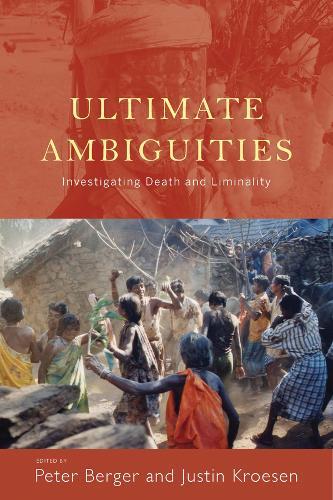
Periods of transition are often symbolically associated with death, making the latter the paradigm of liminality. Yet, many volumes on death in the social sciences and humanities do not specifically address liminality. This book investigates these “ultimate ambiguities,” assuming they can pose a threat to social relationships because of the disintegrating forces of death, but they are also crucial periods of creativity, change, and emergent aspects of social and religious life. Contributors explore death and liminality from an interdisciplinary perspective and present a global range of historical and contemporary case studies outlining emotional, cognitive, artistic, social, and political implications.
Full Product Details
Author: Peter Berger ,
Justin Kroesen
Publisher: Berghahn Books
Imprint: Berghahn Books
ISBN: 9781789207590
ISBN 10: 1789207592
Pages: 290
Publication Date: 12 May 2020
Audience:
College/higher education
,
Postgraduate, Research & Scholarly
Format: Paperback
Publisher's Status: Active
Availability: In Print

This item will be ordered in for you from one of our suppliers. Upon receipt, we will promptly dispatch it out to you. For in store availability, please contact us.
Reviews
At the theoretical level, the volume certainly makes a strong argument for the enduring relevance of the sociological tradition from Durkheim to Turner. Robben's article alone presents a most poignant illustration of the analytic power of liminality in a contemporary setting. Berger's valiant argument for Durkheim's much maligned concept of effervescence should be taken seriously, for it seems to open a rapprochement between structural and cognitive science approaches to ritual. * Journal of the Royal Anthropological Institute Ultimate Ambiguities: Investing Death and Liminality is a valuable contribution to the often diffuse literature on religion and death/dying given that the widely varying case studies share a common focus on 'liminality explicitly in the context of death'. Editors Peter Berger and Justin Kroesen draw together a wide-ranging set of eleven primarily anthropological chapters. These offer rich and contextualized examples of beliefs, especially ritualization, from various traditions. Yet the key measure of this book's success is theoretical, given its explicit focus on liminality... The book is a valuable resource... the editors deserve praise for putting together one of the most focused and valuable volumes in the death and dying sub-genre. * Reading Religion With studies ranging from the Sora of India to death rituals in Ancient Greece, this selection offers a comparative approach that reinforces previous theories while also challenging liminality as some unidentifiable location... Berger and Kroesen's compilation is a most valuable addition to studies on liminality and death as it introduces key theoretical concepts through varied and intriguing case studies. * Religious Studies Review This is a hugely interesting book that will be a very valuable contribution to the study of death in social science and the humanities. * Arnar Arnason, University of Aberdeen This is an important volume dealing... with the always-complex ritualization of death in comparative perspective, critically reassessing the work of some of the classic authors in the social sciences and more particularly in anthropological debates, and offering new theoretical and empirical angles to better understand the ambiguities inherent to death, burial, and afterlife beliefs. * Francisco Ferrandiz, Spanish National Research Council
At the theoretical level, the volume certainly makes a strong argument for the enduring relevance of the sociological tradition from Durkheim to Turner. Robben's article alone presents a most poignant illustration of the analytic power of liminality in a contemporary setting. Berger's valiant argument for Durkheim's much maligned concept of effervescence should be taken seriously, for it seems to open a rapprochement between structural and cognitive science approaches to ritual. Journal of the Royal Anthropological Institute Ultimate Ambiguities: Investing Death and Liminality is a valuable contribution to the often diffuse literature on religion and death/dying given that the widely varying case studies share a common focus on 'liminality explicitly in the context of death'. Editors Peter Berger and Justin Kroesen draw together a wide-ranging set of eleven primarily anthropological chapters. These offer rich and contextualized examples of beliefs, especially ritualization, from various traditions. Yet the key measure of this book's success is theoretical, given its explicit focus on liminality... The book is a valuable resource... the editors deserve praise for putting together one of the most focused and valuable volumes in the death and dying sub-genre. Reading Religion With studies ranging from the Sora of India to death rituals in Ancient Greece, this selection offers a comparative approach that reinforces previous theories while also challenging liminality as some unidentifiable location... Berger and Kroesen's compilation is a most valuable addition to studies on liminality and death as it introduces key theoretical concepts through varied and intriguing case studies. Religious Studies Review
Author Information
Peter Berger is Associate Professor of Indian Religions and the Anthropology of Religion at the University of Groningen. His books include Feeding, Sharing and Devouring: Ritual and Society in Highland Odisha (de Gruyter, 2015), The Modern Anthropology of India (co-ed with Frank Heidemann, Routledge, 2013) and Godroads: Modalities of Conversion in India (co-ed with Sarbeswar Sahoo, Cambridge University Press, 2020).