Overview
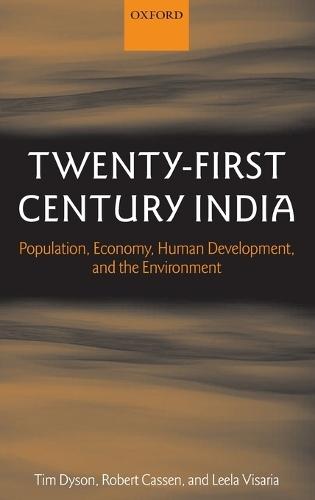
Twenty-First Century India is the first study of India's development giving a fully integrated account of population and development. It is built on new projections of the population for fifty years from the Census of 2001. India's population then had already passed 1 billion. Twenty-five years later it will exceed 1.4 billion, and will almost certainly pass 1.5 billion by mid-century. The projections incorporate for the first time both inter-state migration and the role of HIV/AIDS. They also show India's urban future, with close to half a billion urban inhabitants by the year 2026. The implications of this population growth are then traced out in a range of modelling and analytical work. Growing numbers are found to complicate the task of achieving widespread education in a number of India's states, while other states are already experiencing declines in their school-age population. Demographic growth also contributes to poverty, and increasing divergence in social conditions among the states. As population growth slows in the country overall, the labour force continues to grow relatively fast, with difficult consequences for employment. But national economic growth could be accelerated by the 'demographic bonus' of the declining proportion of dependents to workers in the population. The book is reasonably optimistic about India's food prospects: the country can continue to feed itself. It can also enjoy higher levels of energy use, manufacturing, and modern forms of transport, while experiencing less chemical pollution. India's cities can become cleaner and healthier places to live. Perhaps the most difficult environmental issue, and the one most strongly related to population growth, is water. Some states also face severe pressures on common property resources. A policy chapter concludes the book. India's future problems are large, but in principle manageable. However, whether the country will actually achieve sustainable development for all is another matter.
Full Product Details
Author: Tim Dyson (Professor of Population and Development, London School of Economics & Political Science) ,
Robert Cassen (Visiting Professor, Department of Social Policy, London School of Economics & Political Science) ,
Leela Visaria (Institute of Economic Growth, Delhi)
Publisher: Oxford University Press
Imprint: Oxford University Press
Dimensions:
Width: 16.30cm
, Height: 2.30cm
, Length: 24.20cm
Weight: 0.822kg
ISBN: 9780199243358
ISBN 10: 0199243352
Pages: 436
Publication Date: 25 March 2004
Audience:
Professional and scholarly
,
Professional & Vocational
Format: Hardback
Publisher's Status: Active
Availability: To order

Stock availability from the supplier is unknown. We will order it for you and ship this item to you once it is received by us.
Reviews
A valuable reference book and a model of quantitative analysis and sound prediction --Foreign Affairs
A valuable reference book and a model of quantitative analysis and sound prediction --Foreign Affairs<br>