Overview
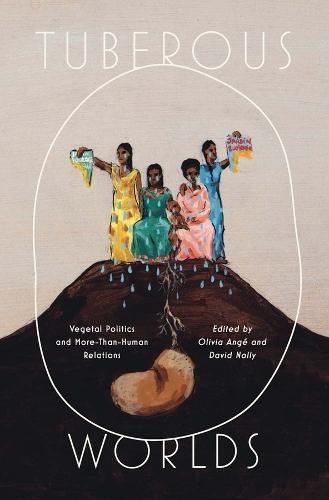
A fascinating examination of ""tuberous associations""—the economies, politics, and ecologies enabled by human-tuber interactions The world is much more tuberous than most people know. From the millions of smallholder peasants cultivating tuber plants to the teams of scientists mapping potato genomic information to the industrial manufacturers selecting the best varieties for producing French fries, life unfolds in a tuber-enabled environment. This book describes the many different forms of ""tuberous association""—the patterns of production, kinship, collaboration, resistance, feeding, and care that arise from and are made possible by tuberous partnerships. Tubers are vital partners, or allies, that support life within autonomous collectives and at the same time are entwined in the extractive practices of colonization, land enclosure, and plantation—facts that reveal the complexity and contingency of vegetal politics. To explore this complexity, the contributors to this book consider an array of tuberous bodies, such as cassava, taro, yam, potato, and sweet potato, to draw out the subtleties and textures of human-tuber companionship in all their startling diversity. By considering tubers not only as a ""product"" or ""staple,"" but also as partners, kin, and ancestors—as lifeforms grafted to our own—the authors argue for a nuanced understanding of tuberous politics, economies, and ecologies.
Full Product Details
Author: Olivia Ange ,
David Nally
Publisher: Yale University Press
Imprint: Yale University Press
ISBN: 9780300281774
ISBN 10: 0300281773
Pages: 368
Publication Date: 07 April 2026
Audience:
Professional and scholarly
,
Professional & Vocational
Format: Hardback
Publisher's Status: Forthcoming
Availability: Awaiting stock

Reviews
“Cunningly counter-positioning twelve intriguing and distinctive investigations of how humans and tuber crops relate, Ange and Nally offer illuminating perspectives on plant-human entanglements and suggest new approaches to materiality.”—Francesca Bray, coauthor of Moving Crops and the Scales of History “An exemplary case of taking the everyday and the quotidian—pounded yam, cassava, or sweet potato mounds—and showing how they contain multitudes.”—Michael Watts, Class of ’63 Professor of Geography Emeritus, University of California, Berkeley “Sweeping across cultures, continents, and centuries, this impressive multidisciplinary collection rightly insists that we have much learn from the rich histories and lifeworlds of humans’ tuberous kin.”—Helen Anne Curry, Melvin Kranzberg Professor in the History of Technology, Georgia Institute of Technology “A stunning set of essays that intellectually graft humans and tubers. More than that, they show the extent to which we are already grafted, physiologically, economically, ecologically, and historically. Across richly diverse sites, the authors interrogate domestication, cultivation, and colonization, but also reveal tuberous worlds that are so much more than human. This is gripping, exciting scholarship.”—Alison Bashford, author of The Huxleys: An Intimate History of Evolution
“Cunningly counter-positioning twelve intriguing and distinctive investigations of how humans and tuber crops relate, Ange and Nally offer illuminating perspectives on plant-human entanglements and suggest new approaches to materiality.”—Francesca Bray, coauthor of Moving Crops and the Scales of History “An exemplary case of taking the everyday and the quotidian—pounded yam, cassava, or sweet potato mounds—and showing how they contain multitudes.”—Michael Watts, Class of ’63 Professor of Geography Emeritus, University of California, Berkeley “Sweeping across cultures, continents, and centuries, this impressive multidisciplinary collection rightly insists that we have much learn from the rich histories and lifeworlds of humans’ tuberous kin.”—Helen Anne Curry, Melvin Kranzberg Professor in the History of Technology, Georgia Institute of Technology “A stunning set of essays that intellectually graft humans and tubers. More than that, they show the extent to which we are already grafted, physiologically, economically, ecologically, and historically. Across richly diverse sites, the authors interrogate domestication, cultivation, and colonization, but also reveal tuberous worlds that are so much more than human. This is gripping, exciting scholarship.”—Alison Bashford, author of The Huxleys: An Intimate History of Evolution
Author Information
Olivia Angé is professor of anthropology at the Free University of Brussels. David Nally is professor of historical geography and fellow of Jesus College at the University of Cambridge.