Overview
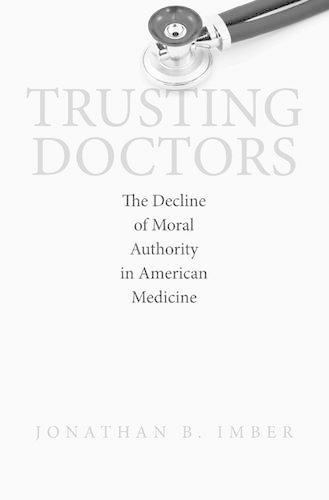
For more than a century, the American medical profession insisted that doctors be rigorously trained in medical science and dedicated to professional ethics. Patients revered their doctors as representatives of a sacred vocation. Do we still trust doctors with the same conviction? In Trusting Doctors, Jonathan Imber attributes the development of patients' faith in doctors to the inspiration and influence of Protestant and Catholic clergymen during the nineteenth and early twentieth centuries. He explains that as the influence of clergymen waned, and as reliance on medical technology increased, patients' trust in doctors steadily declined. Trusting Doctors discusses the emphasis that Protestant clergymen placed on the physician's vocation; the focus that Catholic moralists put on specific dilemmas faced in daily medical practice; and the loss of unchallenged authority experienced by doctors after World War II, when practitioners became valued for their technical competence rather than their personal integrity.Imber shows how the clergy gradually lost their impact in defining the physician's moral character, and how vocal critics of medicine contributed to a decline in patient confidence. The author argues that as modern medicine becomes defined by specialization, rapid medical advance, profit-driven industry, and ever more anxious patients, the future for a renewed trust in doctors will be confronted by even greater challenges. Trusting Doctors provides valuable insights into the religious underpinnings of the doctor-patient relationship and raises critical questions about the ultimate place of the medical profession in American life and culture.
Full Product Details
Author: Jonathan B. Imber
Publisher: Princeton University Press
Imprint: Princeton University Press
Dimensions:
Width: 15.20cm
, Height: 2.80cm
, Length: 23.50cm
Weight: 0.567kg
ISBN: 9780691135748
ISBN 10: 0691135746
Pages: 280
Publication Date: 14 September 2008
Audience:
College/higher education
,
Professional and scholarly
,
Tertiary & Higher Education
,
Professional & Vocational
Format: Hardback
Publisher's Status: Active
Availability: Temporarily unavailable

The supplier advises that this item is temporarily unavailable. It will be ordered for you and placed on backorder. Once it does come back in stock, we will ship it out to you.
Language: English
Reviews
Imber offers a well-researched, insightful work on the role of trust in American medicine, and how social changes altered both doctors' and patients' understanding of the role of the physician from the late 19th century to the present. Imber's relentless focus on the issue of trust differentiates his work from other histories of medicine and doctoring in America... Overall, this is an important book on medicine, doctor-patient relationships, and the historical progress of medical ethics. -- A.W. Klink, Choice Trusting Doctors can strongly be recommended as a reference text for all teachers in the sociology and bio ethical fields and should be referred to by those who determine and regularly change the content of Medical School teaching. -- Sam Mellick, CBE, Supreme Court Library Review of Books Imber offers a thought-provoking entry into the history of bioethics, a history which continues to unfold. -- Susan E. Lederer, Social History of Medicine Imber is at his best ... when he presents his views on religion and the origins of American medical professionalism. With erudition, he draws on archival material drawn from the writings and preaching of American clergy in the 19th and early 20th centuries. -- Joseph J. Fins, Journal of the American Medical Association Trusting Doctors is an original and important analysis of the decline of doctors' moral authority and a subtle, sociologically informed critique of contemporary medical bioethics. -- Robert Zussman, American Journal of Sociology
Imber offers a well-researched, insightful work on the role of trust in American medicine, and how social changes altered both doctors' and patients' understanding of the role of the physician from the late 19th century to the present. Imber's relentless focus on the issue of trust differentiates his work from other histories of medicine and doctoring in America... Overall, this is an important book on medicine, doctor-patient relationships, and the historical progress of medical ethics. -- A.W. Klink Choice Trusting Doctors can strongly be recommended as a reference text for all teachers in the sociology and bio ethical fields and should be referred to by those who determine and regularly change the content of Medical School teaching. -- Sam Mellick, CBE Supreme Court Library Review of Books Imber offers a thought-provoking entry into the history of bioethics, a history which continues to unfold. -- Susan E. Lederer Social History of Medicine Imber is at his best ... when he presents his views on religion and the origins of American medical professionalism. With erudition, he draws on archival material drawn from the writings and preaching of American clergy in the 19th and early 20th centuries. -- Joseph J. Fins Journal of the American Medical Association Trusting Doctors is an original and important analysis of the decline of doctors' moral authority and a subtle, sociologically informed critique of contemporary medical bioethics. -- Robert Zussman American Journal of Sociology I learned a great deal from reading this book... The book is exceedingly well documented, the notes are very illuminating, and I've already bought or downloaded a number of Imber's sources for further reading. Anyone interested in medical ethics, medical sociology, or the history of medicine will find this book a very worthwhile read. -- Daniel P. Sulmasy New Atlantis
Imber offers a well-researched, insightful work on the role of trust in American medicine, and how social changes altered both doctors' and patients' understanding of the role of the physician from the late 19th century to the present. Imber's relentless focus on the issue of trust differentiates his work from other histories of medicine and doctoring in America... Overall, this is an important book on medicine, doctor-patient relationships, and the historical progress of medical ethics. -- A.W. Klink Choice Trusting Doctors can strongly be recommended as a reference text for all teachers in the sociology and bio ethical fields and should be referred to by those who determine and regularly change the content of Medical School teaching. -- Sam Mellick, CBE Supreme Court Library Review of Books
Author Information
Jonathan B. Imber is the Class of 1949 Professor in Ethics and professor of sociology at Wellesley College. He is the author of Abortion and the Private Practice of Medicine.