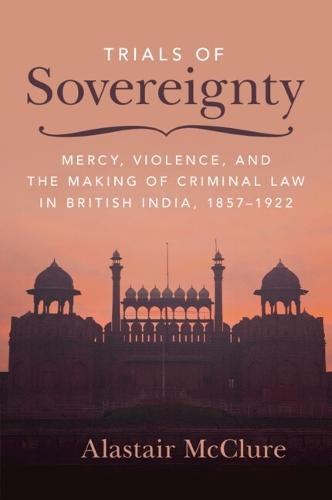
Full Product Details
Author: Alastair McClure (The University of Hong Kong)
Publisher: Cambridge University Press
Imprint: Cambridge University Press
ISBN: 9781009553513
ISBN 10: 1009553518
Pages: 384
Publication Date: 19 March 2026
Audience:
College/higher education
,
Postgraduate, Research & Scholarly
Format: Paperback
Publisher's Status: Forthcoming
Availability: Not yet available

This item is yet to be released. You can pre-order this item and we will dispatch it to you upon its release.
Reviews
'In this fresh and stimulating book, Alastair McClure explores the recalibrations of colonial rule which took place in the loop between calamitous violence and the exercise of mercy, between harsh punishment and its mitigation. We get a full sense of the impact of the 1857 rebellion on the codification of criminal law, and the accommodation in it of vast areas of judicial discretion to uphold both race privilege and unequal categories of colonial subjecthood. This is fine-tuned and rigorous scholarship, a major contribution to our understanding of colonial sovereignty in India and its unwinding.' Radhika Singha, author of A Despotism of Law: Crime and Justice in Early Colonial India 'Trials of Sovereignty offers a compelling history of the ensnaring promise of mercy and its rejection in colonial India. Breaking with the conventional idea that sovereignty was solely built on state violence, Alastair McClure traces how terror and mercy were wielded as related expressions of sovereign power in the courtroom. From the last Mughal emperor to Mohandas Gandhi, McClure's meticulous analysis of modern India's iconic political trials unearths mercy's fingerprints throughout colonial legal history. Because mercy was a crucial colonial tool for curtailing political rights and upholding a hierarchical social order, its rejection was pivotal to ideas of anti-colonial liberation. Trials prompts us to ask: who has the right to punish and by what measure? Posed as a question for the historian, McClure lays bare its significance to our unfinished present.' Bhavani Raman, author of Document Raj: Writing and Scribes in Early Colonial South India 'McClure argues that officials and judges in British India consistently offered reduced sentences and pardons for select subjects, which conferred the colonial state with greater legitimacy. But mercy was always a contested expression of sovereign power that risked exposing colonial weakness, and this vulnerability was gradually recognized by colonial subjects who deployed a range of legal and political strategies to interrogate state power and question the lofty promises of British colonial justice.' Howard S. Erlanger, Law & Social Inquiry
Author Information
Alastair McClure is an Assistant Professor in the Department of History at the University of Hong Kong. His research has appeared in History Workshop Journal, Law and History Review, and Modern Asian Studies.