Overview
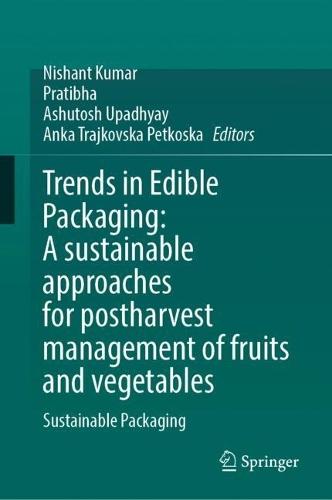
Postharvest losses of fruits and vegetables are a global concern, wasting about 1/3 of the total global production. The postharvest losses lead to increasing greenhouse gases in the environment and may have negative impacts on human health and on planetary wellbeing. Therefore, to overcome these issues, edible packaging in terms of coatings and films are an innovative postharvest management strategy, and help in the preservation of produces by extending the shelf life and quality of the packed items. Edible packaging is non-toxic, biodegradable in nature and generally recognized safe for the consumption. It is a good substitute for plastic and synthetic based packaging, glass, cardboard and metal that has direct impact on the environment and usually ends up polluting land zones and aquatics. More than 170 United Nation member countries are focusing on reducing the use of plastic and synthetic based packaging for food application in order to achieve the United Nations Sustainable Development Goals 2030, particularly SDGs 12 and 13 by reducing post-harvest losses and contributing in the reduction in 50% of food wastes. Therefore, the edible packaging has the ability to provide protection to produces which result in shelf life extension. Numerous types of natural plant and animal derived biopolymers such as polysaccharides, proteins, lipid and their composites, vitamins, nutrients, colorant, flavor agents and nanomaterials used to formation of edible coating for applications. The applications of edible coating provide barrier and UV protection for fruits and vegetables. There are many scientific concepts that have shown the efficiency of the biopolymer based edible coating for fruits and vegetables preservation by retarding the oxidation, water loss and microbial load. Trends in Edible Packaging: A sustainable approaches for postharvest management of fruits and vegetables studies the concept of edible coatings and its mechanism in preservation of fruits and vegetables. The book also provides detailed information about natural plant and animal derived biopolymers for edible coatings. The effects of incorporation of additives/active agents and nanomaterials on the functional properties of edible coatings/films are covered in full, as well as details about their control release mechanism. Chapters are dedicated to polysaccharides, proteins, lipids and composite (binary/ternary) edible coatings on fruits and vegetables. Edible film formation methods and coating deposition processes on the surface of the fruits & vegetables; sustainable approaches towards global SDGs, advantage and drawbacks of the edible coating are also covered extensively in this book.
Full Product Details
Author: Nishant Kumar ,
Pratibha ,
Ashutosh Upadhyay ,
Anka Trajkovska Petkoska
Publisher: Springer Nature Switzerland AG
Imprint: Springer Nature Switzerland AG
ISBN: 9783032131980
ISBN 10: 3032131987
Pages: 475
Publication Date: 21 February 2026
Audience:
Professional and scholarly
,
Professional & Vocational
Format: Hardback
Publisher's Status: Forthcoming
Availability: Not yet available

This item is yet to be released. You can pre-order this item and we will dispatch it to you upon its release.
Author Information
Nishant Kumar is a Research Associate at the National Institute of Food Technology Entrepreneurship and Management (Kundli), NIFTEM-K Pratibha is an Assistant Professor at the National Institute of Technology-Hamirpur Ashutosh Upadhyay is a Professor with the National Institute of Food Technology Entrepreneurship and Management (Kundli), NIFTEM-K Anka Trajkovska Petkoska is a Professor at St. Kliment Ohridski University-Bitola, Faculty of Technology and Technical Sciences-Veles, R. North Macedonia