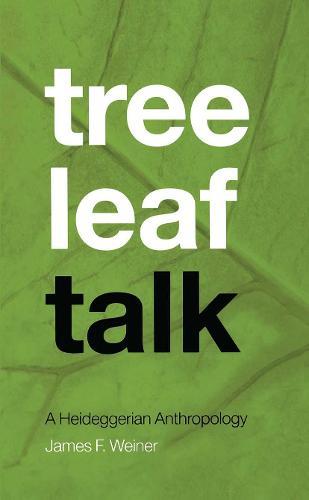
Full Product Details
Author: James F. Weiner (James Weiner passed away as advised by EA Katherine Ong who has been contacted by Alan Rumsey literary executor no other details yet sf case 01661663)
Publisher: Taylor & Francis Ltd
Imprint: Berg Publishers
Dimensions:
Width: 13.80cm
, Height: 1.60cm
, Length: 21.60cm
Weight: 0.453kg
ISBN: 9781859735015
ISBN 10: 1859735010
Pages: 206
Publication Date: 01 October 2001
Audience:
College/higher education
,
General/trade
,
Tertiary & Higher Education
,
General
Format: Hardback
Publisher's Status: Active
Availability: In Print

This item will be ordered in for you from one of our suppliers. Upon receipt, we will promptly dispatch it out to you. For in store availability, please contact us.
Reviews
'What are the limits of relationship? What bounds the scope of imagination? Blending his ethnographic experience among the Foi of Papua New Guinea with his personal reading of the philosophy of Martin Heidegger, Weiner seeks the wellsprings of art and social life in the tension between revelation and concealment. In a world bedazzled by the glitz and speed of telecommunications, bathed in a phantasmagoria of ephemeral images, it is easy to think that reality can be whatever we choose to make of it. In the fashionable doctrine of social constructionism, anthropology has succumbed to this temptation. Tree Leaf Talk bursts the constructionist bubble. The book is a passionate appeal for a rigorously down-to-earth anthropology, rooted in the slow, pedestrian rhythms of day-to-day activity through which experience, history and meaning are sedimented in the land.' Tim Ingold, University of Aberdeen 'Freed from the descriptor, 'A heideggerian Anthropology', Tree leaf talk can then be read as a careful demonstration of the power of something like 'an allegorical anthropology'. University of Technology Sydney 'A powerful, dense and vital contribution to anthropology.' Journal of the Royal Anthropological Institute 'Weiner's questions, his ethnographic approach, and his particular synthesis of others make this book central to all concerned with symbolic analysis, with the process whereby human lifeworlds are constituted, and with what this tells us about what it is to be humans in different historical and cultural moments.' James Leach, Department of Social Anthropology
'What are the limits of relationship? What bounds the scope of imagination? Blending his ethnographic experience among the Foi of Papua New Guinea with his personal reading of the philosophy of Martin Heidegger, Weiner seeks the wellsprings of art and social life in the tension between revelation and concealment. In a world bedazzled by the glitz and speed of telecommunications, bathed in a phantasmagoria of ephemeral images, it is easy to think that reality can be whatever we choose to make of it. In the fashionable doctrine of social constructionism, anthropology has succumbed to this temptation. Tree Leaf Talk bursts the constructionist bubble. The book is a passionate appeal for a rigorously down-to-earth anthropology, rooted in the slow, pedestrian rhythms of day-to-day activity through which experience, history and meaning are sedimented in the land.' Tim Ingold, University of Aberdeen 'Freed from the descriptor, 'A heideggerian Anthropology', Tree leaf talk can then be
'What are the limits of relationship? What bounds the scope of imagination? Blending his ethnographic experience among the Foi of Papua New Guinea with his personal reading of the philosophy of Martin Heidegger, Weiner seeks the wellsprings of art and social life in the tension between revelation and concealment. In a world bedazzled by the glitz and speed of telecommunications, bathed in a phantasmagoria of ephemeral images, it is easy to think that reality can be whatever we choose to make of it. In the fashionable doctrine of social constructionism, anthropology has succumbed to this temptation. Tree Leaf Talk bursts the constructionist bubble. The book is a passionate appeal for a rigorously down-to-earth anthropology, rooted in the slow, pedestrian rhythms of day-to-day activity through which experience, history and meaning are sedimented in the land.'Tim Ingold, University of Aberdeen'Freed from the descriptor, 'A heideggerian Anthropology', Tree leaf talk can then be
Author Information
James F. Weiner is Visiting Fellow, Department of Anthropology, Research School of Pacific and Asian Studies, Australian National University