Overview
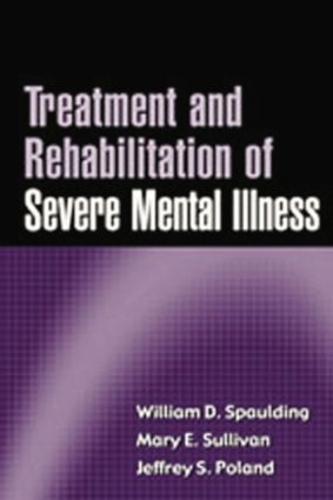
Synthesizing the growing body of biomedical and psychosocial research on the nature and treatment of severe mental illness, this volume presents an innovative framework for planning and implementing effective rehabilitation services. An integrative model of case formulation is described that conceptualizes the individual's recovery on multiple levels: physiological, cognitive, interpersonal, behavioral, and environmental. The authors draw on outcome research and extensive clinical experience to identify interventions of known effectiveness, including psychopharmacology, functional assessment, behavioral analysis, and cognitive therapies. Outlining a comprehensive approach to assessment, treatment, and progress evaluation, the book also provides practical recommendations for program development and staff training.
Full Product Details
Author: William D. Spaulding ,
Mary E. Sullivan ,
Jeffrey S. Poland
Publisher: Guilford Publications
Imprint: Guilford Publications
Dimensions:
Width: 15.20cm
, Height: 2.70cm
, Length: 22.90cm
Weight: 0.662kg
ISBN: 9781572308411
ISBN 10: 1572308419
Pages: 386
Publication Date: 27 March 2003
Audience:
College/higher education
,
Professional and scholarly
,
Undergraduate
,
Postgraduate, Research & Scholarly
Format: Hardback
Publisher's Status: Out of Print
Availability: Awaiting stock

Reviews
Spaulding et al. compellingly argue that the adoption of a new, integrated model of treatment is long overdue, particularly when dealing with severe mental disorders. This book provides a framework that is at once theory-driven, based in the cumulative findings of outcome research with the severely mentally ill, and firmly grounded in the authors' long history of work in the field. Presented is a truly pragmatic approach that, if successfully applied, promises to considerably enhance service provision to this challenging population. I strongly recommend this book for mental health policymakers, clinicians, and researchers. Graduate psychology students, especially those in psychopathology or clinical interventions courses, will find the book's integration of theory and sound practice guidance to be of immense utility. --Morgan T. Sammons, PhD, Mental Health Department, Naval Medical Clinic, Annapolis, Maryland <br> Every student, scientist, and practitioner who wants to know where psychiatric rehabilitation is headed needs to read this book. The authors, national leaders in psychopathology and rehabilitation, combine their intellectually varied backgrounds to bring clarity to the confusion and disagreement that characterize current practices in psychiatric rehabilitation. The book's remarkably satisfying synthesis provides the scientific foundation for an action agenda for 21st century psychiatric rehabilitation. A biosystemic paradigm is used to give logical coherence to clinical assessment, formulation, and rehabilitation planning. So comprehensive is the authors' approach that they are able to conclude with a detailed algorithm for treatment and rehabilitation of schizophrenia. This book is an invaluable source of scholarship, clinical insight, and practical advice for anyone who seeks to understand disabling mental illness and to improve the lives of those who face its daily challenge. As a text, it will be suitable for graduate students in psychology or reha
.,. this book is recommended for clinicians who would like an historical overview of the changes in mental health services and approaches to patients with severe mental illness, as well as the presentation of one useful treatment model. /m-/[ital]Bulletin of the Menninger Clinic[/ital] (Susan Romanelli in Volume 69, Number 2, Spring 2005) <br> Excellent....Psychiatric rehabilitation is in dire need of a comprehensive framework to expand its field. This book, in my opinion, is fulfilling these needs. It presents an up-to-date and detailed overview of the rehabilitation and treatment of people with severe mental disorders....This book is a major work and clearly presents what psychiatric rehabilitation has to offer at its best. The authors have much experience and tremendous expertise in the field of rehabilitation. This book will serve as a core text for courses in psychiatric treatment and rehabilitation of those with severe mental illness. It summarizes the actual state of knowledge regarding this relatively new field of psychiatry. This text is well written in clear and practical language....The price is reasonable for the amount of knowledge it provides, and the text represents a good investment for those who treat patients with severe disabilities or who are interested in developing more rehabilitation interventions. -- The Canadian Journal of Psychiatry <br> The authors of Treatment and Rehabilitation of Severe Mental Illness have succeeded in formulating an integrated model that will be useful to students and to professionals who provide mental health services to persons with severe mental illness. -- Psychiatric Services <br>.,. an enormous amount of information on thescience that underlies a comprehensive view of serious mental illness and its treatment....The work that neuropsychologists have been doing for the past three decades to clarify neurocognitive malfunctioning is most impressive as it is presented here. -- American Journal of Psychiatry <br> This is a most informative and well-thought-through book...the quthors...have clearly a job worth doing well, and they have done it well. It's essential reading for anyone in the helping profession, a most disabling field, and is a wealth of definitive information for us all. -- Metapsychology <br> Treatment and Rehabilitation of Severe Mental Illness is that all-too-rare example of a book that is both informed by rigorous research and inspired by clinical experience. The authors provide an innovative framework for planning and implementing effective clinical services for people with severe psychiatric disabilities....this book should serve as an effective tool in disseminating the technology of psychiatric treatment and rehabilitation to a new generation of practitioners working with the most severely and persistently mentally ill. -- Psychological Medicine <br>
Author Information
William D. Spaulding, PhD, received his doctorate in clinical psychology at the University of Arizona in 1976. He completed a postdoctoral fellowship in mental health research and teaching at the University of Rochester School of Medicine and Dentistry. Dr. Spaulding is currently Professor of Psychology in the Clinical Psychology Training Program, Department of Psychology, University of Nebraska/n-/Lincoln, and a Clinical Psychologist in the Community Transition Program, Lincoln Regional Center. Mary E. Sullivan, MSW, received her masters in social work from Syracuse University in 1978. She also received a certificate in health studies from the Maxwell School of Citizenship and Public Affairs, Syracuse University, in 1978. She is currently Program Director of the Community Transition Program, Lincoln Regional Center, and Adjunct Clinical Assistant Professor in the Department of Psychology, University of Nebraska/n-/Lincoln. Jeffrey S. Poland, PhD, received an MA in clinical psychology from Southern Connecticut State University in 1982 and a doctorate in the philosophy of science from Massachusetts Institute of Technology in 1983. He has held positions at Colgate University and the University of Nebraska/n-/Lincoln, and he currently teaches in the Department of History, Philosophy, and Social Science at the Rhode Island School of Design. Dr. Poland has published articles on such topics as the unity of science, psychiatric classification, and psychopathology.