Overview
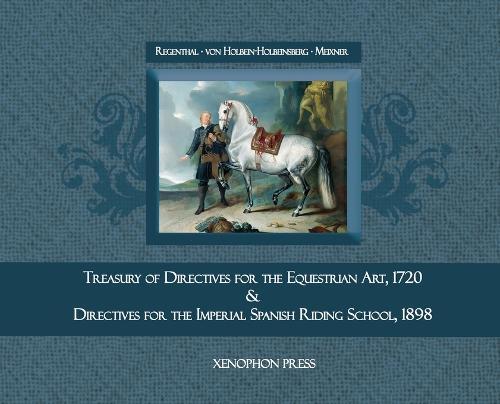
Every so often, a true treasure rides out of history and into our hands. Johann Christoph Regenthal-Chief Rider of the Imperial Riding School from 1709 to 1730-left such a treasure: concise directives for schooling horses and riders at the heart of the Habsburg court. Long unprinted and nearly lost, his manuscript survived only as a single leather-bound copy in German cursive. After almost three centuries in the wings, it returned to the arena in 1996 when Dr. Bertold Schirg prepared a side-by-side transcription, and Olms Verlag brought it once more to light.
Full Product Details
Author: Johann Christoph Von Regenthal ,
Franz Holbein-Holbeinsberg ,
Johann Meixner
Publisher: Xenophon Press LLC
Imprint: Xenophon Press LLC
Dimensions:
Width: 27.90cm
, Height: 1.30cm
, Length: 21.60cm
Weight: 0.712kg
ISBN: 9781948717656
ISBN 10: 1948717654
Pages: 130
Publication Date: 21 October 2025
Audience:
General/trade
,
General
Format: Hardback
Publisher's Status: Active
Availability: Available To Order

We have confirmation that this item is in stock with the supplier. It will be ordered in for you and dispatched immediately.
Author Information
Under Emperor Charles VI (1711-1740), Austria reached not only its widest territorial extent but also its highest refinement in the equestrian arts. Among those responsible for this cultural ascendancy stood Johann Christoph Regner, Edler von Regenthal - Oberbereiter to three emperors and mentor to some of the greatest riders of the eighteenth century. His pupils included Emperor Charles VI himself, Francis Stephen of Lorraine (later Emperor Francis I), and the celebrated Baron von Eisenberg, who spread his fame throughout Europe.Regenthal's contemporaries spoke of a rider ""without the slightest visible movement,"" whose horses performed with perfect unity and freedom, ""as if they executed the schools of their own accord."" His mastery rested not on force but on invisible harmony - a philosophy that shaped the Viennese tradition for generations.After half a century of service, Regenthal sought to preserve his knowledge in a Compendium, a work based solely on practical experience rather than borrowed theory. Though he died in 1730 before publishing it, his manuscript endures as a unique testimony to Austria's independent school of classical horsemanship - one that developed without direct French influence.Rejecting the harsh curbs and monstrous saddles of earlier centuries, Regenthal advocated humane training grounded in balance, patience, and precision. The cavesson, in his view, was indispensable for developing flexibility; draw reins and elaborate bits were ""monstrous inventions."" He demanded a natural, upright seat - the same still seen today at the Spanish Riding School - and he taught that obedience must be achieved ""through gentleness, measure, and intelligence.""His methods culminated in the advanced schools over the pillars, in movements such as the shoulder-in (""head in, haunches out""), the redopp, and the levade, all executed only when the horse was strong, balanced, and calm. Always he warned: ""Harshness destroys what gentleness may achieve.""Although later historians credited Guérinière and Pluvinel as founders of the Viennese style, Regenthal's art had already reached a level his contemporaries believed ""perhaps still unknown in France."" His Compendium stands as a rare document of that golden age - a legacy of measured elegance and moral clarity.To rule the horse without violence, Regenthal taught, is the nobility of our art.